

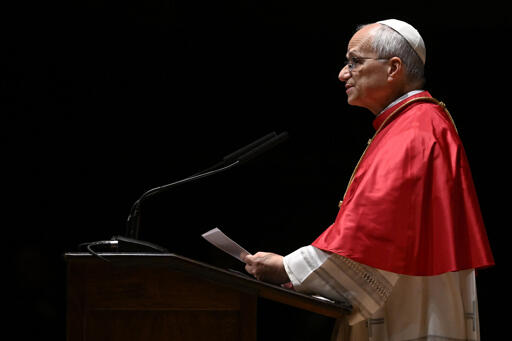
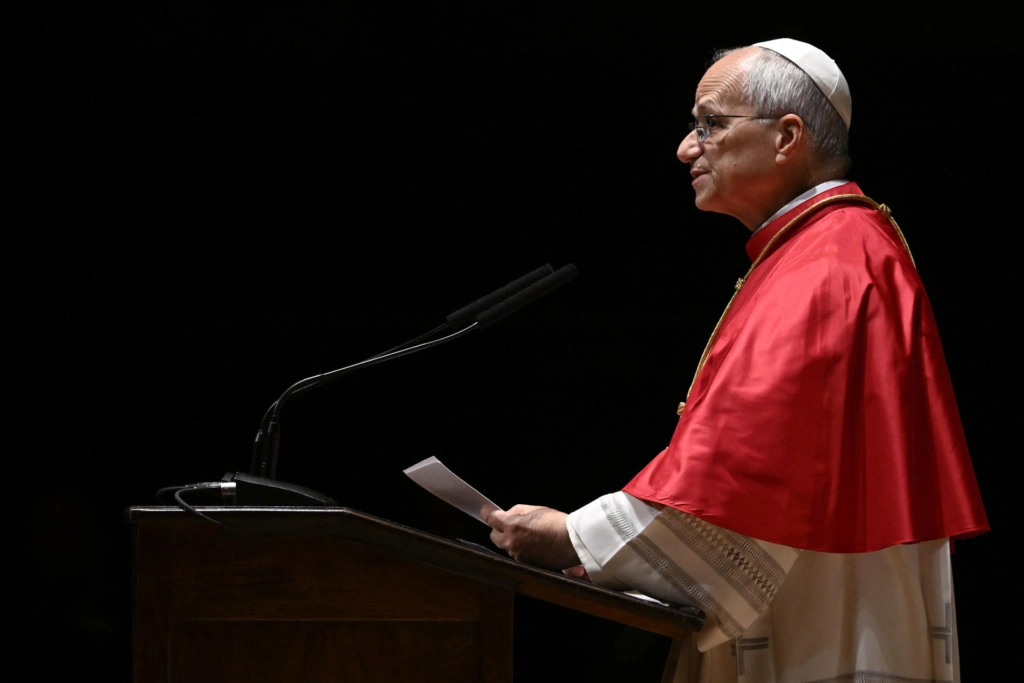
The pontiff addressed corruption, economic development, labor, education and artificial intelligence during his first official speech in Argentina.
Pope Leo XIV called for greater institutional integrity and stronger public trust in Argentina on Sunday, warning that corruption undermines confidence in public institutions during his first official address of his apostolic visit to the country.
RELATED: Leo XIV Arrives in Argentina, the First Papal Visit in Almost 40 Years
The pontiff delivered his speech at the Palacio Libertad in Buenos Aires, where he appeared alongside President Javier Milei at the main institutional reception of his visit.
The event brought together representatives from across Argentina’s political and social spectrum, including Cabinet ministers, lawmakers, provincial governors, judges, business leaders, diplomats and former President Mauricio Macri.
Leo’s address followed a private meeting with Milei at the Casa Rosada and a ceremony in which Buenos Aires Mayor Jorge Macri presented him with the keys to the city.
The pope addressed a range of issues, including economic policy, employment, abortion, sustainability and artificial intelligence. He also called for improvements in education.
Before the pontiff spoke, Milei delivered a brief welcome, highlighting the national unity surrounding the event and paying tribute to his predecessor, Pope Francis, whom he described as “the most important Argentine in history.”
Leo’s address marked the central institutional engagement of his apostolic visit to Argentina, bringing together the country’s political leadership and representatives of its social and economic sectors.
Pope Leo XIV’s Full Speech at Palacio Libertad in Argentina
Mr. President of the Republic, distinguished authorities and members of the diplomatic corps, ladies and gentlemen,
I am deeply pleased to be here today in this beloved land of Argentina. Mr. President, I thank you for your kind words and for the warm welcome that, through you, your people have extended to me. I also greet the members of the diplomatic corps and the other authorities present here, and I extend my heartfelt greetings to all Argentinians.
I have come as the successor of the Apostle Peter and, therefore, as a pastor. I wish to meet with the Church that journeys through this land and also to address the entire nation and those entrusted with the responsibility of serving it. The Church accompanies the lives of peoples through the mission entrusted to her. For this reason, she wishes to offer those who hold public office a message inspired by the Gospel and directed toward safeguarding the dignity of every person, harmony and the common good.
My arrival in this land has a particular meaning for me. For twelve years, the universal Church listened to the voice of an Argentine pontiff who carried with him, in his memory and in his heart, the places, the people and the faith he had received here.
Today, as I succeed him in the Petrine ministry, I am, in a certain sense, retracing that journey in the opposite direction. I come to the homeland where Pope Francis began a story that would later become intertwined with the entire Church. To approach the land where he grew up is also to approach a much broader history, made up of generations of men and women who, before and after him, received this homeland and left something of themselves in it.
Some were born here, while others arrived from far away and found a home. Others belong to Indigenous peoples whose presence predates the birth of the nation. From this encounter between different origins and experiences, a people gradually took shape, one that has known how to open its doors, make room for those who arrived and preserve, even in difficult times, a remarkable ability to rise again and move forward. All have contributed to the Argentina I am joyful to visit today.
No generation begins its homeland from scratch. It receives it. It receives it in a language and in bonds that precede it, in institutions founded by others and in resources that have grown through the work of many. History holds reasons for gratitude, but also painful memories.
Each generation must discern what deserves to be preserved, confront the unjust consequences of the past and increase the common material and spiritual heritage. The homeland now in your hands will tomorrow become the inheritance of others.
Culture offers some of the most distinctive expressions of that heritage. Argentina has found a way to express itself in a recognizable voice far beyond its borders. This is evident in José Hernández’s Martín Fierro, in the pages of Jorge Luis Borges and in the works of so many writers who have enriched the Spanish language with the accents of the Río de la Plata region. It is also evident in tango, born from the encounter of different neighborhoods, ports and origins. Argentina has expressed itself in the music and traditions of its interior, in its theater and in everyday gestures as simple as sharing mate, which turns a pause into an opportunity for conversation and closeness.
These are different expressions of the same collective memory, received from previous generations and entrusted to the creativity of those who come after them. Christian faith is deeply rooted in this heritage. Its imprint runs through the nation’s memory and remains alive in countless Argentinians who have found in the Gospel a source of meaning, hope and fraternity.
Sharing the same inheritance also requires learning to live together, even when differences of thought exist. History teaches us how much a people can grow when its differences become an opportunity for dialogue and encounter. For this reason, democracy also belongs to that heritage which must be safeguarded.
Choosing one’s own leaders through the ballot box, participating in public life, freely expressing one’s convictions, trusting in the law and recognizing institutions as a common space are all benefits that grow stronger over time and that each generation is called to protect and strengthen. Democracy is also strengthened by the way we act every day in public life, by our willingness to listen, by the care we take with our words, by the patient pursuit of agreements and by our ability to recognize in someone who thinks differently a fellow citizen with whom we share the same destiny. In this way, trust is built, allowing a society to confront its differences without losing awareness of what holds it together.
Those entrusted with public responsibilities have a particularly demanding task. Authority reaches its highest purpose when it is exercised as service, when it knows how to look beyond immediate concerns and when it places its abilities at the service of what belongs to everyone. Those who exercise authority also have a duty to act prudently, recognize the limits of the power entrusted to them and direct their decisions toward the good of the entire community. The common good that authority serves must also be evident in the concrete conditions of everyday life.
The family, the basic unit of society, occupies an essential place here. Within the family, each person learns to discover that their life is connected to the lives of others and that they are also responsible for them. At home, we learn to care for the weak, to forgive, to share and to remain alongside those who need help. It is also there that many men and women receive the first seeds of faith.
For this reason, one of the most fundamental conditions is being able to live from one’s own work. This land knows well the value of the efforts of those who earn their living in the countryside and in cities, in workshops, schools and hospitals, of those who undertake businesses and of those who sustain their households every day. Work allows a person to provide for their family, develop their abilities and recognize themselves as a participant in building their homeland.
Therefore, everything that creates opportunities, encourages private initiative and allows growth to reach those facing greater difficulties should be supported. I think particularly of families carrying the burden of uncertainty, of those seeking work, of older people who have contributed for years to building society, and of those who, even though they work, struggle to meet their household’s needs. The economy must serve the person, not the person serve the economy.
Argentina possesses considerable human resources. Making that wealth flourish for the benefit of all requires particular attention to young people. The opportunities they find today will largely determine whether they can develop their life plans here. A nation must seriously ask itself what it has failed to do when its young people have to leave their homeland to fulfill their dreams.
Creating the conditions for them to freely build their lives in Argentina requires particularly strengthening education, vocational training, universities and research. Throughout its history, this nation has sought to extend education to increasingly broad sectors of society. Thanks to that effort, generations of Argentinians have been able to develop their abilities and contribute to the country’s progress through a wide range of trades and professions. Preserving and strengthening this educational vocation requires offering young people an education that allows them to discover their talents, develop them and put them at the service of others.
This task also requires trusting young people, recognizing their ability to take initiative and opening spaces where they can contribute their ideas and assume responsibilities. The nation needs their intelligence, creativity and participation now. This vision raises another question: What place do those who have not yet been born occupy in our decisions?
Before asking ourselves what kind of world we will leave them, we must recognize their dignity. Our responsibility toward future generations begins with welcoming life from its earliest moments and protecting it until its natural end. The same dignity demands special attention in illness, dependency and disability.
Even then, we must care, alleviate suffering, accompany people and make each person feel that their life always retains a value that no circumstance can diminish. This responsibility toward humanity also concerns the care of the earth.
Argentina has been blessed by God with extraordinary natural wealth. Its fields, water reserves, energy sources, minerals and diverse ecosystems offer broad opportunities for development. A genuinely human ecology knows how to unite care for creation with care for people, ensuring that the use of these resources contributes to the well-being of communities and preserves the conditions that make life and work possible in their territories.
Rapid technological advances are also opening possibilities that, only a few years ago, could scarcely have been imagined. They also raise far-reaching questions, particularly concerning artificial intelligence. Medicine, education, production and research now have tools capable of profoundly transforming human life. These advances require us to consider the consequences of their application and the responsibilities of those who decide how to use them. Technological development needs an ethical awareness equal to its challenges.
Many of these responsibilities extend beyond the jurisdiction of a single state. Great rivers connect territories, ecosystems extend from one country to another, and energy, food, knowledge and human movements create bonds that cross borders. Thinking about Argentina’s future therefore also means looking toward the peoples with whom it shares this continent.
South America possesses great human and natural wealth, and its peoples share historical ties and cultural traditions that offer extensive opportunities for cooperation. Argentina can contribute to this effort through its experience and capabilities. Strengthening spaces for dialogue and collaboration is a way of taking on together responsibilities that no country can address alone.
Such cooperation is equally necessary in confronting serious threats: organized crime, human trafficking, arms and drug trafficking, as well as corruption, damage social coexistence, fuel violence and divert resources needed for the common good. In the face of these realities, coordinated action among states and strong institutions are indispensable. That strength also depends on the personal integrity of those entrusted with governing, because corruption erodes citizens’ trust in their institutions.
This common effort finds one of its highest expressions in the service of peace. The legitimate interests of each nation must be defended through dialogue, respect for the law and the persistent pursuit of agreements. South America has found ways, at difficult moments in its history, to negotiate and reach understanding in order to overcome serious tensions. Argentina is called upon to preserve this commitment to dialogue and contribute to ensuring that it continues to bear fruit.
The Church also wishes to contribute to this shared responsibility. The Church’s presence in Argentina forms part of a history that extends throughout the Americas. For centuries, the Church has accompanied the peoples of the continent by proclaiming the Gospel and celebrating the faith, educating, caring for the sick, remaining alongside the poor, accompanying families and promoting peace and reconciliation.
This mission is born of the love of Christ, who shed his blood for all and continues today in parishes and communities called to keep their doors open so that every person may find welcome and closeness. In a few words, it expresses the universal invitation of the Gospel, which reaches every person and calls them to encounter Christ and conversion. From this welcome comes the sending forth. Go and proclaim.
That command continues to bear fruit in schools and universities, in social initiatives and in the everyday witness of so many men and women who place their faith at the service of others. There are goods that society needs and that no public policy can produce on its own. Trust, forgiveness, a willingness to serve and the awareness that one’s life has a meaning beyond success or usefulness are cultivated in personal conscience and in the life of families and communities. Faith nourishes and sustains these goods.
For this reason, the Church wishes to remain close to the Argentine nation, to live out charity by sharing its burdens and joys, and to offer it the hope born of the Gospel.
As I look back on the path this nation has traveled, the image that has accompanied these words returns. Each generation receives a homeland that others have placed in its hands. For a time, it is entrusted with inhabiting it, serving it and helping it grow. Then it must hand it over.
Yes, as Gardel sang, life is but a breath, but goodness endures. The goodness that each generation has been able to protect and pass on endures. And faith invites us to look even further, toward the eternal happiness to which God calls us.
Dear Argentinians, an important part of that responsibility rests in your hands today. The extraordinary heritage you possess allows you to look toward the future with confidence. It is now your responsibility to make fruitful everything you have received and keep alive the purpose of achieving national unity proclaimed in the preamble to your Constitution. May those who come after you receive a united homeland worthy of its history and of the possibilities it holds.
My thoughts finally turn to Our Lady of Luján, the silent guardian of your memory. Generation after generation, mothers and fathers, workers, young people and older people from every corner of the country have come before her image, carrying with them the concerns and hopes of their time.
Today, I wish to join my own prayer to theirs, and I want to do so with the words Pope Francis spoke while thinking of you: May the Lord help you grow as a people.
I ask this of the Lord from my heart, through the intercession of Mary Most Holy of Luján. May she continue to watch over this land, care for each of her children and always keep them close to Jesus.
May God bless Argentina and all its inhabitants.
Thank you very much.
From teleSUR English via This RSS Feed.