

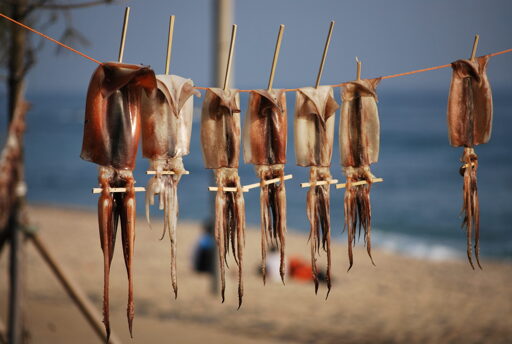
SEOUL — Many South Koreans remember days when squid was inexpensive, everyday food: Stir-fried with spicy chili flakes, steamed in a bath of water and soju, or dried and eaten as a bar snack along with a pint of ice-cold beer. Kim Tae-won, a professor at the Department of Ocean Sciences at South Korea’s Inha University, recalled when he was in high school in the 1990s, “squid was one of the major fishery resources in Korea’s East Sea.” “It was abundant, affordable and a familiar part of everyday meals,” he told Mongabay. But squid prices have skyrocketed in South Korea. One reason is that the country’s squid catch has been declining dramatically, with the current volume only one-sixteenth of that in 2002, according to the country’s national statistics service. Between 2023 and 2025, South Korea’s most prominent fisheries did not produce even 10% of the annual squid catch recorded in the peak production year of 1999, when roughly 225,122 tons of squid were caught from the Korean Peninsula’s surrounding seas. Pacific flying squid (Todarodes pacificus) drying at Daepo Port. Image by Bernard Gagnon via Wikimedia Commons (Public domain). A new study, published in the journal Communications Earth & Environment in October, gives a worrying prediction. It estimates that by the 2040s, South Korea will become “a zero-catch state” for the Pacific flying squid (Todarodes pacificus), the country’s most popular squid species, due to climate change and marine heat waves. Researchers at Pukyong National University (PKNU) in Busan cross-examined fishery…This article was originally published on Mongabay
From Conservation news via This RSS Feed.