

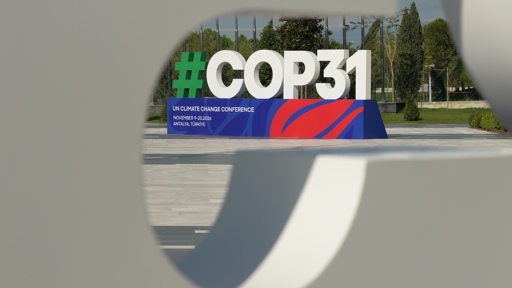
World leaders convene in Antalya, Turkey, on Monday for the United Nations’ 31st Conference of the Parties, or COP31, after another year of deadly climate disasters. Forest fires in Canada, Indonesia, and Brazil impacted millions of people. Heat waves contributed to more than 50,000 deaths in Europe. Floods prompted by the collapse of a melting glacier killed more than 1,500 people in Nepal and caused nearly $5 billion in damages.
And things may only get worse. This will be the first COP since the U.N.’s sobering report on the inevitability of breaching 1.5 degrees Celsius (2.7 degrees Fahrenheit) of global warming. That temperature target was a focal point for climate ambition even before the landmark 2015 Paris Agreement, with scientists warning that exceeding that benchmark could push the planet past dangerous tipping points, triggering climatic changes that may be impossible to reverse.
Despite the urgent need for action, few expect COP31, co-hosted by Turkey and Australia, to produce another breakthrough like the Paris Agreement or COP28’s call to transition away from fossil fuels.
“There’s a whole bunch of decisions that have to be taken, but none of them on their own is going to make headlines,” said Kaveh Guilanpour, vice president of international strategies for the nonprofit Center for Climate and Energy Solutions.
This is in part due to the nature of the negotiations. This year’s event is being referred to as an “implementation” COP, where countries will focus on fleshing out existing commitments under the Paris Agreement rather than making sweeping new ones. The bulk of the official agenda aims to chip away at workstreams that began last year or at previous meetings.
But it’s also related to the state of the world. Although the historic “blue wave” in the midterm election means Democrats could curb the Trump administration’s rollback of federal climate policy, the global outlook remains bleak. Wars and economic turmoil continue to strain multilateral negotiations, and many wealthy countries have limited international aid. “In the current geopolitics, just delivering on housekeeping is news in itself,” Guilanpour said.
Here’s what to watch for.
The ‘housekeeping’ COP
Much of the agenda involves the less visible work of assessing where things stand and putting previous agreements into practice. Countries are set to discuss, for example, the beginning of the next “global stocktake,” the assessment of climate progress that takes place every five years under the Paris Agreement.
They’ll also talk about ways of measuring progress toward the “global goal on adaptation” that delegates agreed to last year in Brazil, and they’ll consider whether to extend a “mitigation work programme” that kicked off in 2022 to encourage faster and more extensive emissions reductions in line with international climate targets.
Countries are also expected to formally create the “just transition mechanism” discussed last year. Broadly, it will aim to boost international coordination and support for a transition away from fossil fuels — for example, by providing job retraining for those employed in the oil and gas industry, or transferring carbon-free technologies from rich countries to poor ones.
“This is a sort of roll-up-your-sleeves-and-get-work-done COP,” said David Waskow, International Climate Initiative director for the World Resources Institute.
Where’s the money?
Climate finance has been a “perennial” discussion, said Jennifer Allan, a senior lecturer in international relations at Cardiff University, and this year wealthy countries will face renewed questions about funding they’ve pledged but failed to deliver.
August’s catastrophic flooding in Nepal illustrates the scale of the problem. Last month, the disaster triggered the first allocation from the U.N. Fund for Responding to Loss and Damage. Yet the $21.6 million payout was not even 1 percent of the damages the country sustained.
The fund itself has little more to offer. About $826 million has been pledged to underwrite it, but only some $450 million has been delivered.
Developing countries successfully lobbied for a “work stream” on climate finance in the COP31 agenda. This could give delegates an opportunity to discuss aligning existing financial flows with climate action and to flesh out a vague promise they made last year to triple adaptation financing by 2035.
But many of the world’s richest countries have curtailed international aid in response to growing energy insecurity, high inflation, global conflict, and other factors. The Trump administration has effectively cut all international climate finance, and Guilanpour said the remaining donor nations “unfortunately just wouldn’t support an increase in climate finance.” A memo circulated among European Union members made clear that there is “no appetite” for committing more money.
Fossil fuels in a post-1.5 future
It took nearly 30 years, until COP28 in 2023, for the conferences to even mention “fossil fuels,” let alone commit to transitioning away from them. But at last year’s meeting in Brazil, delegates failed to make any new commitments on how they’d do it.
Observers hope COP31 will address that unfinished business and the new post-1.5 degree climate reality. Waskow said countries should “reaffirm the need to reduce emissions dramatically, but also ramp up what we’re doing on carbon removal from the atmosphere.”
Still, these issues — especially anything about fossil fuels — are unlikely to appear in the formal negotiating agenda. Turkey and Australia remain heavily invested in coal, oil, and gas, and Axel Michaelowa, an economist at the University of Zurich, said they lack the credibility needed for strong leadership. Turkey has instead promoted, as part of an “action agenda” that is also not on the negotiating schedule, a goal of electrifying 35 percent of the world’s energy consumption by 2035, up from 23 percent today. That is more palatable, Miachaelowa said, because it doesn’t specify that the electricity come from renewable sources.
Any of those high-level goals and statements could appear on the COP’s “cover decision,” a statement reached by consensus at the end of each conference. These texts often don’t represent legally binding treaty commitments but have political value, Waskow said, because they can serve as signposts for later negotiations. Battles over the decision’s final wording have in previous COPs led to dramatic, late-night battles over a single word.
Fixing the COPs
An outsize focus on headline-making decisions, however, may be part of the COPs’ broader problem. “We seem to be trapped in this one-year cycle of expecting a historic outcome … every year,” Guilanpour said.
“What we should be thinking about is a so-called ‘big COP’ every five years,” he added, referring to the cycle of stocktakes when countries are supposed to ratchet up their emissions-reduction commitments. Seen this way, COP31 is a prelude to COP33, when the next stocktake is scheduled to conclude.
Erika Lennon, a senior attorney for the nonprofit Center for International Environmental Law, said she often worries that the conferences are a sort of a “circus,” where countries emphasize flashy pledges over implementing their commitments. Still, she added, the U.N. process is the best we have, and there are several ways of making it more effective, including better decision-making protocols and stricter conflict-of-interest policies.
Rachel Cleetus, climate program director for the nonprofit Union of Concerned Scientists, said it’s “unfair” to place the blame for stagnation solely on the U.N. climate regime. Ultimately, she said, countries must carry out the emissions reductions that science says are needed.
“These kinds of large multilateral negotiations are just one part of what it will take,” Cleetus said. “Then countries have to go home and act on what they’ve promised.”
This story was originally published by Grist with the headline What to expect as world leaders gather for COP31 on Nov 9, 2026.
From Grist via This RSS Feed.