

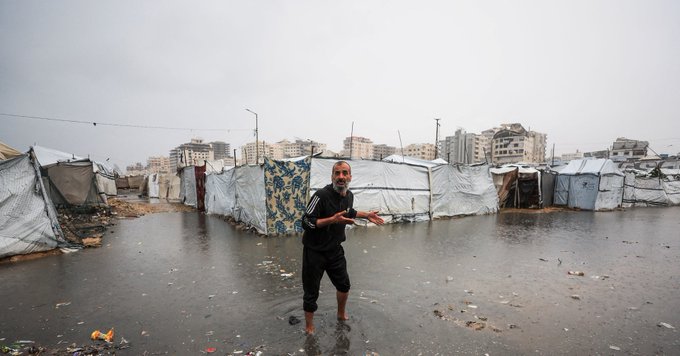
Thousands of tents remain blocked at crossings as heavy rains leave displaced Palestinians exposed and kill five, including three children.
Gaza authorities have demanded the urgent entry of shelter supplies after heavy rains and strong winds flooded makeshift shelters, leaving hundreds of thousands of displaced Palestinians exposed to the elements, while thousands of tents remain held at border crossings because the Israeli military is preventing their entry.
RELATED: Gaza Flooding Puts 950,000 Displaced Palestinians at Risk
Munir al-Bursh, director general of Gaza’s Health Ministry, issued an emergency appeal on Sunday for the immediate delivery of shelter materials and the reopening of crossings, as severe weather compounded the humanitarian crisis across the territory.
The storms have left around 350,000 displaced people sleeping outdoors after their temporary shelters were inundated, according to Gaza authorities. The Government Media Office reported that 70,000 tents had been flooded, while dozens of walls previously damaged by Israeli bombardment collapsed during the first 12 hours of the storm. Civil Defense said water levels reached 1.5 meters in some areas of displacement camps.
Video shows scenes of a sand cliff after it collapsed onto tents sheltering displaced families in Gaza. At least five people, including children, have been killed. pic.twitter.com/S6db4gsM3V
— Al Jazeera English (@AJEnglish) November 8, 2026
The weather emergency also caused deadly collapses in central Gaza. In Deir al-Balah, a landslide buried several tents sheltering displaced families, killing a woman and four children and injuring several others. Hospitals in Gaza confirmed the five deaths, while rescue teams continued searching for missing people beneath the rubble and mud.
Civil Defense spokesman Mahmoud Basal said the collapse occurred amid severe weather affecting the territory. Heavy rainfall and thunderstorms generated powerful currents through the streets, sweeping away tent coverings and flooding shelters, along with families’ belongings.
The scale of the emergency has overwhelmed rescue services. Gaza’s Civil Defense received 2,200 calls for assistance during the day but managed to respond to only 219.
Al-Bursh said thousands of tents remained stranded at crossing points because the Israeli military was preventing their entry into Gaza. Restrictions on shelter supplies, construction equipment and reconstruction materials have also hindered efforts to restore homes and infrastructure destroyed since the Israeli military campaign began in October 2023, he said.
Ver esta publicación en Instagram
Una publicación compartida por teleSUR English (@telesurenglish)
The health official called for immediate measures to protect children living in displacement camps, questioning the international response to their deteriorating conditions.
“Is the world waiting for our children to freeze?” he asked.
The emergency has compounded an already severe housing crisis. The Norwegian Refugee Council (NRC) estimates that 1.65 million people are facing a fourth winter in deteriorating tents and damaged buildings, amid continued Israeli restrictions and a shortage of international funding.
The United Nations Office for the Coordination of Humanitarian Affairs (OCHA) has reported that around 44,000 people are living in more than 2,300 buildings considered unsafe. In an assessment released in mid-October, the agency said more than 4,000 buildings across Gaza required full or partial demolition because of severe war damage.
The humanitarian crisis has also unfolded alongside continued Israeli military attacks. An Israeli drone strike targeted a group of civilians at the Al Qadisiya displacement camp in Khan Younis, southern Gaza, killing two people and injuring 12, according to the press release.
Gaza’s Health Ministry puts the death toll from Israeli military operations since Oct. 7, 2023, at at least 74,640, with another 175,947 people wounded. A ceasefire between Israel and Hamas took effect on Oct. 10, 2025.
From teleSUR English via This RSS Feed.