

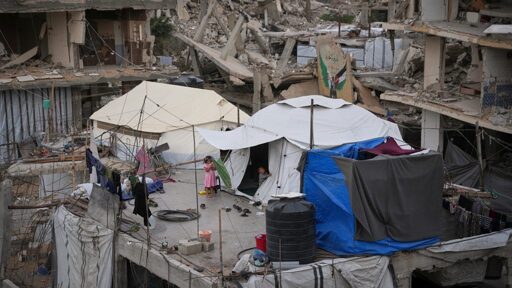

Two million people in the Gaza Strip have been forced by the Israeli military into an area covering approximately 30% of the territory. Now, with the onset of winter, Gazan families are not only facing constant displacement, but are facing flooding in their tents.
The “yellow zone” began to emerge gradually alongside the presence of the Israeli military. It encompasses areas near the Gaza-Israel border, stretching along the entire frontier from the north of the Gaza Strip to the south. As the war continued persisting into October 2025 this zone expanded significantly.
It now includes the entirety of Rafah, two-thirds of Khan Yunis in the southern Gaza Strip, as well as the eastern districts of cities in the central Gaza Strip and the eastern parts of the territory as a whole. Following the announcement of a ceasefire, the Israeli military has gradually extended its reach within this zone, placing yellow concrete blocks in areas adjacent to the “yellow line” and compelling residents to displace toward the western, coastal regions.
Despite it being a temporary ceasefire arrangement, the Israeli army has continued to shift concrete blocks and gradually push the “yellow line” westward toward populated areas (such as the Shuja’iyya, Tuffah, and Zeitoun neighborhoods, and the Maghazi refugee camp). Human rights organizations estimate that the area now under Israeli military control or restricted behind this line exceeds 70% of the Gaza Strip’s total territory.
Palestinians are prohibited from crossing this line or returning to their homes and agricultural lands located to its east; anyone who approaches it risks being directly targeted. This has led to repeated and ongoing waves of displacement for families, as well as a severe reduction in the space available for them to live.
Expanding the “Yellow Line”
This area was not as extensive when the ceasefire took effect in October of last year. Over the past year, however, various parts of the Gaza Strip specifically in the east have been gradually seized, expanding the “yellow line” under Israeli military control. Under the cover of night, the Israeli military places massive yellow concrete blocks; residents wake up to find these barriers in their neighborhoods, forcing them to search for yet another place to seek refuge. Recently, the military placed these blocks in the Al-Masdar area, east of Deir al-Balah in the central Gaza Strip.
Salem Al-Masdar, 45, a resident of the area, recounts: “A few days ago, the Israeli military advanced near our neighborhood. We heard the sounds of tanks and military vehicles, but we assumed it was a temporary operation that they were searching for something. It was a harrowing night for everyone; we lived through moments of sheer terror, as if the war were still raging. We waited for the military to withdraw and for the sun to rise so we could see what they had done. We didn’t dare leave our homes for fear of being shot. The next day, I heard neighbors screaming and went out to see what was happening. We discovered a yellow concrete block in the area, a sign that our lives were now in danger, as the Israeli military had brought this territory under its control.”
Salem could not articulate the shock he felt at having to search for a place to take refuge within an extremely cramped area, already packed with hundreds of thousands of displaced people. He viewed this as an injustice to be forced into such a situation even during a ceasefire, a time when their lives ought to be safe and free from the need for displacement.
Indiscriminate gunfire from within the “Yellow Line”
Fleeing the “Yellow Line” and its surrounding areas does not spare civilians from death. On the contrary, there is daily, indiscriminate gunfire originating from the “Yellow Line” zone, directed toward the tents and areas where civilians have sought shelter. Every day, people are reported wounded by these rounds, fired from Israeli military vehicles stationed along the “Yellow Line.”
Rima Harb, 35, from the Al-Mawasi area, says: “Every day, we hear the sound of tank shells and gunfire echoing through the air. A few days ago, a child from the camp was wounded while on his way to school. I am terrified for my children whenever they head to school; I make sure to accompany them. We live in fear of this indiscriminate gunfire; we never feel safe. Any one of us could be hit at any moment. It feels as though the army is everywhere, not just along the ‘Yellow Line,’ and the shelling continues unabated. We cannot walk the streets safely. Since the ceasefire began, we have never truly escaped the effects of the war; it is as if the conflict is still ongoing.”
She adds: “I constantly worry about my children what if one of them goes outside and gets struck by a bullet? I live in fear of hearing one of them scream; I find myself running toward any sound I hear in the camp. I am in a state of perpetual anxiety for their lives. I try not to dwell on such a possibility, yet I keep following the news, hoping that this suffering in Gaza might finally come to an end. Our lives remain under threat in every conceivable way. It is deeply distressing that the Al-Mawasi area in Khan Yunis is so overcrowded, especially with the persistent displacement orders issued as the ‘yellow zone’ expands. We simply want our children to live in safety.”
The “Green City” in Rafah – inside the “Yellow Zone“
Reports are circulating attributed to the Israeli military that there is a plan to begin constructing a “city” intended for the relocation of civilians. For the residents of Rafah who were forced to flee their city, which now falls within the restricted “yellow zone,” this news offers a glimmer of hope.
Aya Abu Al-Rous, a 38-year-old mother of three from Rafah, was forced to flee her home for the Al-Mawasi area. She describes her daily existence as a living hell, stating: “I have never been able to accept living in a tent, not even for a single day. I have been displaced here for three years, yet I still haven’t adapted. This life bears no resemblance to the life I once knew. I want to return to Rafah as soon as possible; I would be the first to agree to go back, under any circumstances even if it meant living under the control of the Israeli military.
This tent has stripped me of any privacy with my family. I cannot sleep, nor can I properly care for my children. It is freezing cold in the winter and sweltering, unbearable, in the summer. Every single day, I weep over the loss of my home and my city.”
She adds: “I have often wished that I had never left my home. I imagine myself back on the city streets; I long to take my children to their schools. Now, we are forbidden from returning, as those areas fall within the ‘yellow line’ a zone that cannot be crossed. We hear the sound of stray gunfire from Israeli tanks and snipers, which fills us with immense fear. My only desire is to keep my children safe until we can return to the city of Rafah. From the images we see, it has been reduced to total ruin, yet I still want to go back even if it means setting up a tent amidst the rubble. I cannot breathe here; I miss my city so deeply. This is a sentiment shared by all its residents, whose lives were upended by forced displacement.”
Two million Gazans are suffering because of the shifting “yellow line,” which poses a constant threat to their lives even when they are at a distance from it. This nightmare did not end with a ceasefire; rather, it has only worsened as the “yellow zone” expands and concrete barriers are shifted. Palestinians wait for the moment this nightmare will finally end, yet they have no idea when that might be.
From BT News via This RSS Feed.