

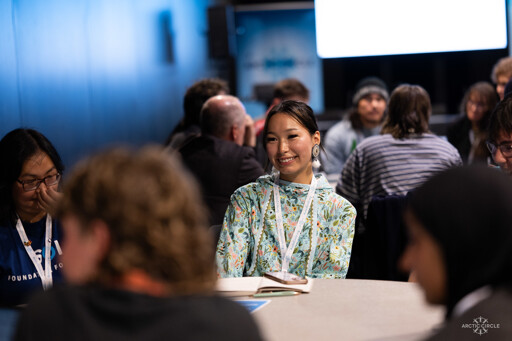

Frey Blake-Pijogge helps facilitate a workshop about “the Arctic we are building” on Oct. 9 — part of the Arctic Indigenous Youth Cohort at the Arctic Circle Assembly in Reykjavík, Iceland. Photo courtesy Oli Haukur Myrdal/Arctic Circle Assembly
The shaking of hands and small smiles welcome me to Reykjavík, Iceland. So does the rain.
I meet the rest of the Arctic Indigenous Youth Cohort the evening before the annual Arctic Circle Assembly starts, all of us tired after journeying from our many time zones that tightly span the planet’s North.
On the streets downtown, people are buzzing. Reykjavík feels alive. And everywhere in the city of nearly 150,000, I see signs about the global assembly, held from Oct. 8-10.

Federal Foreign Minister Anita Anand addresses more than 2,500 participants representing Arctic nations at this year’s Arctic Circle Assembly in Iceland from Oct. 8-10. Photo courtesy Oli Haukur Myrdal/Arctic Circle Assembly
Every October, the world’s northernmost capital city hosts the event, the largest annual gathering of its kind. Organizers say more than 2,500 people from 75 countries attended this year.
Over three days, participants take in the event’s more-than-200 sessions — including panel discussions, round tables, forums, and workshops, their topics ranging from climate change to Arctic sovereignty, military defence, arts, and more.
The Arctic Indigenous Youth Cohort program is run by the federal government’s Global Arctic Leadership Initiative.

Iceland hosted the three-day international assembly at Reykjavík’s Harpa Concert Hall and Conference Centre. Photo by Frey Blake-Pijogge
The next morning, I arrive at Harpa Concert Hall and take in the ambiance of the crowd: the space is brimming with loud laughter and the steady, excited talking of delegates.
We meet in the designated Youth lounge — each of us bringing their own perspectives and skills from around the Arctic. Our cohort includes Indigenous Youth from “Canada,” the “U.S.,” Greenland, Norway, Finland, and Sweden.

Participants attend a session on at the annual Arctic Circle Assembly in Iceland on Oct. 9. Photo courtesy Oli Haukur Myrdal/Arctic Circle Assembly
The first day of the assembly goes by in a blur, as I’m jet-lagged and still getting used to the three-hour time change.
I attend sessions on the geopolitics of polar climate research; one on why media coverage of the Arctic is the “final frontier in public interest reporting”; how the region today is seen through the eyes of Youth leaders; and short presentations by student researchers from fields of biology, law, language, children, and computer science.
All three days’ sessions are unique, yet echo similar themes.
It’s clear that Indigenous peoples are at the forefront of many of the international discussions.

An Oct. 9 session hosted by the Pulitzer Center brought media experts together to talk about ‘All eyes on the Arctic, the final frontier of public interest reporting.’ Photo courtesy Darryl Lyon

Graduate students from around the world present their Arctic research across academic disciplines. Photo courtesy Oli Haukur Myrdal/ACA
“Indigenous peoples have so much richness to offer,” said the Inuit Circumpolar Council’s international chair Aluki Kotierk, former president of Nunavut Tunngavik. “I think states realize that.
“Many Indigenous peoples from the Arctic … have been very instrumental in Arctic diplomacy, and even globally.”
For the rest of the assembly, whether meeting people outside of panels or at the Youth lounge, I feel a huge sense of awe to see how us Inuit from all around Inuit Nunangat are at the forefront of these urgent global discussions.

Youth at the Arctic Circle Assembly hold a discussion during the events. Photo courtesy Oli Haukur Myrdal/Arctic Circle Assembly
Another thing I notice is how powerfully Inuit are showing up at the event — representing our culture through our voices, leadership and perspectives, adorned with our beaded earrings, our silapak (pull-over top), our furs, and our kakiniit (tattoos) and tunniit.
Throughout the assembly, I meet people who are Sámi, Iñupiaq, Métis, Inuvialuk, Gwich’in — and from many other nations.

READ MORE: Indigenous leaders give the UN a roadmap for protecting their peoples
They fill me with a powerful sense of shared kinship I’ve not experienced anywhere else, except with other Indigenous people.
Simply put, I hold this kinship very dear to my heart.
Across the three days of panels and discussions, I meet people from across the Arctic — panelists and participants alike — who I found all share similar values towards the present and future of the Arctic.

During the Arctic Circle Assembly in Iceland on Oct. 9, Youth leaders meet with federal foreign affairs minister Anita Anand. Photo courtesy Global Affairs Canada/X
One core theme throughout the meetings is the environment — not only how it is being impacted by climate change, but also the predicted catastrophic collapse of the water current between the Atlantic and Arctic oceans.
The lands and waters that we hold so dear are facing the brunt of this rapidly worsening crisis, and each nation is deciding its own ways of adapting to meet this challenge head-on.

READ MORE: From the ashes of my father’s house: A memoir from COP28
Our love for our lands and waters transcends states’ colonial borders. And the survival of all peoples is reaching a frightening tipping point.
“We will not be spectators to our own future,” Greenland’s foreign affairs minister Múte Inequnaaluk Bourup Egede, formerly the territory’s youngest-ever prime minister, told attendees.
“Our future will not be decided around us, it will be shaped with us — our future, our voice, our choice.”

‘Greenland’s’ foreign affairs minister Múte Inequnaaluk Bourup Egede speaks at the assembly. Previously the territory’s youngest prime minister, he represents the Inuit Ataqatigiit party. Photo courtesy Oli Haukur Myrdal/Arctic Circle Assembly
Another topic that emerges again and again is culture and language, and how it’s so deeply connected to the lands and waters we live on.
I think about how my paternal grandma, Katie Pijogge, loved speaking Inuttitut with other fluent speakers. Her love for our culture and ways of life on the land were always so apparent in how she lived.

READ MORE: In a changing northern landscape, Inuit bear guards keep people safe in the wilderness
Arctic sovereignty and defence are also common subjects, as the polar region is being developed more and more rapidly — and increasingly at the heart of global superpowers’ military and economic ambitions.
“The Arctic is changing strategically, economically, and environmentally,” said Adm. Giuseppe Cavo Dragone, NATO’s Military Committee chair, in a keynote speech.
“This change is happening at an unprecedented pace … it is becoming a new frontier that creates additional room for geopolitical competition.”

Frey Blake-Pijogge, right, listens to an Arctic Circle Assembly speaker alongside other Youth. Photo courtesy Oli Haukur Myrdal/Arctic Circle Assembly
Observing these discussions unfold among world leaders invokes questions about my own family: Could this be how it felt when my mother’s father, Sid Blake, lived through the Second World War as a child? Or how he watched all the rapid development of our pristine lands and waters over his lifetime into what we know today as “Labrador”?
I wonder what he might think about his granddaughter attending such a high-profile international assembly alongside thousands of state, Indigenous, and academic leaders from across the North?

READ MORE: Child welfare system carries on residential ‘school’ legacy, Innu families tell inquiry: ‘When is it going to stop?’
Every panel I’m able to attend — and there were too many difficult choices — sparks conversations with my fellow delegates outside in the hallways.
In fact, I think perhaps that is where the most meaningful discussions I was a part of actually occurred.
A highlight of my time at the Arctic Circle Assembly is discovering the backgrounds of the other 11 Youth participants who make up our Arctic Indigenous Youth Cohort.
Over our days together, I learn where they and their families are from, and hear stories of their parents, grandparents and Ancestors.

Frey Blake-Pijogge (left) with some of their fellow delegates to this year’s Arctic Indigenous Youth Cohort at the Arctic Circle Assembly in ‘Iceland’ from Oct. 8-10

Photos courtesy Arctic Circle Assembly
Somehow, all our journeys have converged to attend the same Arctic Indigenous Youth Cohort in Iceland last month.
- Malou is from Nuuk, Kalaallit Nunaat. Her family is from Napasoq.
- Aimee is also from Nuuk.
- Keeya is from outside of “Entwistle, Alberta.”
- Marcus from Tromsø, Norway.
- Sam is from Unalakleet, Alaska. His family is from Noorvik and Buckland.
- John is from Anchorage, Alaska. His family is from Selawik.
- Tukai is from Kuujjuaq in Nunavik. His family is from Kangirsuk.
- Tyra is from Inuvik in the “Northwest Territories.” Her family is from Aklavik and “Fort McPherson.”
- Vesa is from Njauddâm in Finland.
- Kaniq is from Iqaluit in Nunavut. His family comes from Ikpiarjuk.
- Kalle is from Staare, Sweden. His family hails from Tåssåsen.
- Justin, our cohort facilitator, is from Swan River, Manitoba.
- And I live in Goose Bay, “Labrador.” My own family comes from “Rigolet” and “Hopedale,” in Nunatsiavut.
Each of us in our cohort follows in the footsteps of our own ancestors — their stories, lives and perspectives from around the Arctic.
We made up just 12 individuals out of more than 2,500 attendees who journeyed to Reykjavík.

Members of the band Pamyua close the Arctic Circle Assembly on Oct. 10 in Iceland. Photo courtesy Oli Haukur Myrdal/Arctic Circle Assembly
Another highlight I hold close to my heart is the music and dancing of an Inuit-soul group Pamyua, who blend Yup’ik and Cup’ik cultures and performed at the assembly’s closing night.
The band’s members hail from “Greenland,” “Alaska” and “Denmark.”
Their fun and upbeat music includes Inuit throat-singing, drumming, and dancing — and they will be on my list of favourite music groups for the rest of my life.

READ MORE: IndigiNews’ First Person stories
I met so many inspiring and powerful people from such a wide range of professions, expertise and experiences — Youth around my age who are leaders carrying entirely unique points of view.
For me, that is what made this huge assembly so incredibly memorable and unique: a massive gathering solely by and for Arctic people, devoted to the future of our beloved region.

A young person attending the Arctic Circle Assembly makes a heart gesture on the international event’s final day. Photo courtesy Oli Haukur Myrdal/Arctic Circle Assembly
The post Attending the Arctic Circle Gathering as an Inuk Youth was transformative and inspiring appeared first on Indiginews.
From Indiginews via This RSS Feed.