

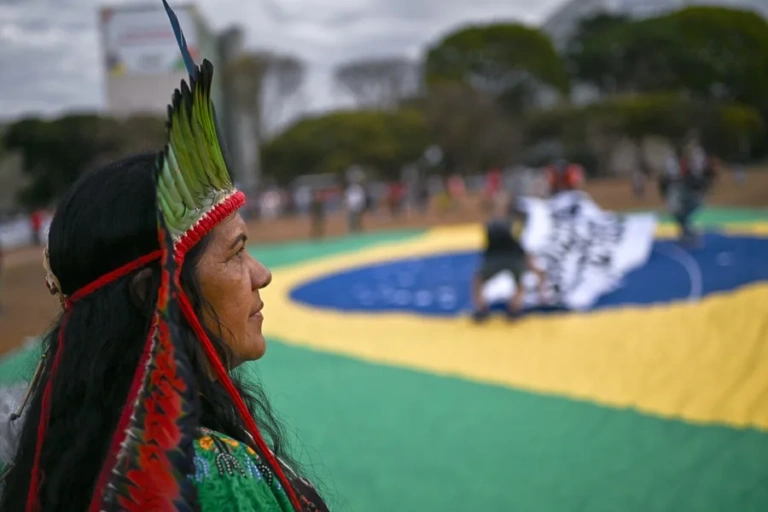
Indigenous land demarcation in Brazil advances as Lula’s government prepares new processes amid rising violence against Guarani Kaiowá communities.
Related: Spanish PM: The Far Right Will Crumble in Spain as It Did in Brazil and the US
Indigenous Land Demarcation Brazil: 72 Territories Advance Under Lula
Brazil’s government is preparing new Indigenous land demarcation processes that could be ready for President Luiz Inácio Lula da Silva’s signature before the end of 2026. Indigenous Peoples Minister Eloy Terena said the move is directly linked to rising violence against Guarani Kaiowá communities in Mato Grosso do Sul.[telesurtv]
Terena told Brasil de Fato that the recent attacks—including murders, hit-and-run incidents, and threats to poison water—reflect a historical conflict rooted in the lack of demarcation of Indigenous territories. He argued that incomplete demarcation leaves communities without secure access to their traditional lands.[telesurtv]
The minister said racism, land conflicts, and limited access to clean water worsen the situation. He also criticized the conduct of state security forces, saying Indigenous communities often view the police as aligned with cattle ranchers rather than neutral protectors.[telesurtv]
What the New Demarcations Would Cover
Terena said the government is working to present new demarcation processes that could be finalized and awaiting the president’s signature before the end of 2026. The announcement signals an effort to accelerate recognition of Indigenous territorial rights.[telesurtv]
Under Lula’s third term, the government has recognized 20 Indigenous lands, declared 21 others, and established 31 reserves, according to Terena. Together, those measures cover 12.5 million hectares.[telesurtv]
The figures show both progress and unfinished business. While the government has advanced on some territories, many communities remain in legal limbo, exposed to invasions, violence, and pressure from agricultural and extractive interests.[telesurtv]
Brazil’s National Foundation of Indigenous Peoples
Police and State Government Under Criticism
Terena said the Military Police has a history of “brutal and ineffective” actions in Indigenous communities. He argued that many residents see the police as partial toward ranchers and landowners.[telesurtv]
He also revealed that the government of Mato Grosso do Sul has not followed the protocols for police action on Indigenous lands presented by the federal government. That failure, he said, deepens distrust between communities and state authorities.[telesurtv]
The minister said the Public Security Amendment approved by Congress this week could expand the federal government’s capacity to protect Indigenous territories. He argued that the current requirement for governors to authorize the deployment of the National Security Force makes it harder to respond to conflicts, especially in communities that do not trust state police.[telesurtv]
Legal Obstacles Remain
Despite the progress, Terena said judicialization and the application of the temporal framework law remain major obstacles to demarcation. He said the government has the capacity to advance processes but continues to face interference from the legislative and judicial branches.[telesurtv]
The temporal framework law limits Indigenous land claims to territories physically occupied by communities on October 5, 1988, the date of Brazil’s Constitution. Critics argue that the rule ignores historical displacement and violence that forced communities from their lands.[telesurtv]
Terena also expressed concern about the composition of the Congress elected in October, which he sees as even more resistant to Indigenous rights. He warned that political opposition could slow or block future demarcation efforts.[telesurtv]Supreme Federal Court of Brazil
Violence Against Guarani Kaiowá Communities
The Ministry of Indigenous Peoples recently asked the Federal Police to investigate episodes of violence against Guarani Kaiowá communities in Mato Grosso do Sul following the election results. The ministry said it is working to guarantee protection and rights for affected communities.[telesurtv]
The Articulation of Indigenous Peoples of Brazil (APIB) and the Aty Guasu Association are collecting complaints that could lead to concrete legal action. The reported cases include murders in Naviraí, hit-and-run incidents in Coronel Sapucaia, death threats, racist statements, and threats to poison water in Tacuru and Nioaque.[telesurtv]
One municipal employee in Tacuru allegedly suggested in a WhatsApp message that the water used by Indigenous residents of the Sassoró village be poisoned. The message read: “Put poison in the water, let’s kill these plagues.” The employee was removed from his duties after the incident became public.[telesurtv]
Lula Sends Ministers to the Region
President Lula ordered three ministers to travel to Mato Grosso do Sul to follow up on the threats and violence against Indigenous communities after the elections. The delegation included Terena, Human Rights Minister Janine Mello, and Justice Minister Wellington César Lima e Silva.[telesurtv]
The ministers visited the Taquapiri and Sassoró villages. Terena said Lula asked them to go to the territory to closely monitor the situation.[telesurtv]
The federal government also created an interministerial task force, requested Federal Police investigations, and deployed the National Security Force to Sassoró, Taquapery, and Limão Verde. The measures are intended to protect communities facing immediate threats.
Brazilian Ministry of Human Rights
Geopolitical Context
The push for new Indigenous land demarcation in Brazil reflects a broader struggle over land, resources, and political power in the Amazon and other biodiverse regions. Indigenous territories are not only cultural spaces; they are also critical carbon sinks and buffers against deforestation.
The Guarani Kaiowá live in one of Brazil’s most conflict-prone agricultural frontiers. Their territories are often surrounded by large farms, and disputes over land demarcation, water access, and public services have persisted for decades.[telesurtv]
The political context matters. The temporal framework law, congressional opposition, and state-level resistance create a legal and institutional environment that can slow recognition of Indigenous rights even when the federal government supports them.[telesurtv]
The violence in Mato Grosso do Sul also reflects a wider pattern of intimidation against Indigenous communities during electoral periods. APIB has recorded more than 30 episodes of violence linked to the electoral process, suggesting that political polarization is intensifying pre-existing conflicts.
What Comes Next
The immediate test will be whether the new demarcation processes are completed and signed before the end of 2026. That would represent a concrete step toward securing Indigenous territories and reducing the vulnerability of communities facing violence.[telesurtv]
The government will also need to address the institutional failures that allow violence to persist. That includes enforcing police protocols, strengthening federal protection, and ensuring that state authorities cooperate with Indigenous communities rather than treating them as obstacles.[telesurtv]
For Terena, the long-term solution is to turn executive programs into law. He argues that presidential decrees can be reversed by a new administration, while legislation offers greater continuity for Indigenous rights.[telesurtv]
From teleSUR English via This RSS Feed.