

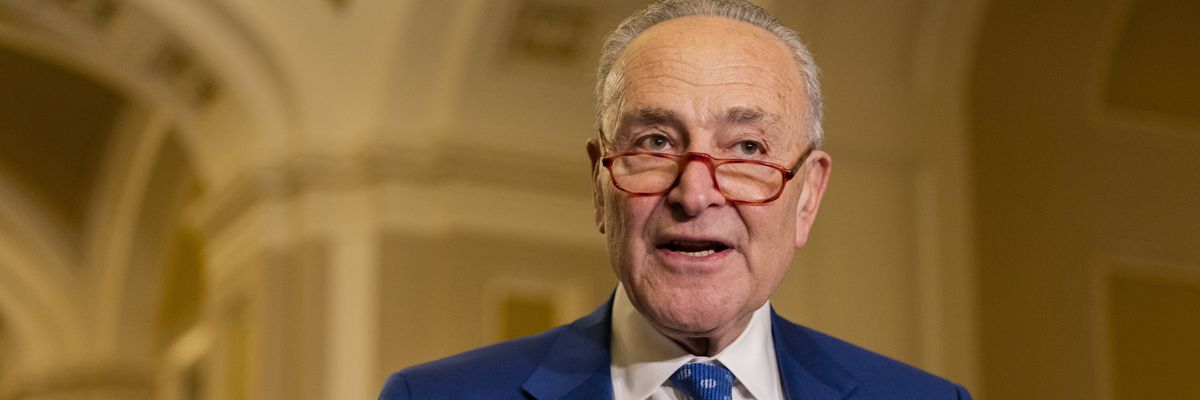
With a vote expected as soon as Monday on a far-reaching permitting reform bill in the US Senate, opponents to the legislation are raising the alarm over legislation they warn represents the worst kind of bipartisanship: the kind where corporate interests have twisted enough arms in each party to get what they want while the public and the common good get the short end of the stick.
The looming vote to advance S.5653, the so-called Bipartisan American Affordability and Jobs Act, BAAJA for short, has largely been overshadowed by the midterm elections, but coming on the heals of the Democratic Party’s routing of Republicans last Tuesday it is being pitched as one final chance for the current Congress to pass at least one piece of legislation before President Donald Trump becomes a truly lame duck president come January.
The Democratic co-sponsors in the Senate—Sens. Sheldon Whitehouse of Rhode Island and Martin Heinrich of New Mexico—have tried to thread the bipartisan needle by arguing that the benefits of their proposal outweigh what Republicans demanded in exchange.
“We need a fast, fair transition to clean energy, but not one built on the backs of communities that live next to mines and pipelines. These communities are the ones drinking the water and breathing the air and this bill gives them fewer protections."
But the problem, according to critics, is that it’s a horrible and counterproductive bill that will empower utility conglomerates, mining companies, data center operators, and oil and gas behemoths to extract huge concessions on the future buildout of polluting projects while hiding behind the promise of a more efficient permitting process for clean energy infrastructure—a noble goal.
The crux of it, as summarized by The Verge, is that while the legislation, if passed, “could be a catalyst for lots of clean energy, it could also speed up polluting projects and limit oversight of new data centers.”
Green groups in the days leading up to Monday’s have intensified their opposition, even in the face of offered changes to the bill that lawmakers have introduced to make it more palatable. On Saturday, the Senate Democratic Caucus met in Washington, DC to discuss the bill and offer “manager’s amendments” in hopes of garnering enough votes for passage.
According to Elizabeth Bast, executive director of Oil Change International, however, “No amount of last minute tinkering can disguise that this bill is a massive giveaway to fossil fuel companies and Big Tech at the expense of communities, the climate, and people’s energy bills."
The bill, Bast added, “is exactly what the fossil fuel industry has been asking for years” and called on all lawmakers to vote against it.
Earthworks, one of the hundreds of advocacy groups lining up against BAAJA, warns that the legislation would give less say to the public and Tribes when it comes to major energy projects, setting up conditions that are a giveaway to the mining, data center, and fossil fuel industries.
**“**The bill would expand the 1872 Mining Law so companies could claim nearly unlimited public land for waste dumps, roads, pipelines and power lines,” Earthworks said in a statement. “The demand for minerals for the energy transition is real but it is no excuse to let mining companies take more public land with fewer safeguards, under a law that already prioritizes mining ahead of other land use.”
The group’s policy director, Lauren Pagel, said, “We need a fast, fair transition to clean energy, but not one built on the backs of communities that live next to mines and pipelines. These communities are the ones drinking the water and breathing the air and this bill gives them fewer protections."
Veteran climate organizer Bill McKibben, writing about the legislation on Saturday, also pointed out the fundamental problem with legislation that treats permitting reform for clean energy projects and dirty energy projects as an equal endeavor.
While acknowledging that currently it remains “too hard to build stuff we badly need—housing, transit, energy,” when it comes to building energy infrastructure, “there’s a problem, and that problem (as so often) is climate change. Building more housing produces…more housing. But if you take climate change seriously, you have to build more clean energy and less dirty energy, or otherwise you don’t get anywhere.”
It’s a similar argument made by groups like Public Citizen, who said Friday that while some of the bill’s provisions—like those related to transmission lines and ratepayer protections from data centers—are “strong and sorely needed,” the problem remains that “the bill’s drawbacks are greater, more immediate, and more certain.”
Whatever benefits the legislation might secure, explained David Arkush, director of Public Citizen’s Climate Program, the downsides will be far worse, undercutting existing laws designed to protect public lands, endangered species, and the nation’s natural resources, including clean air and water.
BAAJA, said Arkush, “seriously weakens the Clean Water Act and Endangered Species Act and guts the National Environmental Policy Act and the National Historic Preservation Act. It fast-tracks the permitting of all manner of projects, then makes it virtually impossible to regulate or arguably even enforce existing rules against them, without an act of Congress.”
“Among other effects,” he continued, “the bill will open the door to a vast increase in exports of liquefied natural gas and facilitate a hasty and reckless buildout of data centers powered by fossil gas. And the bill would make it significantly more difficult to moderate, regulate, or alter these actions later, regardless of what public health, climate destruction, or public sentiment demand.”
As far as McKibben is concerned, “I think that if this deal had been made 30 years ago, it might have made sense—we’d be reaping the benefits now. But the fossil fuel industry made sure we didn’t. And this bill, which they’re backing with great enthusiasm, seems an awful lot like a hedge to make sure they can string their business model out for a few more decades—a way to lock in the fruits of their decades of political obstructionism.”
With Democrats soon returning to power, opponents of the permitting reform bill said it makes no sense to bend to Republicans in this moment to get a bill through that falls short in such fundamental ways.
“In the November 3 elections, voters across the country resoundingly rejected data centers," said Arkush. “This is not the time to pass a bill that enables Big Tech to charge forward with them, powered by fossil fuels, over the objection of local communities.”
Come January, he said, “the makeup of Congress will change substantially,” making it likely that a significantly “better deal can be reached then—one that enacts the laudable and important provisions in this bill, and more, without so many sacrifices.”
In October, veteran Democratic operator John Podesta warned that providing legislation like BAAJA to the Trump administration would be like giving the president and his party a “loaded howitzer” with which to attack environmental protections.
With Trump’s appointment on Friday of Stephen Miller to be his new White House chief staff, McKibben connected that choice of the “single most vile character I’ve ever seen on our national scene” with Podesta’s comments and offered this guidance: “Handing Stephen Miller a loaded howitzer is not something any senator should even contemplate. Period.”
From Common Dreams via This RSS Feed.
People JUST voted Overwhelmingly AGAINST the Republican agenda, EVEN so far as flipping BLOOD RED STATES Blue! Which means it’s the PERFECT time to Help Republicans do EXACTLY what they Want!
-LITERALLY Democrats!
Yes
