

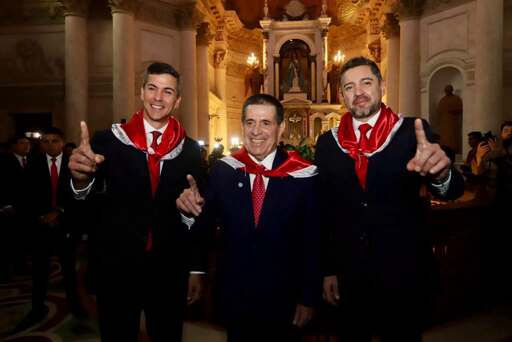
Caracas (OrinocoTribune.com)—The Senate of Paraguay removed President Santiago Peña from office on Friday, November 6, in an impeachment proceeding arising from the Ueno Bank crisis.
Police arrested Peña later on Friday, in compliance a warrant issued by the Attorney General’s Office. He appeared there on Saturday, November 7, with his lawyer, Ricardo Preda, to give a statement, the institution reported.
Ueno Bank crisis and protests
The Central Bank of Paraguay had ordered an intervention and rescue procedure for Ueno Bank, which has 2.94 million clients, nearly two-thirds of Paraguay’s population. The bank had experienced a meteoric rise in its assets during Peña’s term and received millions of dollars in public resources.
The crisis left depositors unable to access their funds, including 32,000 retirees who received their pensions through the bank. The Social Security Institute (IPS) also faced concern over payments to retirees.
In addition to Peña, judicial authorities ordered the arrest of Carlos Carvallo Spalding, who led the Central Bank until Tuesday. He resigned amid the Ueno Bank scandal and scrutiny of his previous role as chair of the board of Ueno Bank.
The arrest order initially placed Peña under house arrest at his residence in Asunción. As protests grew outside the house, police used force against demonstrators. An officer at the scene said that Peña had been notified that he was under house arrest pending his appearance before the Attorney General’s Office. Prosecutor Silvia González reported that he was at home and had made himself available. Earlier, rumors had circulated that he had fled the country.
Amid protests by depositors and other demonstrators, the police transferred Peña from his home in the Santísima Trinidad neighborhood of Asunción to the Presidential Escort Regiment headquarters on Friday night. Authorities said that the move was intended to protect him ahead of his preliminary hearing. Police established a security cordon as demonstrators demanded that he be held in a regular prison.
Senate removes Peña, Alliana takes office
The Senate approved Peña’s removal unanimously, with all 44 senators present voting in favor. The vote included members of the ruling Colorado Party, the Liberal Party, and smaller political groups. Peña had submitted his resignation before the Senate completed the impeachment proceeding, but lawmakers continued the trial. His removal through impeachment also disqualifies him from becoming a senator for life that would have granted him parliamentary immunity.
Following the vote, Vice President Pedro Alliana was sworn in as president to complete the term through August 15, 2028. Article 234 of Paraguay’s Constitution provides for the vice president to assume the presidency following the president’s resignation, removal, or death. The same article states that Congress must elect a replacement vice president by an absolute majority.
In his first address as president, Alliana promised to compensate those affected by the Ueno Bank collapse. “We will not abandon the depositors. I have ordered immediate action to compensate them,” he declared, pledging to prioritize the most vulnerable.
Alliana also said that he would present Congress with a plan to “rationalize” public spending, focused on reducing what he called “superfluous expenses.” He said that the government needed to redirect resources to sectors with the greatest social needs.
The succession has not ended questions about political accountability. Alliana, a Colorado Party ally of former President Horacio Cartes, has reportedly been named in investigations involving Ueno Bank. He has also faced allegations of nepotism and influence peddling involving relatives employed in public institutions, although these allegations have not resulted in a criminal conviction.
Colorado Party legislator Hugo Meza opposed impeaching Alliana while voting to remove Peña, leaving Alliana’s path to the presidency open. The transfer of power to another figure from the same political elite has prompted questions about whether the succession will bring accountability for the crisis or preserve the Colorado Party’s control of government.
Alliana announces depositor payments and appointments
On Saturday, Alliana reported that the government had disbursed more than 996 billion guaraníes—about $160 million—to secure the return of deposits in 1,196,000 affected accounts. He said that payments would continue through the weekend and that the government’s priority was to return the depositors’ money.
Alliana also said that IPS retirees would receive their salaries and bonuses. IPS President Derlis León explained that more than 90,000 beneficiaries would be paid on November 17. The accounts of the 32,000 retirees who had received payments through Ueno Bank were being transferred to eight other banks.
Paraguay’s Peña Resigns as Ueno Bank Crisis Triggers Impeachment Vote
Alliana appointed lawyer Ariel Martínez as interior minister, saying Paraguay needed “peace, order, and security.” Civil engineer Juan Carlos Baruja was appointed minister of public works and communications.
The appointments point to continuity with the Colorado Party governments of Peña and Cartes. Martínez previously served as interior minister under Cartes in 2018, after working as deputy minister of internal security and political affairs. During his earlier appointment, his father and brother simultaneously headed the Defense and Justice ministries, respectively.
Separately, Constanza Peña, the ousted president’s daughter, who is studying in the United States, drew negative reactions on social media after posting an Instagram story from a gym wearing a shirt that read “Tax The Poor,” seen by many as a provocation.
Special for Orinoco Tribune by staff
OT/JRE/SC
From Orinoco Tribune via This RSS Feed.