

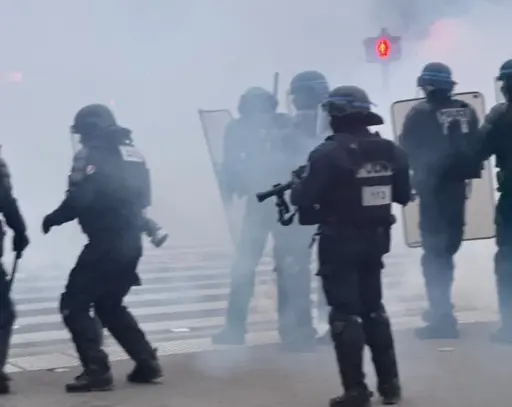
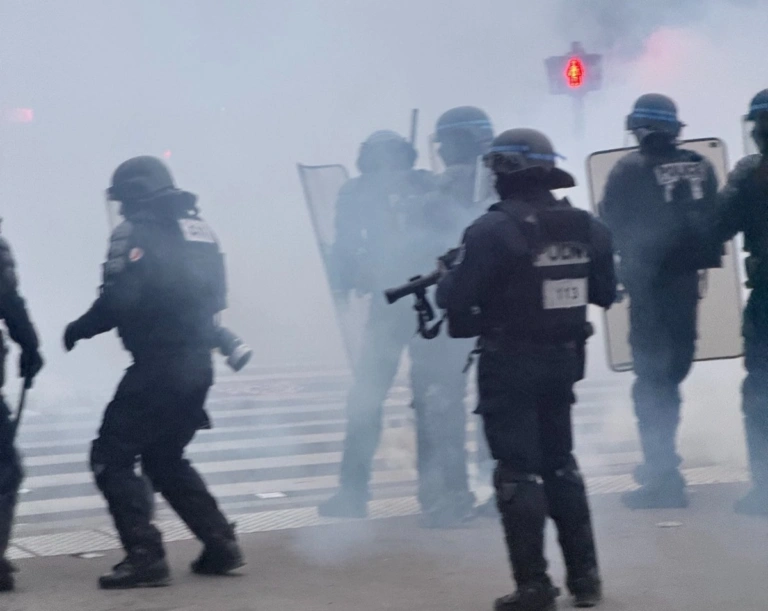
France protest crackdown intensifies as police use tear gas and stun grenades during the fourth wave of cost-of-living demonstrations.
Related: France Cost of Living Protests: 70,000 Police Deployed for 4th Action
France Protest Crackdown: 70,000 Police Face 4th Wave of Unrest
A major France protest crackdown marked the fourth consecutive day of demonstrations on Saturday, November 7, as police used charges, tear gas, and stun grenades to disperse protesters in Paris and other cities. The government had deployed 70,000 police officers and gendarmes nationwide.[telesurtv]
Security forces intervened in Paris, particularly at Place de la Nation, as well as in Bordeaux, Brest, and Lyon. The operations left numerous arrests, injuries, and a tense atmosphere on the streets.[telesurtv]
The crackdown followed mobilizations called by the General Confederation of Labour (CGT), student unions, and Yellow Vests groups. Protesters are demanding action against the rising cost of living, higher fuel prices, austerity budgets, and the economic policies of President Emmanuel Macron.[telesurtv]
Police Tactics Under Scrutiny
Police charges and anti-riot equipment were used as the demonstrations wound down. The government’s large deployment reflects its concern that spontaneous gatherings, rather than officially organized marches, could become unpredictable.[telesurtv]
teleSUR reported that police dispersed crowds in Paris, Brest, and Lyon using stun grenades and tear gas. Videos posted by the outlet showed Yellow Vests protesters in Lyon fleeing clouds of smoke after riot police intervened.[telesurtv]
The use of force has intensified scrutiny of the government’s handling of the protests. Critics argue that heavy policing risks deepening resentment among workers, students, and communities already affected by inflation and austerity.[telesurtv]
French Ministry of the Interior
A Movement Built on Economic Anger
The protests began in the suburbs of Paris on September 18 and gradually spread across France. What started as an education-centered movement expanded into a broader revolt over the cost of living, drawing in unions and activists.[telesurtv]
The demonstrations now combine demands from workers, students, and Yellow Vests activists. Their core grievances include low wages, expensive fuel, cuts to public services, and limited access to education and universities.[telesurtv]
The movement’s scale was visible on Thursday, November 5, during a general strike. Unions estimated participation at nearly 1.6 million people, while the Interior Ministry reported more than 600,000.[telesurtv]
The gap between those figures reflects a familiar dispute over how to measure protest participation. But both numbers point to a level of mobilization that has become politically difficult for the government to ignore.[telesurtv]
General Confederation of Labour
Journalists Caught in the Crackdown
The violence has also affected the press. The Lyon Press Club issued a statement titled “Stop the Abuses of the Security Forces,” denouncing physical assaults, arbitrary searches, intimidation, and the seizure of equipment from journalists.[telesurtv]
The organization highlighted the cases of two news-agency photographers who were seriously injured on November 5, suffering fractures and burns despite wearing press identification armbands.[telesurtv]
The incidents raise concerns about press freedom during a period of civil unrest. Journalists covering protests must be able to document events without fear of being targeted by police or having their equipment confiscated.[telesurtv]
Government Seeks a Social Response
Under growing pressure, Prime Minister Sébastien Lecornu has called a social conference for Monday, November 9, at the Government headquarters. The meeting will bring together unions, employers, and education representatives to discuss purchasing power.[telesurtv]
The government hopes the talks can produce measures to address the cost-of-living crisis and reduce social tension. But protest organizers say they will keep up pressure until their demands are met.[telesurtv]
The movement’s demands include wage increases, protection of public services, investment in education, and a reversal of austerity policies. The government’s response will determine whether the protests escalate further or enter a negotiated phase.[telesurtv]
Arrests and Legal Consequences
The protest wave has already led to more than 4,914 arrests, according to figures recently released by the Justice Ministry. The figure does not include arrests from the latest day of protests.[telesurtv]
The ministry said that 70 percent of those arrested—329 people—already face legal proceedings that could result in prison sentences. The high number of arrests has become a central point of controversy around the government’s response.[telesurtv]
Human rights groups and legal advocates argue that mass arrests and aggressive policing may criminalize social protest rather than address its underlying causes. The government maintains that firm action is necessary to protect public order and prevent violence.[telesurtv]
Geopolitical Context
The France protest crackdown is unfolding against a broader European backdrop of inflation, energy costs, housing pressure, and austerity. Across the continent, governments are struggling to balance fiscal discipline with growing public demands for wage increases and stronger social protections.
France’s movement is especially significant because it brings together established unions, student networks, and the Yellow Vests, a grassroots movement that first emerged in 2018 over fuel taxes. That combination gives the protests both institutional reach and street-level momentum.[telesurtv]
The government’s response is being watched across Europe. If Paris relies primarily on policing, it may face prolonged unrest; if it offers meaningful concessions, it could set a precedent for other governments facing similar pressure from workers and students.[telesurtv]
The protests also test the stability of one of the European Union’s largest economies. Continued disruption could affect transport, public services, tourism, and investor confidence, while deepening political polarization ahead of future elections.[telesurtv]
What Comes Next
Monday’s social conference will be the first major test of whether the government can move from repression to negotiation. Unions and student groups are expected to demand concrete measures on wages, fuel prices, education, and public services.[telesurtv]
The government faces a difficult choice: continue a security-first approach or make concessions that could ease public anger but challenge its fiscal agenda. Either path carries political risk.[telesurtv]
For now, the central conflict remains unchanged: a state trying to restore order, and a broad social coalition demanding relief from a cost-of-living crisis it says has become unbearable.[telesurtv]
From teleSUR English via This RSS Feed.
They fired tear gas even before the end of the protest. The “unrests” is from them.
Needs more for bombs for fascist cops
The movement’s demands include wage increases, protection of public services, investment in education, and a reversal of austerity policies.
This frustrates me. Just like it does when I argue about this on Lemmy.
Running a huge deficit is the same thing as burning oil, or dumping toxins, or dumping capital in a bubble like crypto and AI, or inflating the wealth of the uber wealthy, or taking away rights. It’s the same thing every progressive is staunchly against in other contexts: kicking the can down the road so you have things better, at the expense of your children.
It’s how we got here.
And the only counter argument I ever get is:
-
“Well it won’t be a problem if we tax billionaires,” which ANNOYS me. Taxing the uber rich is a good thing to do, yes, but that’s DOGE logic: it alone is mathematically not enough to make ends meet.
-
“Well, the GDP boost would compensate for it.” This is the same fantasy MAGA used to justify billionaire tax cuts, and it demonstrably does not work that way.
Create a mountain of debt, and that fucks over future generations just like emissions will. Whenever I see an ostensible progressive endorse that, it makes me squirm.
-
