

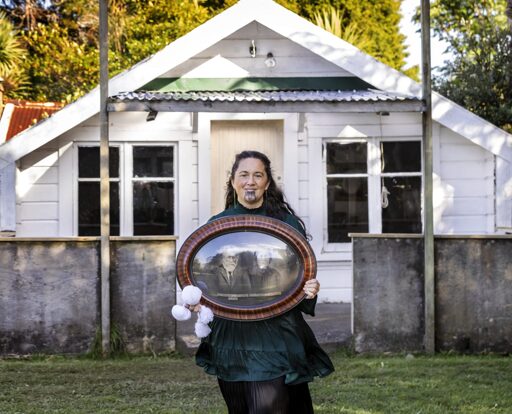

Hotukura Wharehoka stands outside Te Rongo o Raukawa at Parihaka, Taranaki, where she received her moko kauae and her new names on the same day in May 2023. The names are from her tūpuna Wharehoka and Hotukura, in the framed picture. (Photo: Miriama Niwa)
Dr Hotukura Wharehoka’s research into the reclamation of Māori naming practices has culminated in a Māori-language book telling the stories of people who swapped their Pākehā names for Māori ones in mid-life. As she was writing the book, Hotukura (Taranaki, Te Ātiawa, Ngāruahine) did the same.
Here, she talks to Atakohu Middleton, whose story is also in the book.
You grew up with the names Joeliee Seed-Pihama. Where did these names come from?
I was born in 1980, and back then, it wasn’t cool to have Māori names. When I asked my mum Angela, who is Taranaki, Te Atiawa and Ngāruahine, why she didn’t give me a Māori name, she said it just never crossed her mind. I think that’s pretty indicative of the way things were then.
My mum wanted a name that was different, which lots of people did in the ‘80s, so she chose Jolie, which is the French word for beautiful. She spelt it differently to be unique, and that’s how I became Joeliee. My sisters are called Nataliee and Janet-Liee, so she unified us in that way as well.
Seed comes from my mum’s English side, and Pihama comes from my dad’s whānau via a whāngai relationship. Even though I have a new name now, I still carry all of those names and their connections with me.

Hotukura and her whānau in August 1985. Standing at the rear is Miriama Wharehoka and in front are Angela Seed-Pihama holding Nataliee, Hotukura’s maternal great-great-grandmother Neta Wharehoka, and Hotukura, then named Joeliee Seed-Pihama. (Photo: Margaret Bake Photography)
You’ve long been interested in Māori names and reclaiming them. Where does this interest stem from?
In the 1990s, Taranaki leaders like Huirangi Waikerepuru, Te Miringa Hohaia, my maternal koro Te Ru Koriri Wharehoka and many others were revitalising te reo and tikanga, and reclaiming Māori names was part of that shift.
Growing up, I saw people in my own whānau take up Māori names. My koro, Mum’s dad, was named Richard and took the name Te Ru Koriri, in, I think, the 1990s. His wife, my kui, went from Carol to Maata not long after. Some of my uncles who’d gone to university went from being Darryl, Craig, and Rodney to Rongomaiira, Te Kauhoe, and Wharehoka.
I was intrigued. I thought the people taking new names were quite majestic, fierce and strong. Although it was hot gossip when people changed their names, and some of our whānau didn’t really understand why they needed to be so “radical”, it was also a non-event. When people heard someone had taken a new name, they said, “Oh okay”, and just started using it.
Did you grow up in reo and tikanga?
I am technically of the kōhanga reo generation, but I never attended kura or wharekura long-term. When I was around three or four, I had had a couple of years with the Taranaki nannies at the Ngāmotu (New Plymouth) kōhanga reo on Calvert Street, which was new then.
In reality, I grew up as an urban Māori with all that meant back then. My parents were hard workers focused on clothing and feeding us, and on getting ahead. Being Māori just didn’t factor in. I didn’t know my pēpeha, and I remember once calling my kui, Marjorie Rau-Kupa, to ask her what my waka and iwi were.
When I was 18, I enrolled in a reo immersion programme at Western Institute of Technology in Taranaki. I then moved to Waikato University to do a Bachelor of Arts in te reo. I ended up with a hefty student loan to reclaim my reo, but I had the bug. I completed a postgraduate translation qualification, an honours degree, and then a master’s, all by the time I was 24.

Hotukura on graduating from her immersion course, with her whānau. From left: sister Nataliee, nanny Miriama, Hotukura, sister Janet-Liee, mum Angela, and kuia Marjorie Rau-Kupa. (Photo supplied)
It wasn’t until I started having kids at 27 that I really got to put the years of study into practice and use my reo. My husband, Jonathan Wilson, is Ngāti Hauā, Ngāti Māhanga and Ngāti Porou, and there was no question our children would have Māori names and be raised in te reo. Our three boys are Tamarereti, 19, Pakiarohirohi, 17, and Te Kiwai o te Kete, 15. Our daughter Miriama is four. Their names all have connections to their whakapapa.
So how did you feel about your birth name growing up?
Joeliee was fine for a while, as I didn’t know any different. But as I grew older and I wanted to be known as Māori, the name Joeliee wasn’t fit for purpose. I am quite fair-skinned, so I struggled with knowing I was Māori, but not being recognised as Māori in school or on the street.
In my book, Kia whakahokia mai te reo ki a au, which translates as “Let the language be returned to me,” I talk about this feeling as a kind of mamae (ache). I wasn’t seen in the way I needed to be seen. I wasn’t able to uphold my own rangatiratanga and decide for myself how I would be seen and greeted by the world.
There’s something really powerful and vulnerable about saying “This is what I need”, or “This is how I need to be seen in the world”, and asking others to honour that.
During my PhD, I explored the concepts behind the question “Ko wai tō ingoa?” (What is your name?) and realised what that question was really asking. It’s about the whare tangata (womb). You’re asking: “From whose waters do you descend? Whose birthing waters, whose amniotic fluid do you come from?”
It’s about the synergy between the whare tangata and the outside world — your rivers, your oceans. I couldn’t really answer that question with “Joeliee”. It didn’t fit, and I had a yearning for something that answered that question.
Since I started relearning te reo at 18, I’ve been a champion of te reo Māori. Once you learn about how and why we were stripped of our taonga, you can’t unknow it. You can’t turn away. So taking a Māori name for myself was about taking back my language and deciding to contribute to it being spoken every day in Aotearoa.
What do we know about tupuna naming practices?
In pre-colonial times, naming was a collective thing. You might be named by an aunty, an uncle, or someone from another hapū, depending on the context, but parents weren’t the only namers.
Māori also didn’t have last names back then. We could and did take up new names across our lifespans. Often, our ancestors had several names that they were known by. Your name might change to acknowledge your deeds, a new responsibility, or a significant event such as the sudden loss of a loved one.
There’s something powerful about being able to shift and change and move your identity across your life.
Māori women also didn’t change their names when they married. Surnames — the idea that you were the possession of your father or husband — are part of the colonial project. A product of patriarchy, essentially.
Baptisms and christenings were another tool for renaming our people with English or Anglicised names. Māori had our own form of marriage which didn’t require a church or marriage certificate, but when this was outlawed by a Supreme Court decision in 1888, Māori began marrying through the church. This led to the addition of surnames, and the system of having a first, middle and last name became entrenched.
In 1913, under the Registration of Births, Deaths and Marriages Act, native school teachers in remote areas became able to register births, and they would often rename a child on the spot, rejecting and denying Māori names. Or rename them with English names in class.

Hotukura graduated with her PhD in December 2017 at Te Kohinga Mārama Marae, University of Waikato. Back row, left to right: Morwenna Silich, Jimmy Seed, Denise Seed, Hotukura, Maata Wharehoka, Whitirangihau Hikaka and Jonathan Wilson. In front are Agnes Wharehoka, Tamarereti, Pakiarohirohi and Te Kiwai o te Kete. (Photo: Supplied)
So what was the reclamation journey for you?
In my PhD, I did an intergenerational case study within my own whānau, looking at six generations of naming stories that we shared and built together as a whānau. We had lots of conversations, in particular with my kui Maata Wharehoka, about what it would mean for me to take up a Māori name.
I asked her: “What happens if I do want a Māori name? I don’t want to seek it for myself. I want someone to give it to me.” That was just my personal preference. And she said: “We’ll give you a Māori name. We’ll choose one for you, but you have to get a moko kauae first.” And honestly, the moko kauae bit put me off.
Why was that?
My kui never did anything privately or under the radar. I knew it was going to be a big deal, and I felt I had enough on my plate doing my PhD. And at the time, I was also pregnant.
I had always known a moko kauae would happen one day, but I just wasn’t ready. It’s one thing to want people to see you as Māori and to reclaim your reo. It’s quite another to carve that into your face. It’s a major physical change.
If I’m honest, I also knew it would be done traditionally, with an albatross-bone chisel, and that it would come with cultural and community expectations. I was still quite immature in my thinking and wanted to dodge it all. It was a bit like what we did as teenagers whenever the bell went for karakia — we ran the other way.
You got there in the end!
Āe! Two things happened. I graduated with my doctorate and moved on to writing the book. Also, I lost my cousin, Ariana. She was a sister to me, and I was supposed to walk through life with her. At that point, I realised I was ready.
My Kui Maata was also unwell, and she was on what she called her journey of “deathing”. I knew she wanted to see all of us sister-cousins with our kauae, before she left. Shortly after I told her I was ready, she sorted out the date, the time, and the place with everyone.
I got my moko kauae in May 2023, alongside three sister-cousins in Te Rongo o Raukawa, one of the oldest whare at Parihaka. Our whole whānau was there, singing, hugging, cackling, crying. It was beautiful, and their presence and singing really helped with the pain. There is nothing like the feeling of an albatross-bone chisel being tapped into your face!
The design was left up to our tohunga, and I didn’t know what it would look like beforehand. We were his canvas, really. I sat up after receiving my moko kauae, and the karanga and haka flooded around me. My husband did a mihi to the whānau, and my youngest child, one at the time, just stared at me in wonder.
I was beaming. I hadn’t yet seen my moko kauae in the mirror, but I knew it was spectacular. Receiving that taonga alongside my sister-cousins in the house of our tūpuna, it was like laying in a womb and being rebirthed.
It had also been decided that I would get my new name right then and there, and we all walked down to the creek next to the whare for the ceremony. My new name had been decided on by the whānau, facilitated by Kui Maata, and I didn’t know what they were.
A karanga accompanied me as I walked to the water, where the tohunga was waiting, standing calf-deep in the water. The tohunga asked: “Ko wai te ingoa o te wahine nei?” and my brother-cousin Te Akau answered: “Ko Hotukura Wharehoka tōna ingoa.” I started sobbing with emotion.
Hotukura and Wharehoka are the names of ancestors of mine, a wife and husband who lived at Parihaka when it was established in the 1860s. They might seem like first and last names, but really they’re two names that are meant to be carried together.
I know Kui Maata wanted to claim me back into my matrilineal whakapapa too, and so she probably snuck Wharehoka in there on purpose. I always wanted to be a Wharehoka when I was little, like all my other whānau who live at Parihaka papakāinga, and she knew that.
So how did it feel to finally have your new name?
I felt whole, like I was finally my fullest self. I finally carried a name that connected me to the people of the Waitotoroa river and to the whakapapa of my mother. Although I carried the Pihama name through my dad, that name comes to me through a whāngai relationship, so it doesn’t reflect my whakapapa in that regard, even though it carries an immense amount of love.
How did you go about letting others know that you had been given a Māori name?
I did what others have done. I wrote a Facebook post about both my moko kauae and my name. People accepted that. No one asked: “Where’s your new birth certificate?” I immediately changed my name on everything I communicated through — email, Facebook, Instagram.
Did you get a new birth certificate to make the name change legal?
No, and the reason is the researcher in me. I’m interested in the experience of asserting a Māori name that’s not a legal name. I want to document my own lived experience.

Hotukura shares her research at Te Ao o te Tamaiti conference in Hamilton in July this year. (Photo: Erica Sinclair Photography)
There is also a cost to legally changing your name that I think, as tangata whenua, we need to resist. I shouldn’t need to pay to carry my ancestral practices on my own whenua, especially when the Crown is responsible for the near-death of the same language that I’m reclaiming through my name.
I am finding, though, that having to go back to Joeliee for legal purposes is getting more and more annoying. I’m saying to people at work: “Did you book me under my legal name, or did you book me under Hotukura?” Quite often I just tell the clerk: “I have two names — you’ll have to try both.” Nobody’s had a problem with it yet!
So you might eventually make your new names your legal names too?
Yes, but I’m still deciding how much I want to resist in this space. Do I want to try and drop having a surname? That is currently a big issue for some whānau I know, who want to continue the tupuna practice of having a first name only, but have had endless issues in trying to uphold this decision.
The system requires a surname, and it’s a barrier to our whānau who want to walk a different path. But on the other hand, Māori have really co-opted surnames, and we use them to connect to each other and our whānau to certain places. We have adapted and made surnames our own. That’s tino rangatiratanga, but so too is the right to not have a surname.
I enjoyed reading the stories of others who’ve taken Māori names in later life. What strikes you most about their kōrero?
Among the people who tell their stories are Ruakere Hond, Te Rita Papesch, and Hineitimoana Greensill. Each story is about their names, but they’re also about the struggle for te reo, or a journey to te reo. Reclaiming names and reclaiming te reo often go hand in hand. It’s a great book for people who are thinking about taking up a Māori name, because it shows the journeys that others have taken.
Another thing about their stories that struck me as important is that there’s no right or wrong way to get a Māori name. Renaming doesn’t have to be extremely ceremonial, but it can be.
One of the storytellers, Dr Hinekura Smith, turned up for a karanga wānanga at a marae but was quickly told to go back out to the gate and wait. She was then welcomed back onto the marae with her new name.
Another person in the book, Professor Te Taka Keegan, was a student at Waikato University in the 1990s when he was given his name by his teacher, Te Wharehuia Milroy.
If people want to seek out a name, what should they think about?
You can seek out a name for yourself, but fundamentally, you need others to help name you. You need your community, your whānau, your hapū. Think about who from your whānau can walk alongside you while you’re figuring it out — the whānau historian, the whakapapa person, that aunty, that uncle, even a good friend. I think it’s important that you understand your own whakapapa, the naming stories, and the person behind each tupuna name if you’re considering them.
Often, we tend to go straight to ancestral names, but Māori names are also about events and what’s happening at the time. They are markers in history that remind us of important messages we want our future generations to learn from and uphold.
Taking up a Māori name can be really healing. I’ve talked about that act of rangatiratanga, of your identity being seen and noticed, and being able to say, “I’m Māori, and I want to carry that wherever I go.” It’s deeply political and intimate.
I think taking a Māori name is really powerful for whānau who haven’t been able to reclaim their reo yet. To take a Māori name is a step on that journey.
Your book is in te reo Māori only, but I hear that you want to produce a book in English that’s a handbook on Māori naming.
Āe! We need something in English as well that helps us to understand what’s happened to our names, why things are the way they are, and gives our whānau tips on how to reclaim our ingoa Māori if they wish.
I’d like to write a book that enables more whānau to take up Māori names, and not necessarily just at birth. The beauty of going back to our ancestral ways of being and seeing is that if you’re Māori and you want a Māori name, you can have one.
Dr Hotukura Wharehoka is a senior lecturer at Te Whare Wānanga o Awanuiārangi. Her book Kia whakahokia mai te reo ki a au is available for free download here. Written entirely in te reo Māori, it tells her naming story and those of Ruakere Hond, Te Rita Papesch, Atakohu Middleton, Hinekura Smith, Hineitimoana Greensill and Te Taka Keegan.
The post Hotukura Wharehoka: Taking a Māori name appeared first on E-Tangata.
From E-Tangata via This RSS Feed.