

World Media Summit AI talks in Beijing unite 500 delegates from 112 countries to address misinformation, ethics, and media governance.
Related: World Media Summit Tackles AI and Global News Standards
World Media Summit AI: 500 Delegates Adopt Beijing Consensus

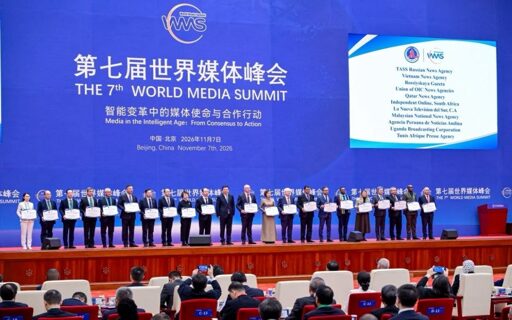
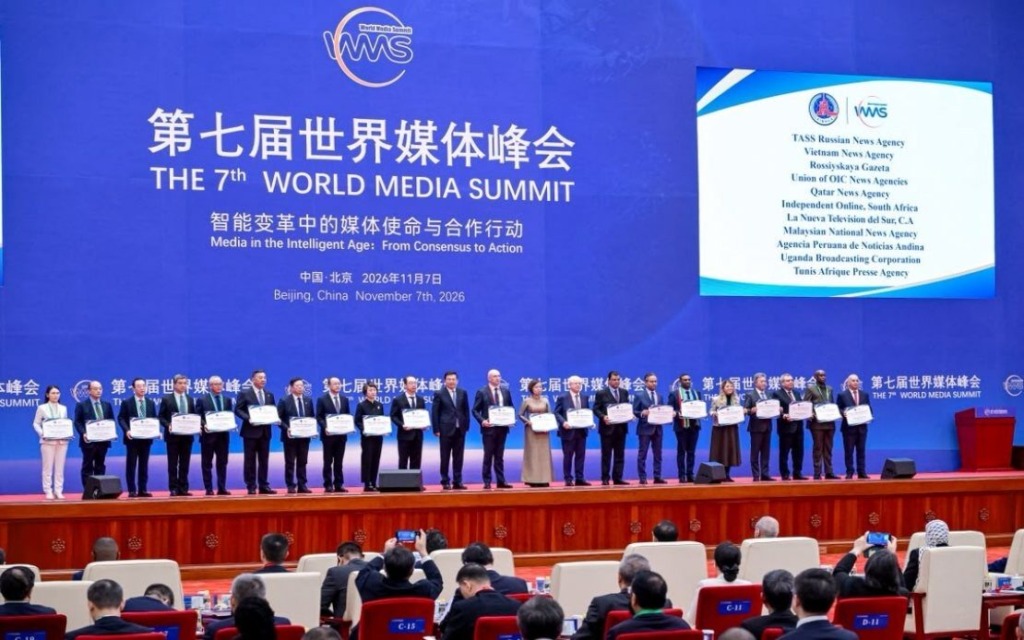
The World Media Summit AI discussions in Beijing have produced a new political framework for how news organizations should use artificial intelligence. Nearly 500 delegates from 112 countries and regions adopted the Beijing Consensus and launched a global initiative to develop standards for AI in the media.[english.news][english.beijing.gov]
The seventh World Media Summit opened in Beijing on Saturday under the theme “Media in the Intelligent Age: From Consensus to Action.” It was co-hosted by China’s Xinhua News Agency and the Beijing municipal government and runs from November 5 to 9.[english.news][english.beijing.gov]
The summit brought together representatives from nearly 330 media outlets, think tanks, government departments, and international organizations, including the United Nations. Its central question is how journalism can adopt AI without surrendering accuracy, public trust, or editorial independence.[english.news][english.beijing.gov]
What the Summit Agreed
The Beijing Consensus was adopted during the opening ceremony. It commits participating organizations to advance the transformation of the global media industry in the AI era and to ensure that technological progress benefits outlets in every country and at every stage of development.[english.news]
The document calls for the inclusive and responsible application of AI in the media sector. It also urges cooperation to defend objectivity, impartiality, and the rejection of false information, inaccurate reporting, and biased narratives.[english.news]
The consensus is not a binding treaty and does not create sanctions. It is a political agreement among media organizations, research institutions, governments, and international bodies, designed to guide voluntary cooperation rather than impose enforceable rules.[english.news]
AI Standards for Journalism
Xinhua also launched the Global Media Initiative for the Joint Development of AI Application Standards. The initiative brings together major media organizations and professional bodies to develop standards for the use of AI in journalism over roughly two years.[english.news]
Its three main objectives are to protect the authenticity of information, safeguard data security and media ethics, and create a global database of AI applications in the media. The standards will be validated by participating media outlets.[english.news]
The initiative includes 22 initial participants, among them Russia’s TASS, Malaysia’s Bernama, South Africa’s Independent Media, China’s People’s Daily, and China Media Group.[english.news]
Unlike the Beijing Consensus, this initiative is intended to produce a concrete deliverable: a set of technical and ethical standards for AI use across news production, verification, distribution, and audience engagement.[english.news]
UNESCO – Artificial Intelligence
Vietnam’s Five Joint Actions
Vietnam News Agency (VNA) Director General Vu Viet Trang presented four points of consensus and five joint actions for responsible AI use in journalism. Her proposals focus on turning broad principles into practical cooperation among media organizations.[en.vietnamplus]
The five actions are:
- Establish common principles for AI governance in journalism and the media.
- Strengthen digital skills among journalists and media workers.
- Develop cross-border cooperation to verify information and respond to false or misleading content.
- Share solutions that allow media organizations to earn fair and lawful income from copyrighted content.
- Put audiences and the public interest at the center of digital journalism.[en.vietnamplus]
Trang said VNA is committed to providing accurate, timely, and reliable information. She said the agency has pursued digital transformation in technological infrastructure, news production, and staff development, while using AI as a tool to support journalists.[en.vietnamplus]
The Risks of AI in Newsrooms
Delegates discussed both the opportunities and dangers of AI. Potential benefits include automatic translation, content production, data search, personalization, and expanded reach for smaller media organizations.[english.news][en.vietnamplus]
The risks are equally significant. Synthetic images and videos, disinformation, algorithmic bias, privacy violations, and digital inequality could undermine public confidence if newsrooms adopt AI without safeguards.[english.news][en.vietnamplus]
Daily Finland editor-in-chief Ofiul Hasnat warned that AI can reduce language barriers and redistribute communication power, but it can also multiply misinformation and technological inequality. He said unconditional reliance on automated content would amount to “editorial suicide.”[english.news]
The summit’s response is to combine innovation with verification: media organizations should use AI to improve efficiency, but retain human editorial judgment over facts, context, and accountability.[english.news][en.vietnamplus]
A Global Media Governance Debate
The summit’s agenda went beyond newsroom tools. It addressed who sets the rules for an information ecosystem increasingly mediated by AI systems: which content is prioritized, how it is verified, who controls data, how creators are compensated, and what mechanisms prevent manipulation.[english.news][en.vietnamplus]
The five discussion themes were:
- AI for all and the transformation of global media.
- Media dialogue and cooperation for a safer world.
- AI-enabled communication to expand exchanges among civilizations.
- AI and the future of global communication governance.
- The Beijing approach: decoding Chinese modernization.[english.beijing.gov]
The inclusion of a session on Chinese modernization makes clear that the summit is also a platform for China’s political and technological narrative. Beijing’s message is that AI should develop in a “safe, fair, and inclusive” way, with equitable access for countries of the Global South.[english.beijing.gov]
Geopolitical Context
The World Media Summit AI gathering takes place amid intense geopolitical competition over the infrastructure of global information: platforms, algorithms, semiconductors, submarine cables, satellites, data, and AI models. For China, hosting the summit allows Beijing to position Xinhua as a coordinator of an alternative media network at a time when U.S.-based technology companies still dominate much of the global digital ecosystem.[english.news][english.beijing.gov]
The summit also reflects a broader demand from Global South countries for greater influence over AI governance. Many governments argue that decisions about content moderation, visibility, monetization, and access to information are concentrated in a small number of technology companies headquartered in the United States.[english.news][english.beijing.gov]
China’s approach emphasizes state-led coordination, international cooperation, and shared technical standards. Western media organizations and governments often favor market-led innovation and stronger protections for editorial independence, creating a structural tension over who should govern AI in journalism.[english.news][english.beijing.gov]
The Beijing Consensus may not be legally binding, but it can still shape norms. If enough media organizations adopt its principles and participate in the standards initiative, it could influence how AI is deployed in newsrooms across Asia, Africa, Latin America, and beyond.[english.news][en.vietnamplus]
What Is Still Missing
The summit did not announce binding mechanisms, dedicated funding, sanctions, or a permanent supervisory body. Its focus remains voluntary cooperation, technical standard-setting, and the exchange of experiences.[english.news][en.vietnamplus]
That limitation is important. A consensus document can build political momentum, but it cannot by itself prevent deepfakes, stop disinformation campaigns, or resolve disputes over copyright and platform power.[english.news][en.vietnamplus]
The real test will be implementation. If the standards initiative produces practical tools for verification, data protection, and ethical AI use, it could become a meaningful reference for newsrooms worldwide. If it remains a statement of intent, the underlying problems of misinformation and unequal access to technology will persist.[english.news][en.vietnamplus]
From teleSUR English via This RSS Feed.