

Europe bomb threats disrupted 27 flights and media outlets across 10 countries, forcing diversions, evacuations, and military escorts.
Related: European Commission Presents 2027 Work Program with Even Less Initiatives
Europe Bomb Threats: 27 Flights Disrupted in False Alarm Wave
A wave of Europe bomb threats disrupted air travel and media operations across the continent this week, forcing flight diversions, emergency landings, evacuations, and military escorts. Authorities have found no explosives so far and have reported no injuries.[cnnespanol.cnn][rtve]
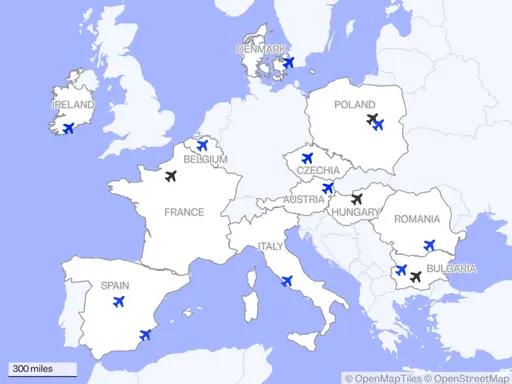
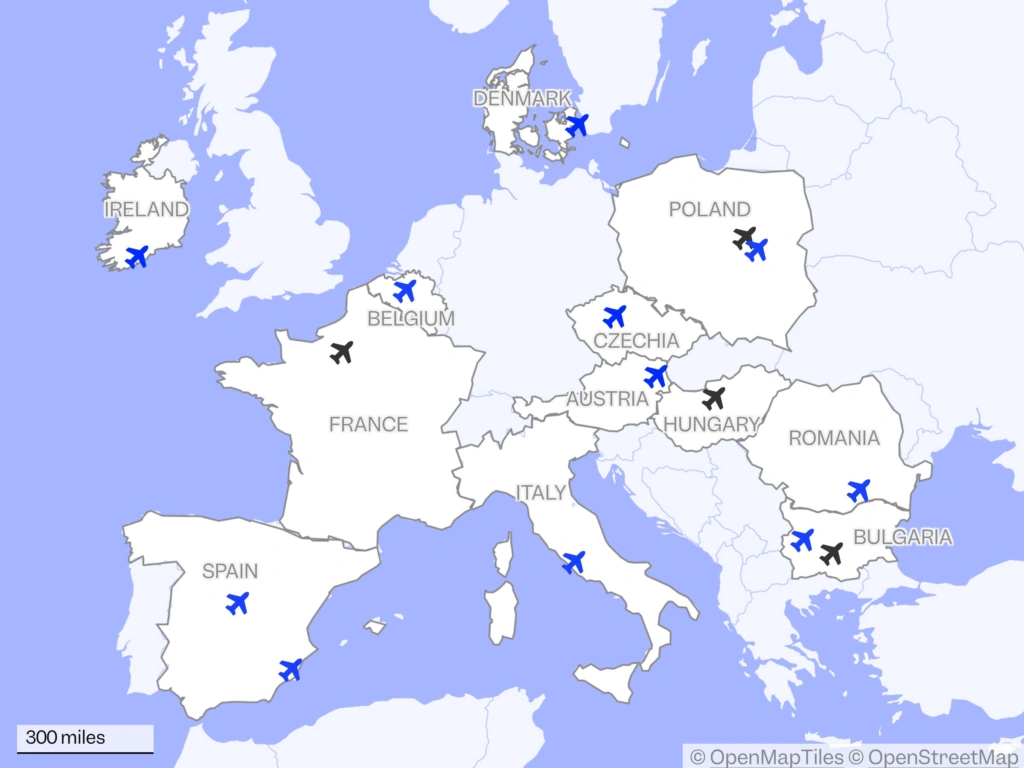
The alerts began on Tuesday and intensified on Thursday and Friday, affecting airports and airlines in at least 10 European countries, including Spain, France, Italy, Bulgaria, the Czech Republic, Poland, Denmark, Portugal, Austria, Belgium, Hungary, Romania, and the Netherlands.[cnnespanol.cnn][rtve]
CNN reported that about 20 aircraft were affected during the week, while RTVE said at least 27 passenger planes had to abort takeoff or make emergency landings because of false bomb threats.[cnnespanol.cnn][rtve]
Flights Diverted Across Europe
One of the most visible incidents involved an Aer Lingus flight traveling from Dublin to Rome. After receiving a threat, the aircraft was diverted to Évreux air base in Normandy, where all 151 passengers and six crew members were moved to a safe location.[cnnespanol.cnn]
The plane landed without incident. French authorities said the diversion was a precautionary measure while security teams inspected the aircraft.[cnnespanol.cnn]
In Bulgaria, three aircraft made emergency landings after threats. Two Ryanair flights from Copenhagen and Madrid landed safely in Sofia, while another Ryanair flight from London was diverted to Plovdiv. Inspections found no problems, and both airports continued operating normally.[cnnespanol.cnn]
In the Czech Republic, four flights to or from Prague were diverted for inspection after authorities received an anonymous email warning of improvised explosive devices. Police later confirmed that no bombs were found.[cnnespanol.cnn]
European Union Aviation Safety Agency
Media Outlets Also Targeted
The campaign was not limited to aviation. In Dublin, offices of Ireland’s public broadcaster RTÉ, the Irish Independent, Newstalk, Today FM, and Virgin Media were evacuated after receiving threats by email.[cnnespanol.cnn][rtve]
Sky News in the United Kingdom also confirmed that it received a bomb threat. Staff were evacuated as a precaution and returned after authorities determined that no explosives were present.[cnnespanol.cnn][rtve]
RTÉ said the email it received came from the same group behind the disruption to European air traffic. The broadcaster did not identify the sender, and authorities have not confirmed whether all the threats were connected.[rtve]
No Explosives Found So Far
Authorities in the affected countries have confirmed that none of the threats has been substantiated. Inspections found no explosive devices, and the aircraft examined landed without damage or casualties.[cnnespanol.cnn][rtve]
The email that triggered part of the alerts falsely claimed that “explosive devices” had been placed on flights from Helsinki and Dublin bound for Rome. A spokesperson for Rome Fiumicino airport confirmed to CNN that the screenshot of the message was authentic, although the threat itself was false.[cnnespanol.cnn]
The Finnair flight from Helsinki was escorted by two Italian Air Force fighter jets to Rome Fiumicino. Italian police carried out security checks but found no bombs.[cnnespanol.cnn]
Investigation Still Underway
No authority has formally attributed the threats to a specific perpetrator, and investigators are still working to establish their origin and motive. European Commissioner for Transport Apostolos Tzitzikostas said it was “too soon” to determine whether the incidents in different countries were related.[cnnespanol.cnn]
CNN reported that analysts have mentioned the possible involvement of an operator linked to Russia, but that remains an unconfirmed hypothesis. The European Commission, the European Union Aviation Safety Agency, and national authorities are examining the case together.[cnnespanol.cnn][rtve]
The anti-feminist group “The Male State” was identified as the sender of a threat sent to a logistics company linked to Rome’s Fiumicino airport. That finding does not establish that the group was responsible for all the alerts during the week.[cnnespanol.cnn]
The Operational Cost of False Alarms
Although there were no explosions or injuries, the impact was significant. Airports temporarily closed, passengers were evacuated, flights changed destination, and air forces in several countries escorted civilian aircraft.[cnnespanol.cnn][rtve]
Authorities stress that a precautionary response is mandatory for any bomb threat, even if it later proves false. The protocol protects passengers but can create delays, additional costs, and disruption across tightly connected European air networks.[cnnespanol.cnn][rtve]
British Transport Secretary Heidi Alexander described the alerts as a “malicious hoax” and confirmed that established protocols had been activated.[cnnespanol.cnn]
International Civil Aviation Organization
Geopolitical Context
The Europe bomb threats come amid growing concern over hybrid threats—coordinated actions that combine cyberattacks, disinformation, sabotage, and psychological pressure to destabilize societies without triggering a conventional war. Spanish Foreign Minister José Manuel Albares described the false alerts as “an attempt at hybrid aggression and psychological warfare.”[rtve]
Some European leaders have blamed Russia and Iran for the broader pattern of disruptions, although both countries deny involvement. The claims remain politically charged and have not been substantiated by a formal investigation.[rtve]
The threats coincide with cyberattacks on supermarket refrigeration systems in several European countries and an attempted online attack on blood banks in France. Security experts say such incidents can disrupt services, impose economic costs, and allow attackers to observe how airlines, airports, and governments respond.[rtve]
The aviation sector is especially vulnerable because even a single unverified threat can trigger military escorts, airport closures, and cross-border coordination. The wave of false alarms highlights how low-cost digital tactics can create high-cost disruption across Europe’s transport and media systems.[cnnespanol.cnn][rtve]
What Comes Next
Investigators will focus on tracing the emails, identifying common patterns, and determining whether the threats were coordinated by one group or several actors. The European Commission says it is monitoring the situation closely and maintaining contact with affected member states and EASA.[cnnespanol.cnn]
For airlines and airports, the immediate priority is to maintain passenger safety while limiting unnecessary disruption. For governments, the challenge is to distinguish between credible security risks and coordinated campaigns designed to exhaust emergency services and undermine public confidence.[cnnespanol.cnn][rtve]
Until the investigation produces answers, European authorities will continue treating every alert as potentially real. That caution is necessary—but it is also what makes false bomb threats such an effective tool of disruption.[cnnespanol.cnn][rtve]
From teleSUR English via This RSS Feed.