


Bullets:
Oil refineries across the Persian Gulf have been destroyed since late February, when the United States and Israel attacked Iran.
The Ukraine War also features heavy drone and missile attacks across a range of energy targets.
Oil prices moved violently higher, but occasionally pulled back as new supply routes were developed.
But diesel and other energy products will remain high, even if the wars end tomorrow. It will take months, and hundreds of billions of dollars, to restore destroyed refinery capacity.
The impact of diesel shortages were even felt in the United States, where voters swung hard away from Trump and the Republicans.
Inside China / Business is a reader-supported publication. To receive new posts and support my work, consider becoming a free or paid subscriber.
Report:
Good morning.
Through this year, 2026, a lot of things got broken that can’t be fixed. At least not soon, and at least not cheap. Ever since the War on Iran kicked off in late February, Wall Street investors and politicians were focused on counting how many ships squeezed through the Strait of Hormuz, or how much oil was sent through the pipelines in Saudi Arabia.
All of that is a sideshow. It does mean that speculators with advance knowledge of what the White House was going to be tweeting about later that night can make big piles of money:

But the only people who buy crude oil, to use in their businesses, are the refineries. And refineries are getting blown up, across the Persian Gulf by Iran, and by both sides in the Ukraine War. Bloomberg should know better, considering how much they charge me to subscribe, but they’ve done it again, here. Another headline about Mideast Oil flows that are close to what they were before the war.
The “oil export arteries are flowing again”. It’s a “remarkable recovery” considering there’s a war on. Shipments of crude are at 17.5 million barrels a day, which is 98% of what it was in January.
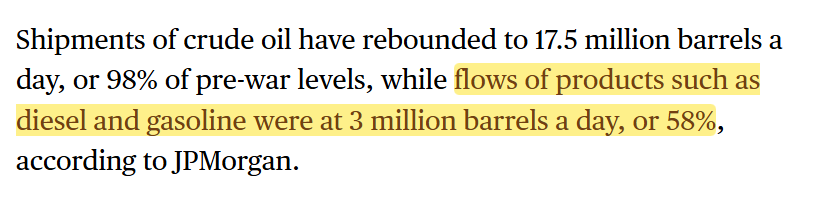
But they bury the lede—“refined fuels are at 58% of pre-war levels, at 3 million bpd. Over 5 million barrels a day of diesel and gasoline used to come out of the Persian Gulf, today it’s down by 2 million a day.
The European Union consumes 1.86 million barrels of gasoline every day, and that’s more than what’s missing: just the 2 million barrels of refined fuels from the Persian Gulf would have been enough to supply Europe. And that’s gone.
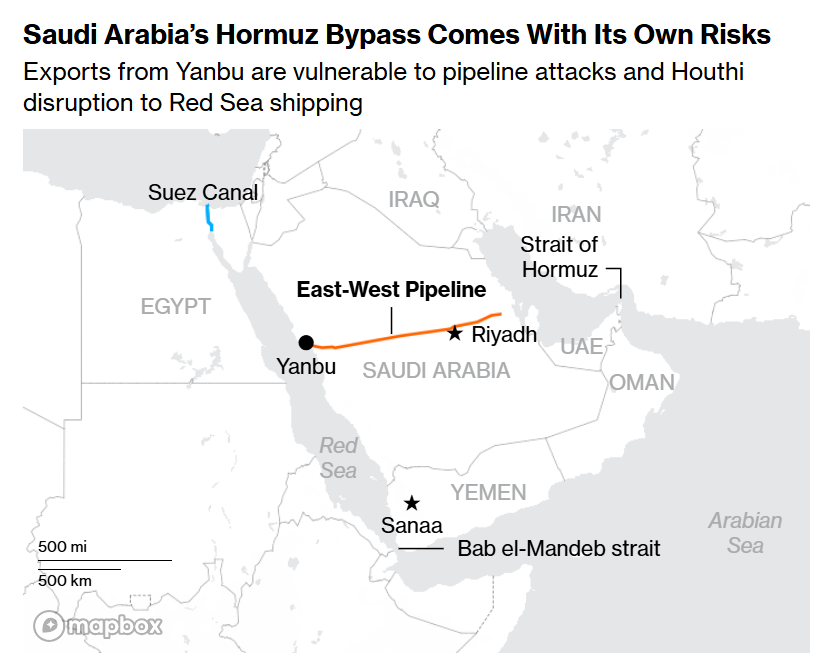
More focus on the crude oil: The East-West Pipeline gets headlines whenever the Houthis launch a drone at the thing, but that is a crude oil pipeline, not for gas or diesel.
That massive fleet of sanctioned “dark tankers” are sneaking out 23 million barrels a day of crude oil. The good news, such as it is, is that oil producers are getting crude oil out of the Persian Gulf, and lots of insiders believe that they’re paying Iran for the permission to sail the ships past. The bad news is that the market is critically short of gasoline, and jet and diesel fuel.
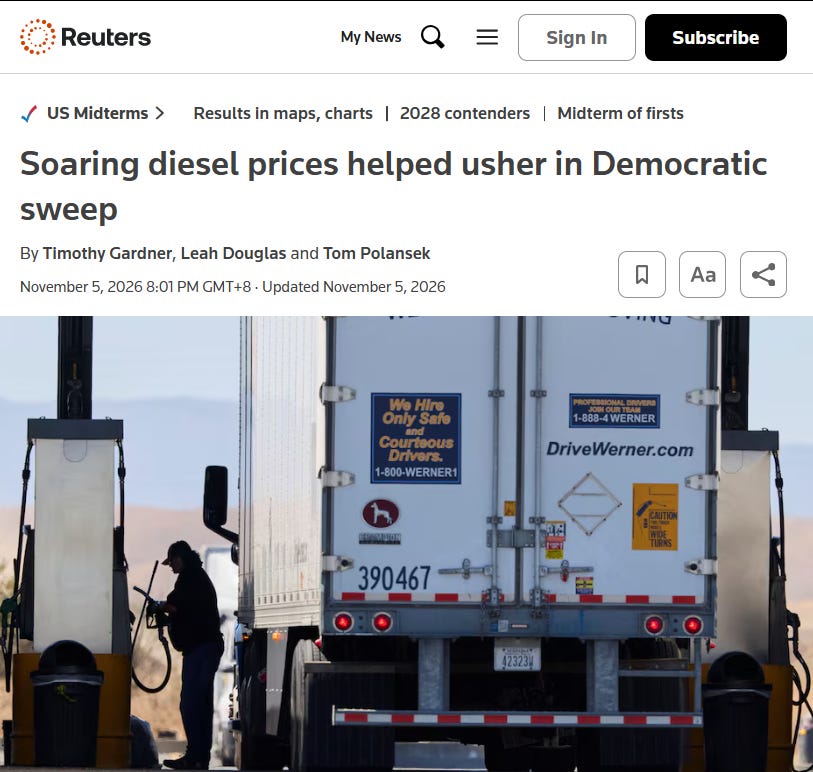
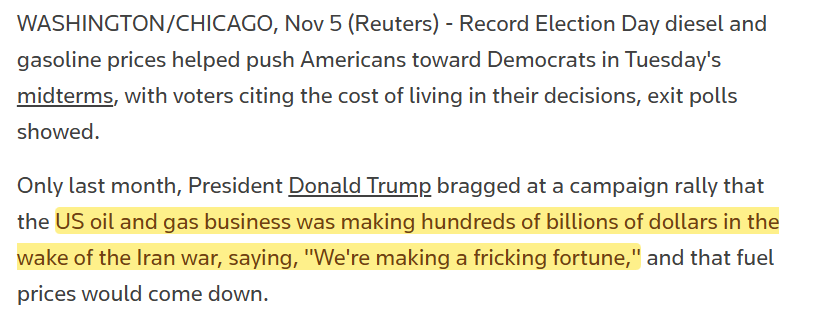
In the midterm elections a few days ago in the United States, 90% of voters said the cost of living is too high, and that influenced how they voted. For oil companies and refiners, it’s a great time to be alive—they’re booking record profits, and the Iran War is a license to print money:
But that is obviously a small constituency compared to voters at large, and the people who need affordable energy to do their jobs and balance their own budgets scrambled the electoral map in ways nobody has seen in decades.

Nobody alive today remembers the last time Kansas elected a Democrat to the Senate. For the first time since the Civil War, New England doesn’t have a Republican Senator. The Civil War ended in 1865.
Diesel is the fuel of business and industry, and logistics and agriculture. And it wasn’t just refineries in the Persian Gulf that blew up this year—it was the Republican Party, among the voters who use diesel fuel. Farmers need diesel fuel to power their tractors and farm equipment, then the crops are loaded onto trucks that also burn diesel. On top of that, fertilizer prices rocketed higher when the Hormuz closed, at exactly the same time farmers rolled into planting season.
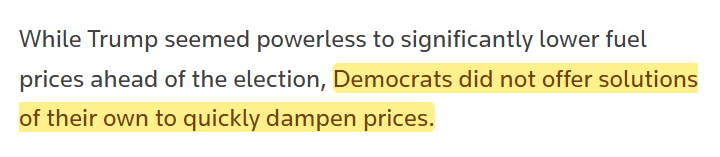
“Democrats did not offer solutions of their own to quickly dampen prices.” That’s probably for the best, because there aren’t any. The supply side of the diesel markets is wrecked, and will stay that way for months. The world has less diesel fuel today than it did two years ago, and until Middle East and Russian refineries come back online, we’re at shortage.
Even if the wars end today and the refineries that were damaged are rebuilt, there’s another problem. The refineries that have been running all-out all year need to be shut down for maintenance and repair.
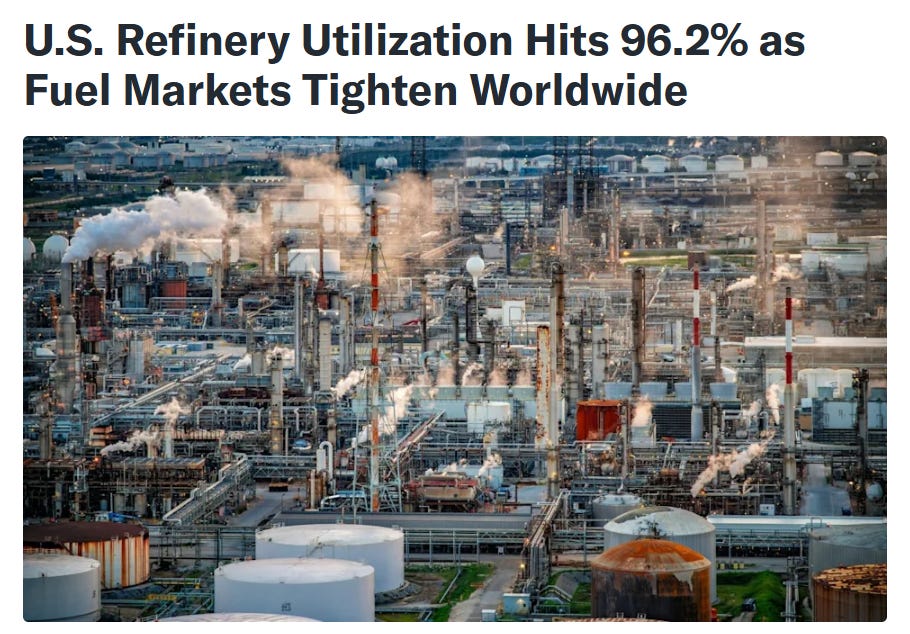
That maintenance has been deferred, and the bill for that is coming due, and so Morgan Stanley forecasts that 3.4 million barrels per day will need to come offline. That’s two and a half times what’s normal, and again it’s because the refineries that are out of range of drones and missiles are running at the highest utilization rates ever.
The volatility in the refined fuels markets is more violent than in crude oil, and that’s saying something. The benchmark oil prices—Brent and the WTI—get all the attention from the guys who write the headlines, but it’s the diesel and gas prices that hit households, and swing elections. We spent a couple of hours Googling, to find a single industry expert or insider who thinks differently from the people right there. :

It’s industry consensus, from the people who are in the supply chains and the engineering and the logistics of the energy markets, that we are a long way from having things back to normal. Even if the wars ended tomorrow, too much damage has been done, and prices to end users will stay high. The stockpiles need to be refilled, which is another floor under prices.
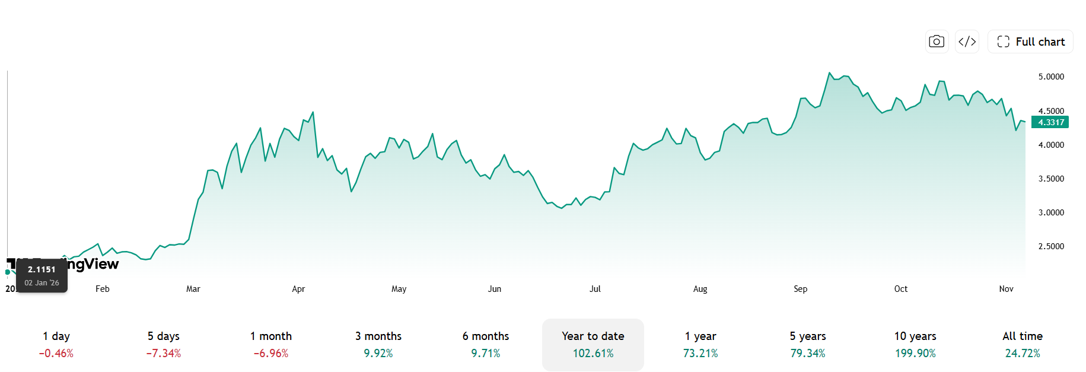
This is the chart for Ultra-Low Sulfur Diesel, traded in New York, and we see for ourselves what those guys are talking about. It started the year at $2.11 a gallon. Today’s it’s $4.30, up over 100% on the year. The problems for refined products are much more structural, compared to just the crude oil. 10 million bpd of refining capacity across the world is offline.
If prices do happen to go down because the wars end, that won’t last for long. The refineries need to be built back, along with strategic reserves and inventories. The market is in “steep backwardation”; spot prices, for energy delivery today, are far higher than the futures price. Buyers are paying high premiums to get diesel right now.
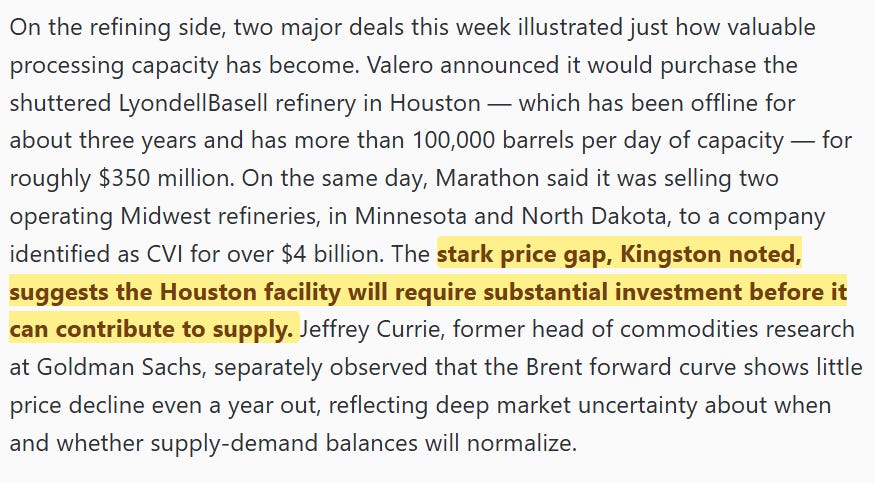
The problems also show up in M&A activity. Valero is a refiner, and will pay $350 million for an idled 100,000-bpd refinery in Texas. Marathon is selling two refineries in the Midwest for over $4 billion. That massive difference means that the Houston plant needs lots of additional investment to bring it online:
Refineries themselves are also responding, by turning more of the crude they buy into the higher-margin diesel and jet fuel. In 2026, US refiners have decreased their proportionate production of gasoline, because it’s more profitable to produce other distillates. In the case of jet fuel, it’s running 2% over the historical average, and diesel is about one percent higher:
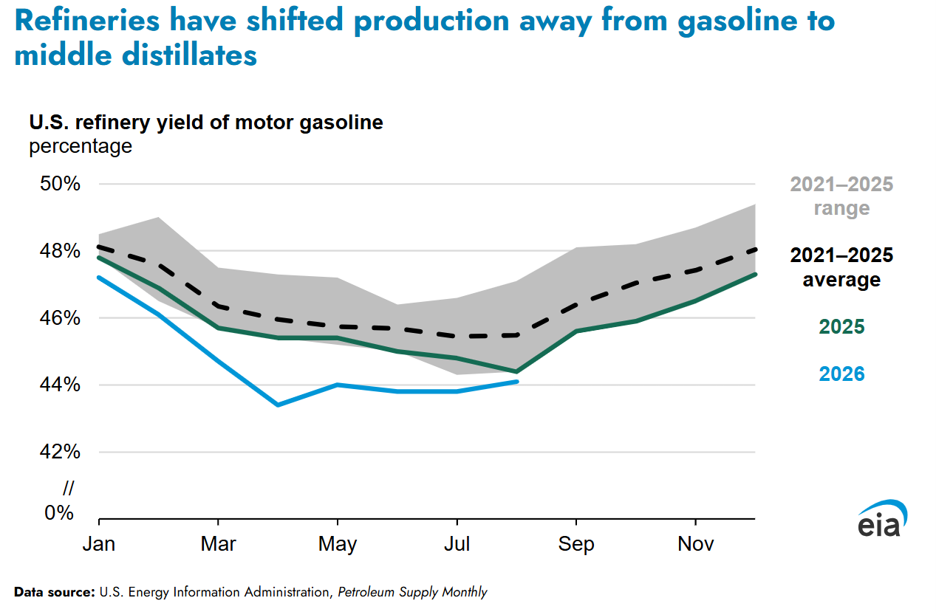
That doesn’t sound like much, and it’s not. At the individual US refinery level, it means they’re booking higher profits. But economy-wide, and worldwide, we’re just pushing on a string.
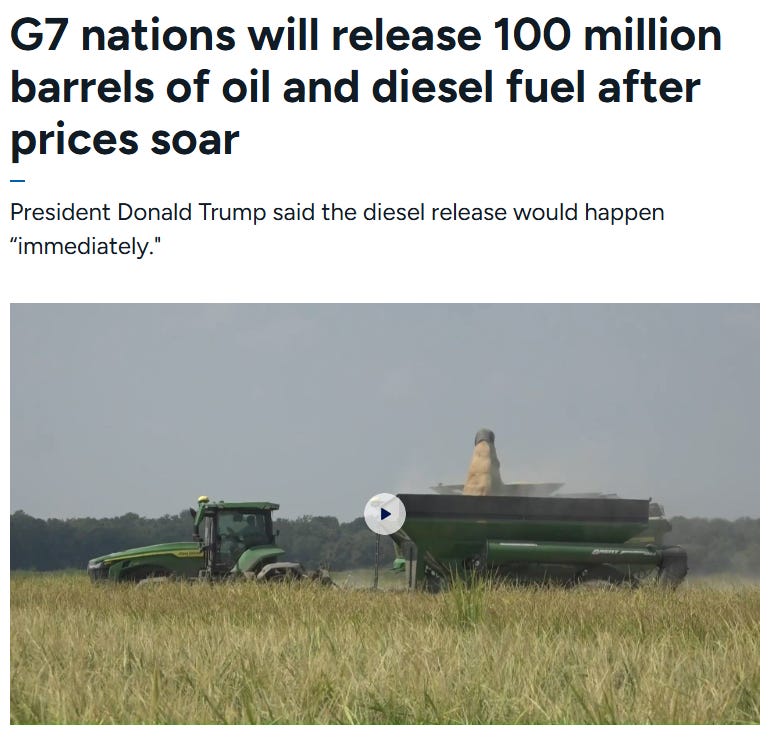
Ten million barrels a day of capacity is offline, and governments are draining the tanks in their strategic reserves to keep planes in the air and trucks on the road, and tractors in the fields.
Be Good.
Resources and links:
JPMorgan and Goldman See Mideast Oil Flows Near Pre-War Levels
https://www.bloomberg.com/news/articles/2026-09-30/mideast-crude-oil-flows-hit-98-of-pre-war-level-jpmorgan-says
JPMorgan says Middle East crude exports back to 98% of pre-war levels as product flows lag
https://www.oilandgasmiddleeast.com/news/jpmorgan-middle-east-crude-exports
Soaring diesel prices helped usher in Democratic sweep
https://www.reuters.com/business/energy/soaring-diesel-prices-helped-usher-democratic-sweep-2026-11-05/
The Diesel Crisis Is Here To Stay
https://oilprice.com/Energy/Crude-Oil/The-Diesel-Crisis-Is-Here-To-Stay.html
Morgan Stanley Sees Fuel Tightness Persisting Through Mid-2027
https://www.bloomberg.com/news/articles/2026-10-21/morgan-stanley-sees-fuel-tightness-persisting-through-mid-2027
‘Band-Aids on a shotgun wound’: Diesel prices to remain high into 2027
https://www.overdriveonline.com/business/article/16274699/bandaids-on-a-shotgun-wound-diesel-prices-will-remain-high
Diesel Prices Collapse, Then Rebound: What’s Driving Volatility?
https://www.freightwaves.com/news/diesel-prices-collapse-then-rebound-whats-driving-volatility
Ultra-Low Sulfur Diesel Futures, NYMEX, Year-to-Date
https://www.tradingview.com/symbols/NYMEX-HO1!/?timeframe=YTD
U.S. Refineries Make Dramatic Shift Away From Gasoline
https://oilprice.com/Energy/Energy-General/US-Refineries-Make-Dramatic-Shift-Away-From-Gasoline.html
Refineries have shifted production away from gasoline to middle distillates
https://www.eia.gov/todayinenergy/detail.php?id=68424
Oil and petroleum products - a statistical overview
https://ec.europa.eu/eurostat/statistics-explained/index.php?title=Oil\_and\_petroleum\_products\_-\_a\_statistical\_overview
The market moves before Trump posts
https://stories.theconversation.com/the-market-moves-before-trump-posts/
The Well-Timed Trades Made Moments Before Trump’s Policy Surprises
https://www.wsj.com/finance/investing/the-well-timed-trades-made-moments-before-trumps-policy-surprises-36e6963a
U.S. to Allow Dark-Fleet Tankers to Shed Sanctions, Wright Says
https://gcaptain.com/u-s-to-allow-dark-fleet-tankers-to-shed-sanctions-wright-says/
Iran is (probably) collecting tolls, and why Asia stopped buying oil from the US
A new global food crisis: farmers can’t get fertilizers out of the Persian Gulf
Inside China / Business is a reader-supported publication. To receive new posts and support my work, consider becoming a free or paid subscriber.
From Inside China / Business via This RSS Feed.