

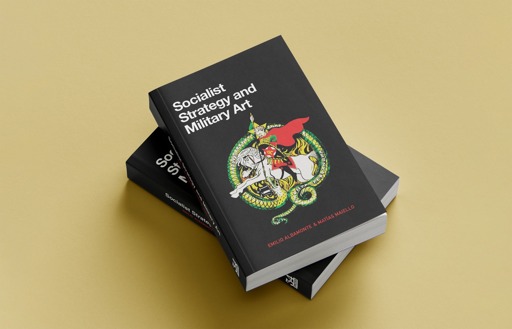
First published in 2017, Socialist Strategy and Military Art by Argentinian Marxists Emilio Albamonte and Matías Maiello returns to the vital question of revolutionary strategy, an issue which seemed to lay dormant for decades. Following the work of important figures in the Marxist tradition, Albamonte and Maiello draw lessons from military theory and strategy — or the “art of winning” in Trotsky’s terms — to achieve working-class hegemony. Today we launch the English edition of the book, with an original prologue by the authors.
The fight for a socialist future is no longer a debate confined to the margins. It is expressed by a massive youth movement across Europe and general strikes in Italy, France, and Spain that put forward demands against militarism and the rising cost of living. In the United States, a new class consciousness is expressed by the rise of the DSA and the strike against ICE in Minneapolis.
These are trends that have been accelerating quickly since the 2008 financial crisis, which created a global economic downturn and marked the end of the “End of History.” No longer could the myth be sustained that the capitalist system would develop and expand without limit. What we saw instead was a world that has become racked by repeated crises, wars, climate change, campaigns against immigration, rising inequality, and an ascendant Far Right. But this new period has also brought with it renewed waves of class struggle, from Occupy Wall Street, to the Arab Spring, to the Yellow Vest movement in France, to Black Lives Matter, to the worldwide movement for Palestine. It is in this 21st-century context that new debates are emerging around the strategy these movements need to seriously confront not only capitalism’s morbid symptoms but the system itself.
Socialist Strategy and Military Art draws on the strategic thought of revolutionaries in the Marxist tradition across the 20th century, including Vladimir Lenin, Leon Trotsky, Antonio Gramsci, and Rosa Luxemburg, while seeking to apply their analysis in a non-dogmatic way to the conditions facing the workers’ movement today. The book also undertakes a critical examination of others claiming the banner of Marxism who are once again becoming a reference point for many on the Left, such as Karl Kautsy, Che Guevara, or Mao Tse-Tung.
Unlike many other books that have taken up the question of strategy in recent years, Albamonte and Maiello connect socialist strategy and military theory, engaging critically with the work of Prussian general Carl von Clausewitz. Though his relevance is often overlooked today, Clausewitz’s military writings were deeply influential for Marx and Engels and later studied by Lenin and Trotsky — not just in relation to the relationship between war and politics, but as a framework for thinking how the working class can conquer power. The authors investigate ideas like workers’ hegemony, the united front, soviets, and dual power as key elements of revolutionary politics.
As Albamonte and Maiello write in the prologue to the Spanish edition:
The world crisis will continue to increase and sharpen class struggle; the question is whether these opportunities are exploited to open the way to revolution and socialism in the 21st century or whether they will give rise to the triumph of the right and, eventually, fascism. This depends on the work of strategy. As Trotsky noted: “Had the Bolshevik party failed to carry out this work, there couldn’t even be talk of the victory of the proletarian revolution. The Soviets would have been crushed by the counter-revolution and the little sages of all countries would have written articles and books on the keynote that only uprooted visionaries could dream in Russia of the dictatorship of the proletariat, so small numerically and so immature.” This may be one of the main conclusions, 100 years after the Russian Revolution, for the new century that has begun. It is the starting point of the work that you find in your hands.
Although the book examines key lessons and political thought from the 20th century, these ideas are closely related to struggles taking place in our own time. The authors spend a significant portion of the book articulating a vision of working class self-organization, and the fundamental obstacle posed by the bureaucracies that control working-class organizations. They aim for the construction of a genuinely international revolutionary party, capable of preserving these lessons and guiding the working class towards its world-historic mission.
First published by Ediciones IPS and the Party of Socialist Workers (Partido de los Trabajadores Socialistas) in Argentina, 34 Press and Left Voice are publishing the English-language edition of this important work. You can order your copy now and we encourage you to share it widely. We offer our pages to debate its contents.
The post Announcing the English-Language Edition of “Socialist Strategy and Military Art” appeared first on Left Voice.
From Left Voice via This RSS Feed.