


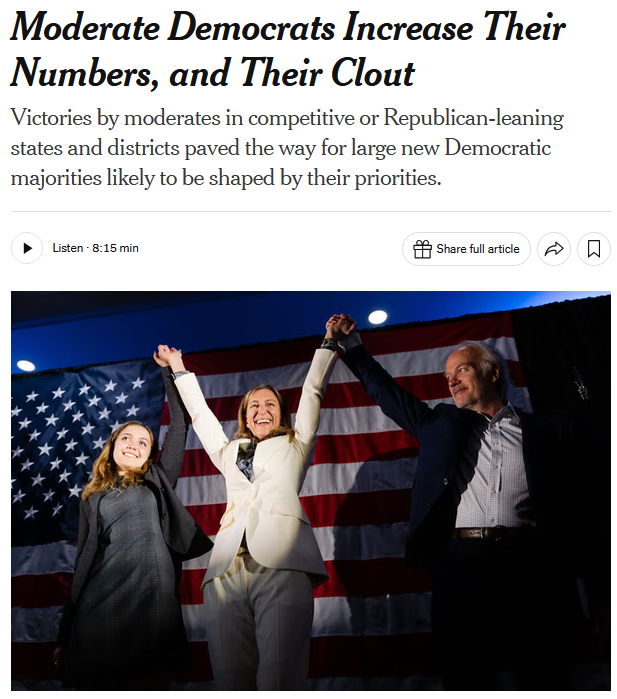
The New York Times‘ Robert Jimison and Olivia Diaz (11/4/26) attributed the Democrats’ November 3 victory to “moderates” who can be “trusted to govern” and offered a “practical alternative.”
Up and down the ballot, across the country, and according to every major news outlet, Democratic candidates won big on Tuesday night. True to form, immediately before and after this sweeping victory—which was largely expected, though its scale and scope were not—centrist Democratic consultants and the corporate press were out in force, warning voters to curb their enthusiasm and stay in the moderate lane.
The New York Times (11/4/26) acknowledged that it was “progressives who helped energize the party’s base,” while suggesting without evidence that progressive policies are favored, not by the rank-and-file voters who turned the country blue, but by ideologically driven lawmakers.
According to the Times, “the path to Democrats’ sweeping victory…was paved overwhelmingly by moderates,” and the new Democratic majorities in Congress were “built around lawmakers who campaigned not as left-wing heroes but as pragmatic populists.” These so-called populists “promised to lower costs, improve healthcare and restore trust in government, not necessarily to deliver…sweeping transformations.”
This is a bold claim to make without explaining what and who “pragmatic populists” are, or how they differ from “left-wing heroes.”
New York City Mayor Zohran Mamdani made three main policies the centerpiece of his mayoral campaign: fast, free buses; universal childcare; and a rent freeze. He has delivered a rent freeze, has begun fulfilling his commitment on childcare, and has made progress on the “fast” part of his promise for buses, without getting to “free.” He talks often about restoring faith in government.
Does that make him a “pragmatic populist” who “promised to lower costs” and “restore trust in government,” a “left-wing hero,” or, as the Times (6/16/25) labeled him in a 2025 editorial, “a democratic socialist who too often ignores the unavoidable trade-offs of governance”?
Progressives in Texas?
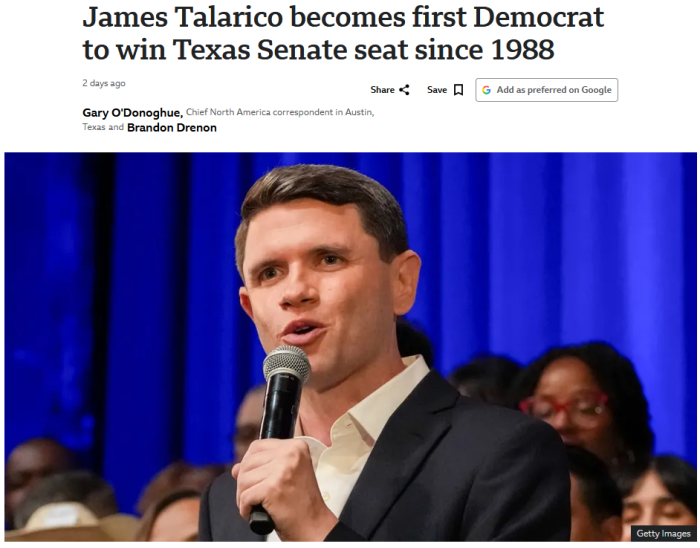
Senator-elect James Talarico (BBC, 11/4/26): “We just proved that all the money in the world is no match for the people of Texas.”
The victories of Democrats across the ideological spectrum, including the moderates the Ne****w York Times singled out for praise**,** were fueled by anger at President Trump and voters desperate for change. Yet regardless of whether candidates described themselves as progressives, socialists, populists or moderates, many ran and won by championing policies favored by large majorities of Americans, from Medicare for All and other forms of healthcare expansion to withdrawing US support for genocide, taxing the rich and paid family leave.
Take Texas: Ken Paxton was Texas’s attorney general for 12 years. On Tuesday, state legislator James Talarico beat him by more than 12 points. Talarico is the first Democrat to win a US Senate seat in Texas since 1988.
Biographically, Talarico may not have much in common with Zohran Mamdani, but he ran on taxing the rich, banning corporate PACs, raising the federal minimum wage, expanding workers’ rights, passing paid family leave and restricting aid to Israel. His Republican opponents labeled him a Communist.
Texans also elected state legislator Gina Hinojosa their first Democratic governor in more than 30 years. Hinojosa served as the vice chair of the Texas Legislative Progressive Caucus; during her gubernatorial campaign, she portrayed herself as an economic populist rather than a progressive or a centrist. Republican Gov. Greg Abbott still accused her of putting “Chinese Communists” above “Texas families.” She beat Abbott, a 12-year incumbent, by more than 7 points.
‘F****ool’s gold of midterms success’
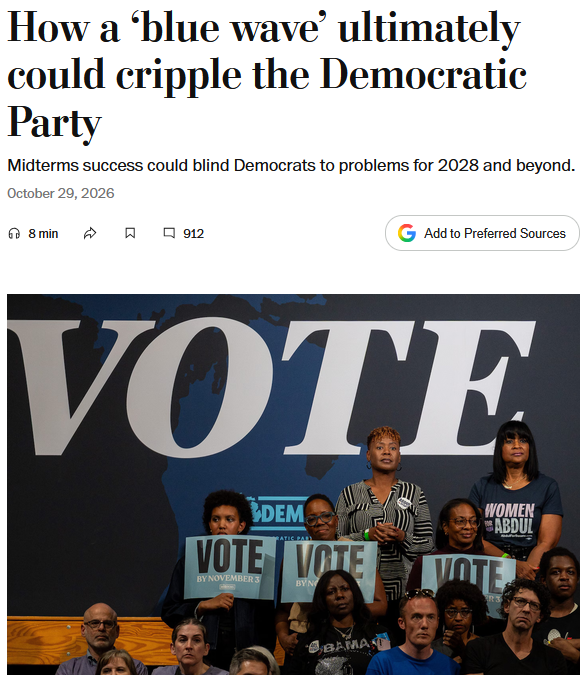
Ruy Teixeira (Washington Post, 10/29/26) dismisses Democratic proposals like “universal child care…Medicare-for-All… taxing the rich and raising the minimum wage” as “suspiciously similar to the laundry list of progressive economic priorities that defined the Biden administration,” which “didn’t work.” One problem with this analysis: The Biden administration didn’t implement any of these policies.
The results call into question the knowledge and expertise of the corporate press, and some of their favorite political scientists and think tank experts. While conceding in its post-election analysis that “Democrats won in a lot of red states,” NPR (11/4/26) then issued a muddled warning to Democrats regarding 2028:
To have a real chance at expanding the presidential map, they need to figure out how to appeal to red-state and rural voters. They showed in this election they can do that, but they won’t have Trump as their rocket fuel in this next presidential election.
So Democrats did indeed show that they can appeal to red-state and rural voters—but they’ll have to do it again in 2028. This is true, if not exactly a revelation.
In a Washington Post op-ed (10/29/26) published days before the election, “How a ‘Blue Wave’ Ultimately Could Cripple the Democratic Party,” political scientist and pundit Ruy Teixeira expressed a similar view as part of his prediction that Democrats might do so well they’d overlook their defects:
The better [Democrats] do in 2026, the more likely they are to ignore their party’s weaknesses with working-class and rural voters. Those weaknesses led to Trump winning the 2024 election, but they are likely to fade from the party’s memory as Democrats, buoyed by the fool’s gold of midterms success, attempt to placate an energized left.
Teixeira offered little insight into how Democrats might meaningfully address these “weaknesses,” other than by “unit[ing] behind a plausible centrist economic program.”
He acknowledged that Democrats were likely to win the pending elections, while warning—or, depending on your perspective, reassuring—readers that Democrats could still blow it by failing to deliver on policy. Teixeira conceded that Democratic candidates’ focus on affordability and economic populism was “a successful formula for this cycle,” but added that it “could have diminishing returns” post-election.
How so? The problem, according to Teixeira, is that Democratic candidates have proposed “a confusing smorgasbord of measures on affordability,” including “regulations that may or may not be successful,” and social policies that are “expensive and extremely difficult, if not impossible, to implement in today’s fiscal climate.” Why even try? After all, these policies are “suspiciously similar to the laundry list of progressive economic priorities that defined the Biden administration,” which “didn’t work.”
Regardless of whether or not these policies worked, or why exactly they didn’t, Americans of all stripes seem to want them: Two-thirds of US adults favor Medicare for All, three-quarters want national paid family and medical leave, more than six-in-ten US adults say tax rates on large businesses and corporations should be raised, about six-in-ten say taxes on household income over $400,000 should be increased, and more than half of U.S. adults want to increase federal spending on childcare.
Since Teixeira is primarily concerned with Democrats’ economic proposals, and his main argument is that voters perceive the Democratic Party as too far left, it’s important to note that, in fact, most Americans support these policies by wide margins.
Demands from die-hards

The Washington Post‘s Nancy Cook
and Katherine Doyle (11/4/26) counterpoised “action on the economy” with “demands…to prosecute Trump”—implying that taking economic action meant absolving Trump.
After the election, the Washington Post (11/4/26) portrayed without evidence Democratic voters’ demands as too contradictory and divisive for party leaders to satisfy:
Wednesday marked a new chapter, too, for Democrats, who will have to decide how to balance voters’ desire for action on the economy with demands from their die-hard supporters to prosecute Trump and other administration officials.
This assertion contradicts available evidence. Die-hard Democratic supporters are not the only Americans calling for investigations of the Trump administration. According to an October AP-NORC poll, 61% of adults surveyed said investigating the Trump administration was either a priority or their highest priority, as opposed to 38% who said it was not a priority.
Other outlets were quick to note what they saw as the lessons Democrats should learn from their triumphs. To the New York Times (11/4/26), the results “showed that the party was still divided: between progressives and moderates, over Israel, over the best path forward.”
The Times’ insistence that Democrats remain “divided” over Israel might still be true of the party leadership, but it is at odds with polls of voters, which indicate that a large majority of rank-and-file Democrats oppose aid to Israel (New York Times, 11/2/26). News outlets report that a “worrying drop in support” for Israel (BBC, 11/4/26), coupled with American Jews’ steadfast majority support for Democrats (Forward, 11/5/26), helped fuel the blue wave. “The Midterms Were a Thumping Rebuke of the US/Israel Relationship,” as a Guardian headline (11/4/26) put it.
‘A toxic position’

The New York Times‘ Lisa Lerer (11/4/26) contrasted “the ‘resistance’ ethos that characterized [Democrats’] response to Mr. Trump’s first term” with candidates who “argu[ed] that the president and his Republican allies were enriching themselves while ordinary Americans struggled.”
In this lengthy story on the midterms, the New York Times (11/4/26) quoted Lis Smith, whom it described not as a consultant best known for working with centrists, but as “a strategist who started a Democratic political group to promote insurgent candidates”—a reference to The Bench, a billionaire-funded PAC that opposed progressives in Democratic primaries.
“This is just the beginning of what is going to be a decades-long rebuilding process. The worst thing Democrats could do is think all our problems are solved,” Smith said. She added, “The problem with a good election night is it can conceal a lot of weaknesses.”
Some of those “weaknesses” were spelled out in an interview Smith did with Politico (11/2/26). “‘We were also seen as being dismissive of people’s concerns,’ she said of 2024 Democrats. ‘Too many people are coming over the border, we’d say that’s Fox News propaganda.'”
She told Politico Iowa’s “Adam Hamilton is a great example” in 2026 of “the types of Democrats we are going to need,” in part because “he is someone who says Biden’s policies on the border were a disaster.”
Abolishing ICE, Smith says,
if you are in upper Manhattan in a, you know, gentrifying district like Darializa [Avila Chevalier] is, fine. That’s a fine position to take. But my Lord is that a toxic position in almost all of the states and districts that the House and Senate are going to come down to.
ICE is an agency that among Democrats and Democrat-leaning independents nationwide—not just in “upper Manhattan”—has an 84% unfavorable rating. In the CBS exit poll (11/5/26), 58% of 2026 voters said Trump’s immigration enforcement has gone too far—roughly the same as the 55% of the national vote Democrats received. It seems more likely that defending ICE and Trump’s border policies is the “toxic position.”
Democrats won big on Tuesday, but few would argue that Americans have a favorable view of either major political party. And many would say that a primary weakness of the Democratic Party is its overreliance on self-serving consultants who offer quick fixes for the major structural problems that fuel and reinforce political alienation.
From FAIR via This RSS Feed.