

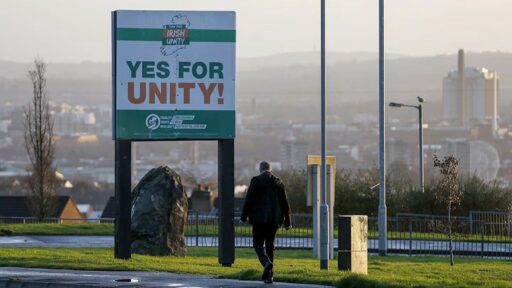

Irish Prime Minister Micheál Martin recently announced plans to establish a government body to prepare for different scenarios for the country’s constitutional future, including the possibility of a united Ireland. A first round of updates about this plan are expected before the end of the year.
In addition to outlining the scenario of a unitary Irish state, the body would also be tasked to prepare for a possible continuation of the existing situation, and “a future united Ireland in which Northern Ireland would remain a devolved entity, maintaining its own separate assembly and government, civil services, public services and police,” Martin said in an interview with The Irish Times in late October.
“Sinn Féin believes that a united Ireland is the best future for all our people,” party leader Mary Lou McDonald stated in response. “Ending partition and bringing our country together offers the biggest opportunity to build a stronger economy, deliver better public services and create a fairer, reconciled society across the whole island.”
Sinn Féin: unification would strengthen Ireland economically and politically
Martin’s announcement came four months after parliamentarians voted on a Sinn Féin bill on reunification, which proposed deadlines for the government to develop a plan for the organization of public services and other areas of life in a united Ireland.
Sinn Féin has argued for years that reunification would bring an opportunity to strengthen the island politically and economically, providing space for planning jobs and creating a unified healthcare system.
“Through Unity, we can build the best education and childcare systems for every child and young person,” McDonald said earlier this year. “We can strengthen public services, tackle poverty, and build a fair society in which disabled people and those who care are supported to live lives of equal citizens.”
The proposal, named the Planning for Constitutional Change Bill, also proposed a citizens’ assembly to ensure different perspectives are represented.
Read more: A new spring for Irish unity
In July, Martin’s Fianna Fáil and government partner Fine Gael voted against the Sinn Féin proposal, citing concerns over the bill’s time limitations and participation models. At the time, McDonald defended the timeliness of initiating reunification from the Irish side as the Good Friday Agreement approaches its 30th anniversary.
“There has been nothing rushed, hasty or pre-emptive about this process,” McDonald said. “Over the last three decades, we had big challenges, disagreements, political confrontations, we have had high and lows – of that there is no doubt.”
“However, the peace is secure. It is robust, resilient and commands wide support. It is now time to write the next chapter. The chapter of reunification.”
A counter-reaction against unity momentum?
Part of the responsibility for building this process, however, also rests with the British government – which is tasked with organizing a referendum if it becomes apparent that a majority of people in the north of Ireland would support leaving the United Kingdom.
British Prime Minister Andy Burnham oscillated on this issue in recent appearances. In August, he described a border poll as “off the table.” His reaction was followed by an initiative launched by pro-independence parties from Wales, Scotland and Ireland, who signed a memorandum of understanding in September, pledging joint efforts toward self-determination.
Watch: Is the UK breaking up? Ireland, Scotland & Wales unite for independence
Some critics have also emphasized attempts to derail growing talks about reunification, including in the context of recent events on Garvaghy Road. In late September, members of the Portadown community organized protests and resistance to attempts by the Orange Order’s Drumcree march to pass through the largely Catholic area.

Thousands gathered at Garvaghy Road. Photo: Sinn Fein
“What happened at Garvaghy Road is a manufactured political crisis, which has been over two years in the making,” wrote Sinn Fein’s Declan Kearney. “The subtext to what is happening is the next year’s Assembly and council elections, and the objective of removing Sinn Fein as the largest party in the north and Michelle O’Neill from the position of First Minister.”
“The current perfect storm of whipped up sectarian polarization and political instability is a pre-meditated counter-reaction to the growing momentum for Irish unity,” he added. “This is being driven by those sections of the British state, which are determined to prevent the right to national self-determination, and holding a unity referendum.”
From BT News via This RSS Feed.