


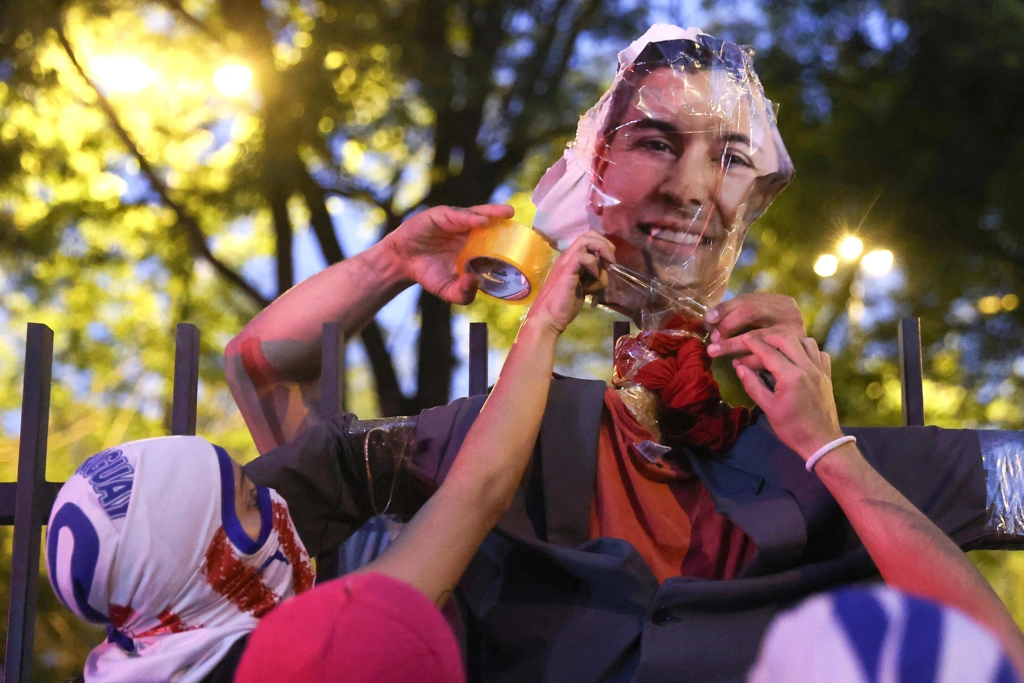
Paraguay’s Senate removed President Santiago Peña from office on Friday, finding him guilty of poor performance of duties in an impeachment trial over the collapse of Ueno Bank.
The vote was 44 in favor with one senator absent, out of 45 senators. Santiago Peña did not appear at the trial and left his defense to his lawyers.
Peña, 47, becomes the second Paraguayan head of state in recent history to be removed through a political trial. The Senate also ordered every record of the case sent to ordinary courts.
Vice-president Pedro Alliana will assume the presidency. Several legislators described him during the hearing as part of the Ueno scandal, meaning the political team that surrounded the outgoing leader remains in command.
RELATED: Six Ueno Bank Executives Sent to Pretrial Detention in Paraguay Probe
The proceedings began Thursday, when the Chamber of Deputies approved the accusation with 78 votes. That same day Peña submitted his resignation, but a vote on it in a joint session of Congress collapsed for lack of quorum after ruling-party lawmakers left the chamber, so he remained formally in office.
The resignation was a tactic to obtain the status of lifetime senator, which carries immunity until Congress lifts it. Article 189 of the Constitution says democratically elected former presidents become lifetime senators unless they have been impeached and found guilty.
🇵🇾 BREAKING: Paraguay’s Senate just convicted President Santiago Peña of misconduct and removed him from office over the collapse of Ueno, a digital bank linked to his business interests.
Senators rejected his resignation, stripping him of the lifetime seat and immunity given… https://t.co/C70qmexhjr pic.twitter.com/14N2Rm9kYN
— NewsForce (@Newsforce) November 6, 2026
Accusations and Defense
Deputy Rocío Vallejo, one of the accusers, told the Senate that Peña created a $1.2 billion hole for Paraguayans and left three million people affected in a single day, referring to the Central Bank’s intervention in Ueno Bank on November 3. She affirmed that the central issue was the theft of public money and serious damage to pension funds, and that five pension funds, including the Social Security Institute (IPS), were left without resources.
“Santiago Peña must leave this Congress with the political sanction of being the largest embezzler in the history of Paraguay, and in a serious country that is poor performance of duties,” Vallejo declared, rebutting a defense that dismissed the accusation as null.
The defense rejected the case. One of Peña’s lawyers, Ricardo Preda, called the accusation a “theory” and argued that banks fail everywhere but that no country has removed a President over it. The defense also called the accusation null. The Senate had earlier rejected, by 39 votes to three, Peña’s request for 72 more hours to prepare his defense.
About 60% of Paraguay’s adult population, nearly three million people, had their financial lives at Ueno Bank. Prosecutors and accusers allege that during Peña’s term large sums of public funds were placed in the bank, which used them for unsecured loans and irregular overdrafts to at least 23 companies owned by or commercially linked to the bank’s leadership. The Central Bank found that Ueno’s solvency ratio had fallen below 50% of the required minimum, and the bank had 2.9 million clients in a country of 6.1 million people.
Santiago Peña, President since 2023, held shares in the bank’s parent business group until well into 2025. Ueno Bank received state contracts under his government, and that Peña appointed Carlos Carvallo, a former president of Ueno finance company, as Central Bank chief. Carvallo resigned on November 3.
Vice-president Pedro Alliana, whom several lawmakers named during the trial as part of the Ueno scandal, will succeed Peña. The Chamber of Deputies earlier rejected an impeachment request against Alliana, by 48 votes to 30.
From teleSUR English via This RSS Feed.