

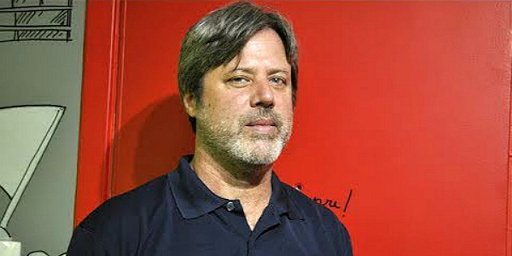
Janine Jackson interviewed Panamerican Dispatch*‘s Brian Mier about the 2026 Brazilian election for the* October 30, 2026, episode of CounterSpin*. This is a lightly edited transcript.*
https://media.blubrry.com/counterspin/content.blubrry.com/counterspin/CounterSpin261030Mier.mp3
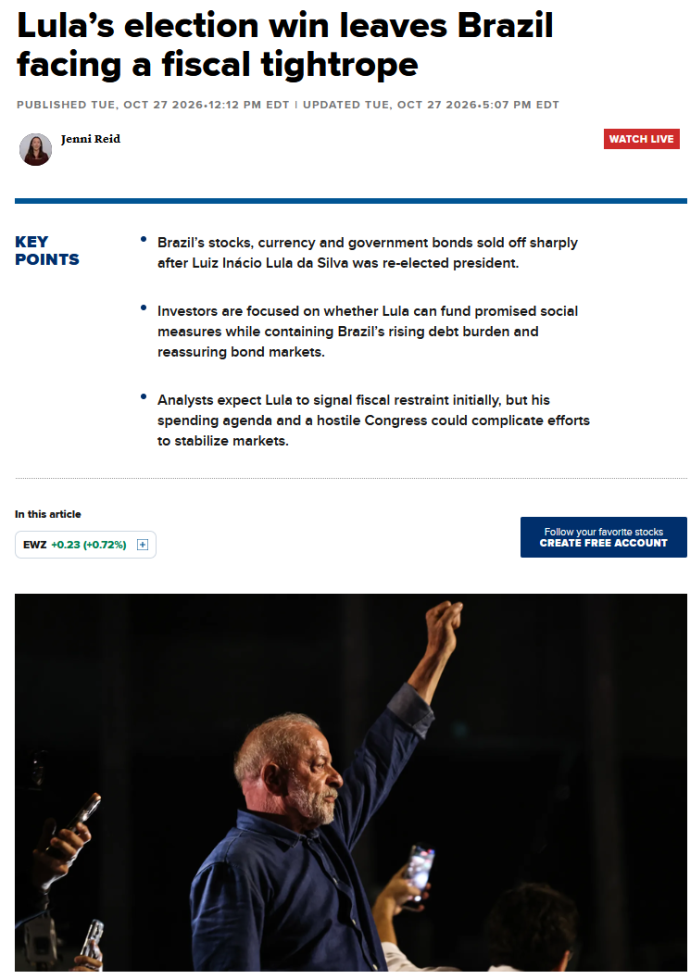
CNBC (10/27/26)
**Janine Jackson: “**We don’t want dictatorship. We don’t want hatred. We don’t want guns. We want a country of love.” So said Brazil’s Luiz Inácio Lula da Silva on the night before his electoral victory over Flavio Bolsonaro, who has subsequently fled the country and been granted asylum immediately in the US, because of course.
I found that quote in the New Republic and the Guardian, but most of US corporate media ignored it in favor of hand-wringing, like CNBC‘s “Lula’s Election Win Leaves Brazil Facing a Fiscal Tightrope.” That included the note that his victory “wiped out a rally in Brazilian assets that followed Flavio Bolsonaro, seen as the more market-friendly and fiscally disciplined of the candidates.” And it added a familiar warning, “Lula has promised expensive measures that appeal to his grassroots base.”
We can expect more of this going forward, but US media certainly won’t be the only headwind that Lula will face. Still, his victory has brought relief, and maybe even a little hope, to millions of people in Brazil and around the world.
Brian Mier is an editor at Panamerican Dispatch and Brazil correspondent for TeleSur English. He joins us now by phone from Recife. Welcome back to CounterSpin, Brian Mier.
Brian Mier: Thanks for having me.
JJ: Listeners will know that the race was tight down to the wire, and that Bolsonaro had won the first round and, evidently, the runner-up winning the second round hasn’t happened for decades. And I just want to ask you, first, where were you when the results were announced, and what was that energy like?
BM: I was so stressed out about the election that I sat in a restaurant, with a buddy of mine, that didn’t have a TV. But we were just checking our phones sporadically, and we started hearing screams from the streets. And then when the tally got up to about 80%, it was pretty much guaranteed that Lula had it, and people were just running around screaming.
So we got on the subway and headed up to Paulista Avenue. The subway itself was like a carnival ride, full of hundreds of people in red, singing and chanting for Lula. And we arrived on Paulista Avenue, where an estimated crowd of 1 million came out for the victory celebration. And it was pretty intense. It was pretty big. It was a lot bigger than 2022.
JJ: I’m reading that the difference between the first round and the decisive round had to do with young voters in particular, but also in just increased turnout.
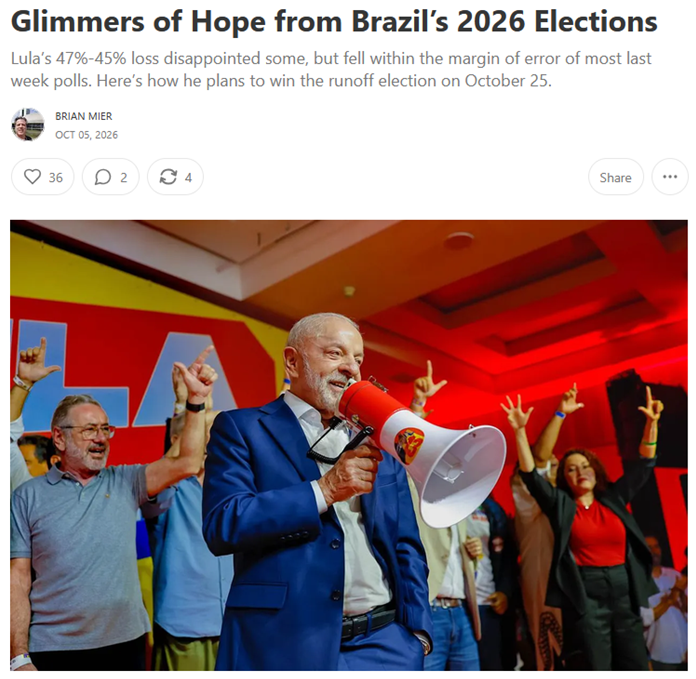
De-Linking Brazil (10/5/26)
BM: Yeah. Well, I wrote an article called “Glimmers of Hope From Brazil’s 2026 Election” like two days after the first round. It wasn’t as bad as people were portraying it. Basically there was a two-point margin of error, and polls had them pretty close to tying, and Bolsonaro won by like 1.8%. But the PT, Workers’ Party, analysis was that they would have a much better chance targeting people who didn’t vote in the first round than trying to change the minds of Bolsonaro fanatics.
And so that’s what they focused on, and they focused on it in two different ways. At the grassroots level, the way they always do, the old-fashioned way, because it’s a party founded by labor union organizers, which is knocking on doors, talking to people at bus stops, handing out pamphlets on the street, talking to your relatives, getting older relatives to come out and vote, because voting is optional for people over 70.
So a big untold story is just the massive amount of senior citizens who remember the dictatorship, who didn’t go out and vote in the first round because they thought Lula was going to win anyway, who put on red, got in their wheelchairs, got wheeled to the polling stations. Some people in their 90s, with their canes coming out to vote for Lula.
So in the end, 14 million more people voted in the second round than the first round. Of those 14 million, 10.3 million voted for Lula and 3.7 voted for Bolsonaro. So it was a good strategy, and it worked.
JJ: I saw that AP said that the victory depended on “younger, older and working class voters.” And I thought, well, who else is there?
BM: Nazis.
JJ: Exactly. I don’t want to underestimate the difficulties that Lula faces now, besides these financial pressures and congressional hostility, but what would you say are the biggest kind of obstacles within Brazil itself, and the region? We’ll get to the US in a second, but what is he confronting out of the gate?
BM: You see the way the Western media is portraying him as being fiscally irresponsible, as all leftists are, according to their 19th century liberal doctrine of fiscal responsibility, a la Margaret Thatcher. But the fact is there’s massive climate change–related weather disasters that have to be prepared for, and the risks have to be mitigated, and this costs money.
In terms of fiscal responsibility, when Lula took office the first time, Brazil only had $50 billion in foreign reserves. When Dilma Rousseff was impeached, the Workers Party had amassed $360 billion in foreign reserves. So they’re not a fiscally irresponsible party, and the amount of debt that Brazil is in is much lower as percentage of GDP than the United States, for example.
The economic issues are not the real problem. The problems facing Brazil, I think, are climate-related. They’re related to the wave of conservatism spreading across Latin America, animosity from neighboring Argentina that’s working very closely with Trump, future animosity from the Trump administration or the US government, and just being able to govern with a very right-wing Congress.
A lot of people are exaggerating how hard that’s going to be, because they don’t know the history of how Congress works in Brazil. But even at the height of Lula’s popularity, in the 2000s, the Workers Party never had more than 22% of the seats in Congress. Currently, after the last election, it has about 19%, 18%.
Lula has never governed in a situation in which Congress wasn’t dominated by right-wing political parties. And he’s been pretty good at stitching together workable coalitions that enabled him to push things through, like the constitutional amendment that he just pushed through, he spent four years working on, that reduced Brazil’s work week from five and a half days a week to five days a week, which was a historic victory that people have been working towards for decades.
But that being said, there are challenges in that. For example, it’s funny, you see people like Glenn Greenwald, people who read Glenn Greenwald and listen to Glenn Greenwald, and a series of New York Times articles trying to portray Brazil as this country that’s dangerously veering towards authoritarianism.
But the fact of the matter is Jair Bolsonaro’s wife was just elected to Senate. Jair Bolsonaro’s third son, Carlos, was just elected to Senate. The man who oversaw the kangaroo court procedure that culminated in Lula’s arbitrary imprisonment, with no crime committed, in 2018 was just elected governor of Parana state.
So he is going to have some headaches from these people, from Bolsonaro’s allies. Some of them are going to switch over to Lula’s coalition, but some of them are going to continue to give headaches to the government.
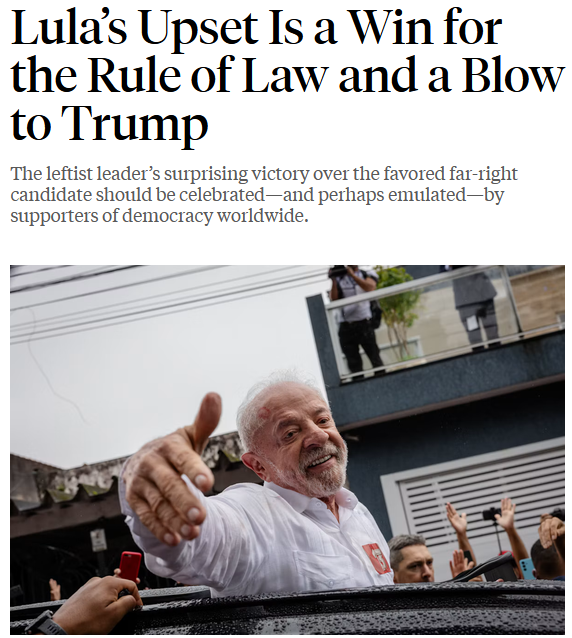
New Republic (10/25/26)
JJ: Well, Trump, of course, was out in front crying “corruption,” that’s no surprise. And then inventing new asylum rules that would allow Flavio Bolsonaro to just slide right in. And then I’m reading in the New Republic about behind-the-scenes State Department meddling, asking diplomats in Brazil to do everything possible to undermine Lula. What can we expect in terms of Brazil/US relations, and how much does or should that matter?
BM: It should definitely matter, because the US has a long history of intervening and propping up neo-fascist dictatorships and far-right-wing authoritarian leaders in all of Latin America. And traditionally, as laid out by Philip Agee in the CIA Diary, which is a great book from the 1970s, the State Department will first hope that their candidate can win in Latin America in a free and fair election. If that doesn’t look like it’s going to work, they start interfering in the election to prop up their candidate, which is what we just had happen in Brazil.
If that doesn’t work, historically, the next step would be to try and foment some kind of coup d’etat. And we saw this happen in Brazil in 2014, when the Democratic Party was gunning for Aecio Neves, an extremely corrupt neoliberal who used tax money to build a private airport on his uncle’s ranch. And he’s involved in all kinds of corruption scandals that they look the other way for.
When he lost the election against Dilma Rousseff, he immediately refused to recognize the results of the election. He called for an audit of the votes, which happened and confirmed Dilma’s victory. And then they paralyzed Congress, so that Dilma Rousseff could get nothing done.
The fact of the matter is that Lula is a more savvy politician than Dilma Rousseff. I don’t think he’s going to have that problem.
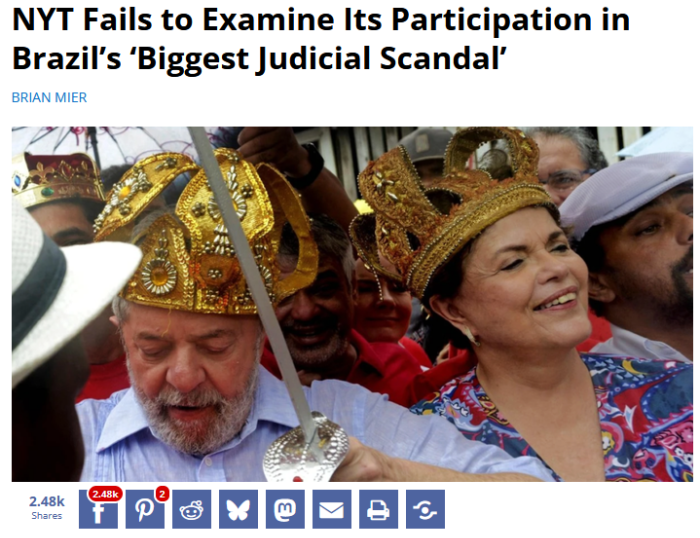
But that’s when they started the whole anti-corruption witch hunt called Lava Jato, or Operation Car Wash, which was a collaboration between the US Department of Justice, the FBI and this Curitiba public prosecutor’s office, in a case overseen by this judge who was just elected to be governor of Parana. And the New York Times gave that entire investigation glowing coverage, and it contributed to Dilma Rousseff’s illegitimate impeachment. So that’s the most recent time that the US has stepped in to overthrow Brazil when it wasn’t happy with the election result.
In this case, I think it’s going to be a little bit different, because it looks like Trump is already backing off in his support for Flavio Bolsonaro. I think in Trump’s mind, he’s got this mental list in his head, in that tiny brain of his, in which he categorizes people in binary fashion. They’re either winners or losers, and he doesn’t want to be around losers. And I think in his mind, Flavio Bolsonaro is now a loser. So even though Marco Rubio and other people in the Trump administration might be trying to help Flavio Bolsonaro, I don’t think Trump is on board with it.
And I think that if the Democrats win the majority in Congress, it’s going to create a bunch of headaches for Trump’s plans in Brazil as well, because the Bolsonaros made the very foolish move of completely siding with one political party in the United States.
At first, the Biden administration seemed happy to work with Jair Bolsonaro, but then a very good group of Democratic lawmakers—about 30 of them at the time, led by Hank Johnson from Georgia—managed to convince the rest of the party that, really, the closeness between Bolsonaro and Trump was bad for the Democratic Party. And so when Bolsonaro started trying to set up the coup, apparently, from what I know from Brazilian media sources, he sent an emissary to ask for help holding a coup to the Biden administration. And the Biden administration said no.
And so I think now, because of so much public association between Bolsonaro and Trump, if the Democrats take control of Congress, they’re going to look the other way at some of Lula’s annoyingly effective social policies, which the corporate Democrats seem to hate, like increasing funding for the free universal public health system, and free university tuition. And they’re going to at least try to cause some problems for Trump’s imperialist “Donroe Doctrine” ambitions for Brazil.
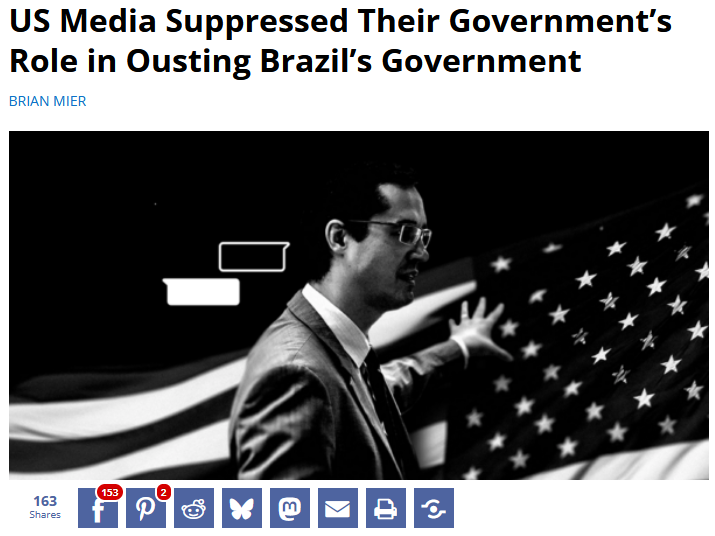
JJ: And I want to tell folks that you wrote about what you described as the “long coup,” and US media’s involvement in that, meaning that time between the 2014 Dilma Rousseff’s impeachment and then 2019. And folks can look at FAIR.org for your 2023 piece on that. But what I want to lift up from that is your quote:
For over half a century, intervening against democratically elected governments has been only half the story. The second half involves justifying, minimizing or denying US involvement.
And I think that’s where news media come in, right?
BM: Not just denying, but gaslighting journalists who try to talk about it. There’s an industry of denying the coup, but they don’t just stop at denying the coup. They try and destroy the careers of journalists that talk about it. Look at what happened to Gary Webb. They go after journalists for talking about US involvement in regime change.
Paul Krugman (10/26/26)
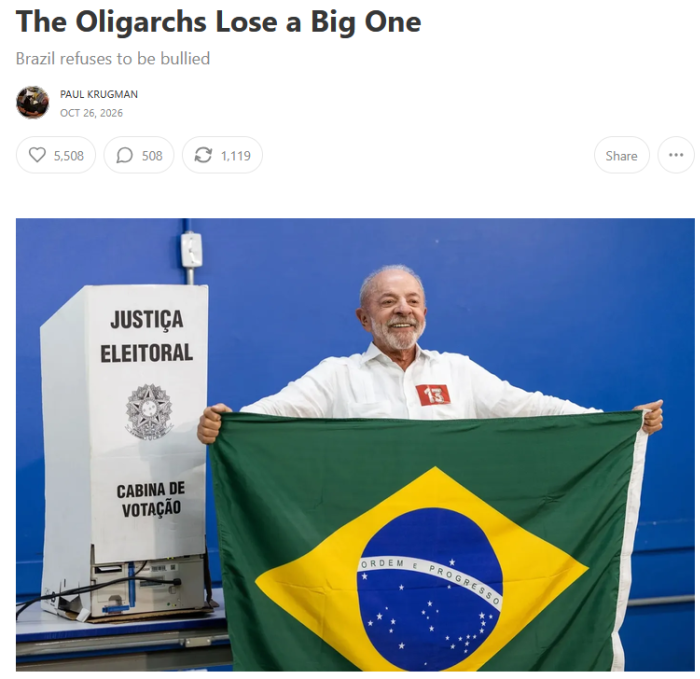
JJ: Well, we hear now from Paul Krugman that Meta, unsurprisingly, frankly, was doing some meddling, hobbling Lula’s account and promoting Bolsonaro’s. That’s kind of par for the course. But I understand that social media also played a positive role, such that people are asking, can they dress up for Halloween as Cyber Lula?
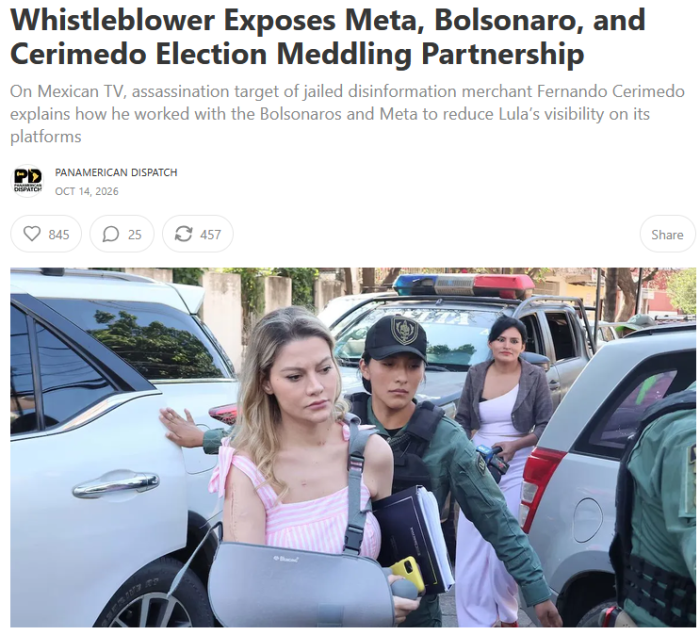
BM: This was really interesting, because the ex-girlfriend of Fernando Cerimedo, whose a kind of cyber-bag man for the international far right in Latin America—he was involved in generating thousands of deep fake AI images in the Colombian election based out of Argentina, friends with Milei—he was arrested for attempting to murder his girlfriend, a lawyer in Bolivia, and she survived and went on Mexican television, Channel 14. Nadia Beller is her name.
She went on Channel 14 and gave an interview saying that Fernando had told her that he and Eduardo Bolsonaro, Flavio’s brother, had gone to Meta headquarters in California and negotiated a deal for supporting the Flavio Bolsonaro campaign by boosting its algorithm and damaging the Lula campaign. And that seemed to be what was actually happening, as the two candidates had pretty much equal reach until about 12 hours before the first-round election. And then suddenly Lula’s reach remained the same, and Flavio suddenly had five or six times more reach than Lula, even though he had less followers.
Panamerican Dispatch (10/14/26)
And so then a bunch of Brazilian journalists did some really good work, and people started testing Meta AI, and Meta AI was refusing to design campaign logos for Lula, but designing them for Flavio.
And so the Supreme Court ordered Meta to provide equal reach for both candidates. Amnesty International and Eko both tested its system of monitoring, and proved that it was very easy to take out illegal campaign ads from outside of Brazil, that’s a crime in Brazil, and also to use them to present disinformation that made it past Meta‘s content moderation. So the Supreme Court ordered Meta to stop allowing that to happen and to provide equal reach, no pushing for either candidate’s reach.
And Meta initially ignored the court order, then protests started happening, then it started reaching the international media. Protests happened in London, in front of Meta‘s headquarters in Ireland and Sao Paulo. And it looks like by the end, the final week before the election, Meta made some kind of decision that it was too damaging to their reputation to continue favoring Flavio Bolsonaro in reach. And the Lula campaign ended up surpassing Flavio’s reach by like 400%.
And part of this is because of a really great congressman named André Janones. I say great, I mean, he’s just really smart, he’s from the working class. And he came up with this idea to bypass Meta‘s algorithms by creating this WhatsApp group and asking everybody to get everyone they knew to sign up to it. And by a couple days before the election, he had 10 million followers, in a group that was only a few weeks old.
And every day he’s just coming on, every hour, just yelling at the camera, sending these videos out where he’s yelling like, “Nobody sleeps. Nobody eats. We can’t do anything until the danger of return to dictatorship is permanently vanquished from our country.” And people are just sharing this stuff around. He’s like, “Go to this site. Use this hashtag. If you have a friend who doesn’t know who to vote for, send him this article.” Every hour he’s coming out with instructions like that, and it worked. It’s pretty incredible. And now leftist political parties around the world are asking him for help.
JJ: As well they should.
I wish we had more time, but I just want to say, I did notice some US press with an unsurprising emphasis, even within some ostensibly respectful coverage, but an emphasis on, “Lula has overpromised, like leftists do, but he won’t be able to deliver.” And it sounds like a threat, frankly. But I just wonder what you would have listeners take away, in terms of what you’re going to see in US news media about Lula, and what antidote should you take with that?
Carbon Brief (9/28/26)
BM: Yeah, it’s funny. This criticism of Lula has seeped into a lot of leftist commentary as well, that he didn’t really do anything for the last four years.
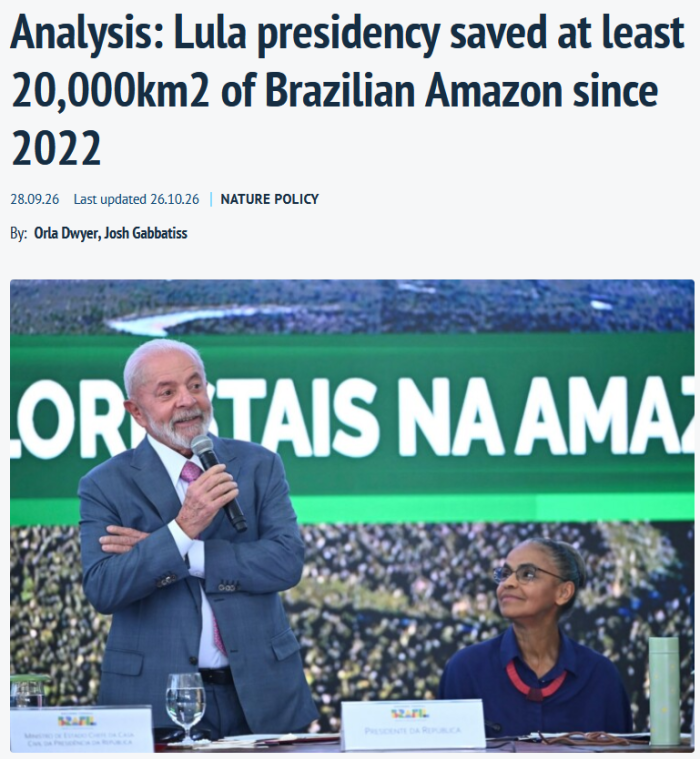
He ended hunger; he took Brazil back off of the the UN’s World Hunger Map. Annual above–inflation rate minimum salary raises. He lowered the work week, with no pay reduction for anyone, through a constitutional amendment. He ended a genocide that was underway against the Yanomami people in the Amazon, committed by illegal gold miners that had been encouraged by Bolsonaro to move into the area. He reduced Amazon rainforest destruction by like 79%, tripled money on renewable energies, and rebuilt the public university system and built new universities. But they don’t report on any of this.
So he’ll keep keeping his campaign promises, and the Northern media will just pretend he’s not doing anything, because a lot of the policies are too complicated to explain in soundbites anyway.
But it’s frustrating, because I’ve seen people, even on a Facebook page of a frequent FAIR contributor, I saw some guy arguing that Lula hadn’t done anything in the last four years. And well, first of all, it’s the government, right? If you’re a leftist, you shouldn’t individualize a leftist movement. That’s what capitalists do. But the fact of the matter is, just do some research and find out what they’re actually doing. And you’d be surprised. I mean, he promised to make online gambling illegal if he were elected, and then he just went ahead and did it anyway before the election.
He’s done a very good job, in three different presidential terms, of working around a right-wing Congress, and managing to make structural adjustments that have significantly increased the quality of life for Brazil’s large working class.
When he first took office, only 4% of the students in Brazil’s public university system—which is still tuition-free, even though Bolsonaro tried to start charging tuition for it—only 4% of the students were Afro-Brazilians from the working class. The PT, the Worker’s Party, set up an improvement over the US affirmative action system that’s locked into social class. So a requirement is that you have to have studied in public schools and come from a family that makes less than two times the minimum wage.
Today, 52% of the university population of the student body in a nationwide public university system is Afro-Brazilian and working class. And these were the young people who came out in massive numbers on the streets for Lula to protect the rights that they have earned, that they’ve won in the last 25 years, that the Bolsonaros, the US international imperialist class, want to remove.
Flavio Bolsonaro was promising to defund the public university system. Because it can’t end the affirmative action; that would be electorally impossible. So he was promising a backdoor strategy, transferring the public university system out of the Ministry of Education into the jurisprudence of the Ministry of Science and Technology. And that would have removed it from the constitutional requirement of funding from a certain percentage of income tax money every year, would have resulted in massive defunding for the entire system.
So since it’s politically impossible for them to end affirmative action, their plan was to destroy the system, and then say, you have to start charging for tuition, so that it transformed into another thing for only elites. Only the elites in Brazil would be able to afford it, which is what it was like until Lula first took office in 2003. And that’s just one example.
JJ: Yeah. And I will just say, the idea that folks will pay attention to Brazil and learn something from it—I understand why some people are afraid of that.
So, just finally, we understand the hope and the fear that is coming out of this victory, yeah?

Brian Mier: “I don’t know to what depths the United States government will go this time around to try and destroy Lula, which they’ve been working on for decades.”
BM: Yes. But I think that if you look at both the hope and the fear, the hope has definitely beaten the fear. And, if anything, people are going to remain vigilant to protect their rights and their government, more than ever right now, from US incursion. I don’t know to what depths the United States government will go this time around to try and destroy Lula, which they’ve been working on for decades. But I feel like he’s in a stronger position now than he has been for the last four years. I mean, it was a massive victory. If it weren’t for Meta, he would have won by 10 million votes.
JJ: Exactly. And what I mean is, I think that some people will be afraid that the involvement in Brazil means that, “Oh, maybe people will get an idea that people can fight for people, and we don’t want that.” So I think we can expect from media a kind of dampening down, because heaven forbid people take a lesson that you can have a bottom-up victory the way that we had in Brazil.
BM: It’s true. And they would much rather have someone like Gabriel Boric in Chile, who just was a lifestyle leftist who didn’t do anything economically, than have someone who might say inappropriate things now and again, and might not be very modern, but does a lot of transformative policies to improve the life of the working class at the expense of big business, redistribution and things like that.
JJ: All right. Well, we will end it there, but we’re going to have future conversations.
We’ve been speaking with Brian Mier. He’s an editor at Panamerican Dispatch and Brazil correspondent for TeleSur English. Thank you so much, Brian Mier, for joining us this week on CounterSpin.
BM: Thank you. It’s always a pleasure.
From FAIR via This RSS Feed.