

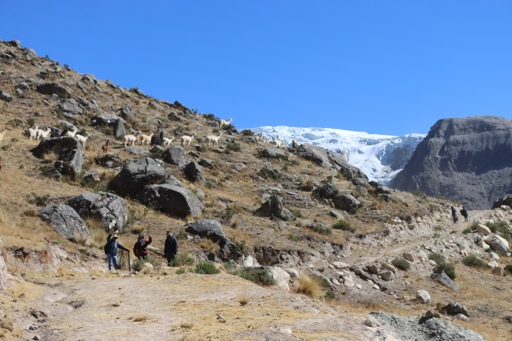
Like many in the community of Phinaya, in southeastern Peru, Donato Bermúdez makes his living from alpacas. His flock of 500 roams the slopes beneath the vast Quelccaya glacier, the site of the second-largest tropical ice cap in the world. Reaching 5,600 meters (18,400 feet), its white peak is home to centuries of tradition. “We believe the glacier is essentially alive,” Bermúdez, a lifelong resident and former community president of Phinaya, told Mongabay by phone. “We say it gives us the water, the lifeblood that flows to the community.” But he and other Phinaya locals now fear that a threat may be looming from the other side of the mountain. In the shadow of Quelccaya, long-delayed lithium and uranium mining projects are gaining fresh momentum under President Keiko Fujimori, who is determined to put transition minerals firmly on Peru’s economic agenda. “Lithium and uranium mining would be catastrophic for the Quelccaya glacier,” said Yolanda Quispe, 44, a community leader and park ranger from Phinaya, who has spent a lifetime beneath the glacier. “The fauna and flora that exist around it, the people — all of this would be destroyed,” she told Mongabay over the phone. Through Peruvian subsidiary Macusani Yellowcake, Canadian firm American Lithium controls major deposits of lithium and uranium — two minerals the Peruvian government describes as critical to the clean energy transition — across at least 174 concessions covering more than 1,090 square kilometers (421 square miles) in the department of Puno, beneath the Quelccaya glacier. The…This article was originally published on Mongabay
From Conservation news via This RSS Feed.