

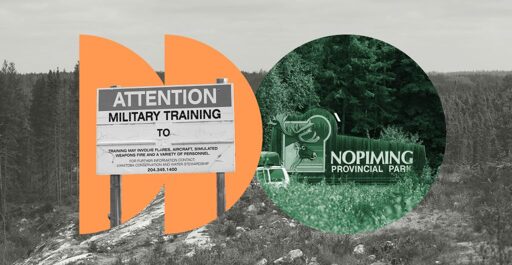
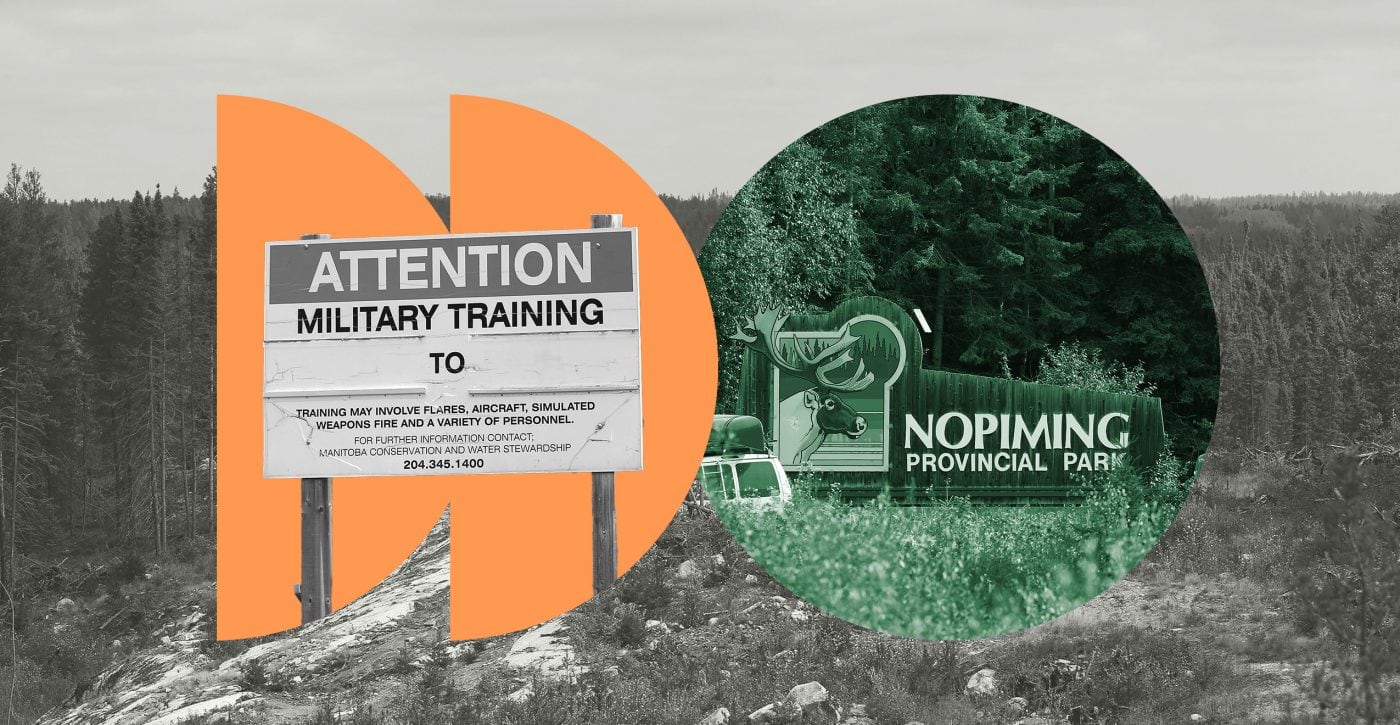
Photo illustration: Shawn Parkinson / The Narwhal. Photos: Shannon VanRaes / The Narwhal
It’s been more than a year since Pat Popp and her husband fled their home in Nopiming Provincial Park to escape an encroaching wildfire, but it’s a day she thinks about often.
Popp recalls seeing distant flames from the window of her property on Bird Lake when she went to bed on May 12, 2025. An evacuation order was issued the next morning.
“They had to water down the highway to get us out of here and then we were evacuated for five weeks,” Popp said over the phone.
Much of Nopiming — a sprawling boreal forest and recreational area 175 kilometres northeast of Winnipeg — burned in the wildfire, which was sparked by lightning and spread to nearly 4,000 square kilometres by the time it was finally deemed extinguished last December.
Today, charred fir trees dominate the landscape around Bird Lake, where the Popps have lived full time since 2017 and where Pat’s husband, Russ, has had a cottage since 1966. Popp said she feels traumatized by how close they came to losing everything. Those anxieties were reignited last month when she noticed military training had resumed in the woods near her home.
The Canadian Forces School of Survival and Aeromedical Training has been operating in Nopiming Provincial Park since the mid-1990s under a memorandum of agreement between the military and Manitoba government.
Now, in the wake of the wildfire, park residents and a local wilderness advocate are calling for the relocation of the long-running survival training program to protect the damaged forest and its inhabitants — humans and animals alike.
Military uses provincial park for survival training
The Manitoba government markets Nopiming, which means “entrance to the wilderness” in Anishinaabemowin, as a destination for “nature-oriented recreational opportunities such as canoeing, hiking and mountain biking in a largely undisturbed environment.” But the park has also long allowed both mining exploration and military activities with the provincial park.
The agreement that allows the military to use the park was last reviewed in 2021, and dictates where and under what conditions military activities are permitted in the park, Capt. Ken Jacobson, a public affairs officer with CFB Winnipeg, said in an emailed response to questions from The Narwhal/Free Press.
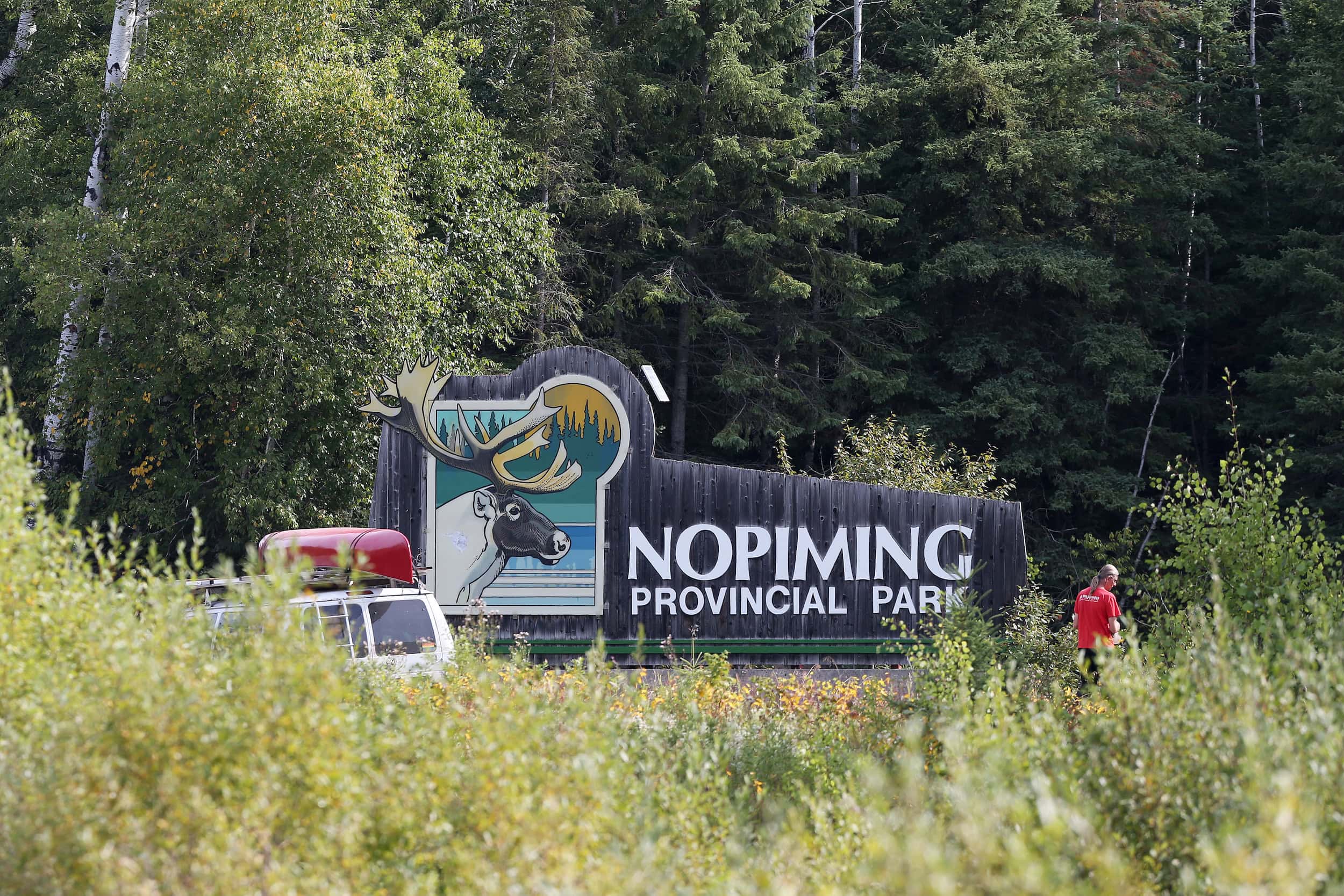
Nopiming Provincial Park is one of few protected areas that allow military training inside their boundaries. According to CFB Winnipeg, the exercises are carried out under an agreement that dictates where and when they may occur. Photo: Shannon VanRaes / The Narwhal
The school trains Air Force members how to survive in remote wilderness environments following a plane crash or emergency situation; as well as how to evade, resist and escape enemy capture.
“Training focuses on survival fundamentals such as shelter construction, firemaking, signalling, water procurement and food acquisition. The program does not involve combat training,” Jacobson said.
The school is based at a former summer camp on Springer Lake — a body of water north of Bird Lake near Provincial Road 314. Students and staff were evacuated during the 2025 fire and most of the facilities were destroyed. The base is currently outfitted with tents and temporary storage units. So far, none of the permanent structures have been rebuilt.
The program returned to Nopiming in October 2025 through consultation and permits approved by Manitoba Parks, Jacobson said, adding modifications have been made to reduce the natural resources used by trainees in the field, such as limiting the number of trees required to build a shelter.
Timber is allowed to be harvested for personal use in designated areas of Crown land and Manitoba provincial parks with a permit. The agreement between the province and military includes a provision that allows trees to be cut down during the survival training, according to the provincial spokesperson.
Students may also fish and hunt small animals in accordance with provincial regulations during the training exercises, Jacobson said, but are not allowed to harvest large game.
The agreement between the military and province only allows campfire training to occur from April to May and September to October unless prior notice is given and pending local fire restrictions, a provincial spokesperson said in an emailed statement.
Residents concerned about military firemaking in a park recently ravaged by wildfire
The military confirmed training activities are being conducted this fall south of the Bird Lake cottage development in an area untouched by the fire.
The firemaking and close proximity are what worry Pat Popp most.
“They are so close to my home. I mean, we’ve been worried about this for years: these fires that they start and can so easily get out of control,” she said. “It’s just so stressful knowing that this much of the park is gone and now they’re pushing them into this small area.”
In 2021, Popp wrote a letter to the province expressing her concerns about the potential wildfire risk associated with the military survival exercises, which involve making open fires in makeshift camps outside of designated pits.
In a response letter reviewed by The Narwhal/Free Press, then deputy minister of conservation and climate, Jan Forster, said parks staff had engaged with Department of National Defence staff “to strengthen communications, and to ensure training activities are restricted during times of high to extreme fire danger.”
While the fire danger was extreme in northern parts of the province, the risk remained low in most of southern Manitoba this year due to wetter conditions.
The school is required to have firefighting equipment on hand during training demonstrations, and instructors are responsible for confirming campsite fires have been properly extinguished before departing a site, the provincial spokesperson said.
A 2025 wildfire evacuee and resident of nearby Flanders Lake, who asked not to be named, shared similar concerns about military trainees making open fires near Nopiming’s residential area and described the practice as a preventable risk — particularly in a forested region where much of the ground is covered by peatlands, which can harbour smouldering fires for months. The permanent park resident hadn’t noticed any signage related to military training in the area this fall and said it’s unsettling to see uniformed Canadian Forces members arriving in the neighbourhood unannounced.
‘Now that the park is burnt, the area needs peace’: advocate
Eric Reder, senior Manitoba campaigner with the Wilderness Committee, said his organization has been pushing the province to decommission and remove the military training facility at Springer Lake since at least 2014. He believes the issue is more pressing following last year’s wildfire.
“Military training can happen somewhere, but this isn’t the place for it,” Reder said over the phone while driving up to Nopiming last month. “And now that the park is burnt, the area needs peace.”
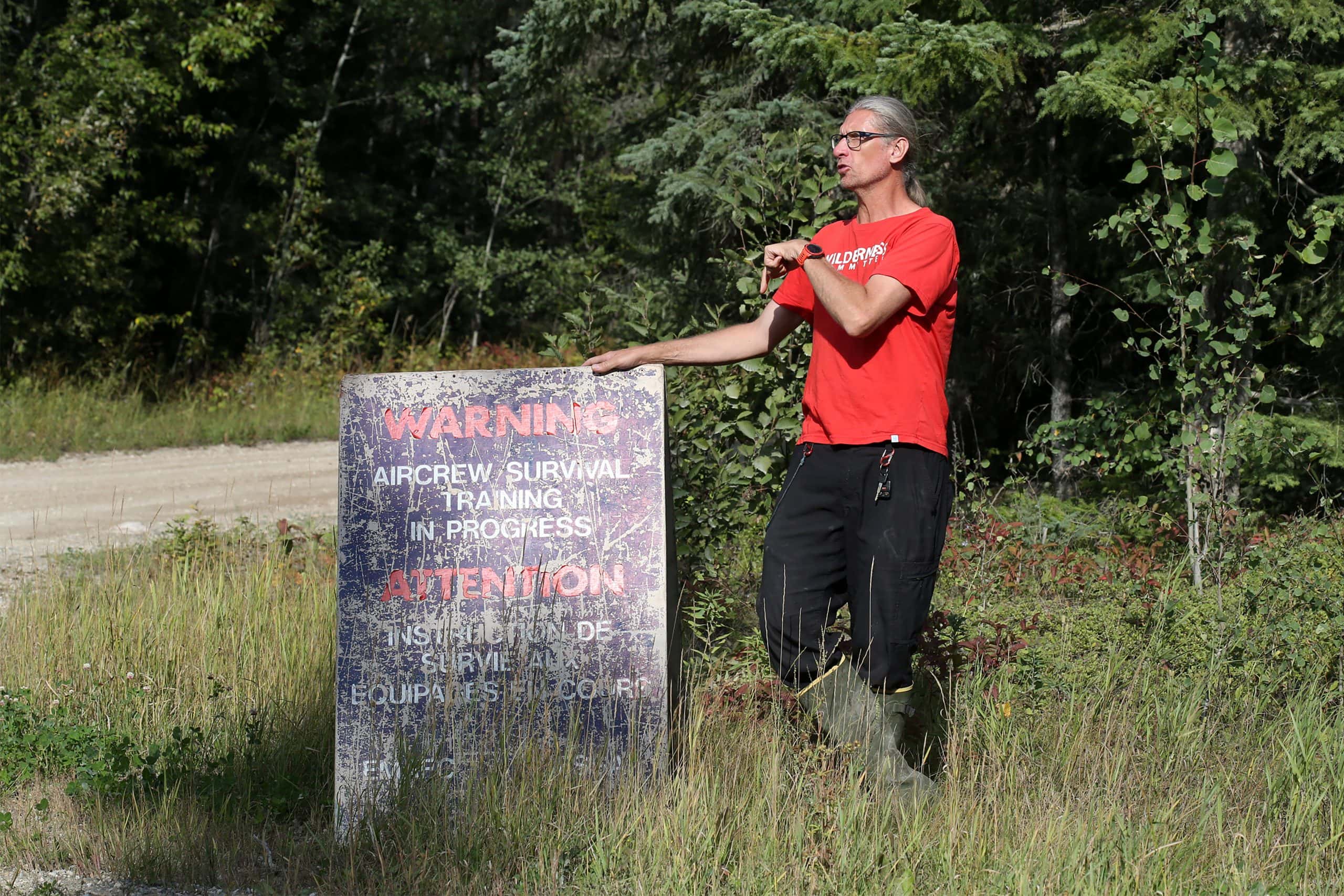
A recent report calls for a moratorium on “disruptive” military exercises in Nopiming Provincial Park. “That’s not what parks are for,” says climate campaigner Eric Reder. Photo: Shannon VanRaes / The Narwhal
In a report released earlier this year, the committee recommended a moratorium on industrial activity and “disruptive military training exercises” to allow the park’s vegetation and wildlife — including its threatened boreal woodland caribou herd — to recover.
Over the years, Reder has documented remnants of temporary campgrounds in the bush and gouges in trails left by the tracks of an all-terrain vehicle used by the school.
“It’s way too invasive for an area that is a sensitive ecosystem. It’s important wilderness, but it’s also a park, right?” Reder said of the military training. “That’s not what parks are for.”
Popp also worries about the impact on flora and fauna, adding she’s seen a large military plane flying over the area frequently this fall.
“It’s so vulnerable at this point,” she said of the forest. “It’ll take decades to regenerate, it won’t happen in my lifetime.”
The province said there are no plans to end the military training agreement.
The military and province are developing a tree-replacement initiative and looking at other forest regeneration options. “This work reflects a shared commitment to responsible environmental stewardship and the continued preservation of the park’s natural environment,” Jacobson said.
Eva has been reporting on environmental issues in Manitoba since joining The Narwhal in 2026. Her role is part of a partnership with the Winnipeg Free Press.
The Narwhal’s reporters are telling environment stories you won’t read about anywhere else. Stay in the loop by signing up for our free weekly dose of independent journalism.
From The Narwhal | News on Climate Change, Environmental Issues in Canada via This RSS Feed.