


Under the banner “One People, One Struggle: Against Imperialism for Popular Power in West Africa,” the West Africa People’s Organisation (WAPO) convened its Second Congress at the Amilcar Cabral School in Agyanoa, Ghana, from October 31 to November 1. The two-day event gathered delegates from 29 organizations across 11 countries. Representing political parties, social movements, trade unions, peasant groups, and women’s organizations, participants assembled to construct a unified front against imperialist domination and chart a strategic path toward popular sovereignty across West Africa.
Following an opening cultural performance by a local ensemble, Revolutionary Kolomashie, the beat of drums and blare of the trumpet set the scene for vibrant plenary sessions and commission debates focused on the concrete realities of anti-imperialist struggle in West Africa in the current conjuncture.

Local ensemble Revolutionary Kolomashie performs at the opening of the WAPO Second Congress, 31 October 2026. Photo: Jnr Johnson Segbefiah / Pan African Television
The subregion continues to suffer under severe insecurity and destabilizing violence unleashed by NATO and French military interventions since the fall of Libya. Grounded in this stark reality, the gathering zoomed in on the rising tide of anti-imperialist resistance across the region – expressed through massive mobilizations against foreign military bases that have defined the regional conjuncture over the four years since the founding of WAPO – and notably marked by the expulsion of French troops from Mali, Niger, and Burkina Faso.
WAPO President Philippe Noudjenoume described the shifts in the Sahel as a pivotal moment: “The central factor determining any analysis of our West African subregion today is the governments of Mali, Burkina Faso and Niger, united in the Confederation of the Alliance of Sahel States (AES). What is happening in these three countries can only be described as a patriotic and sovereignist revolution.” Noudjenoume added that this movement represents “a giant leap towards realizing the dream of our illustrious Pan-African heroes, such as Kwame Nkrumah, Sékou Touré, Patrice Lumumba and Modibo Keïta.”

WAPO President Philippe Noudjenoume delivers the Opening Address of the WAPO Second Congress. Photo: Jnr Johnson Segbefiah / Pan African Television
In his welcoming address Socialist Movement of Ghana (SMG) Convenor Kyeretwie Opoku emphasized that this shift resulted directly from grassroots mobilization. Referring to the expulsion of French troops he said, “This didn’t happen because France changed its mind. It happened because people in the streets of Bamako and beyond fought for it, protested, and drove the French out!”
Opoku noted that the formation of the Alliance of Sahel States (AES) by Burkina Faso, Mali, and Niger – alongside their departure from ECOWAS – signals a new emancipatory epoch where nations are actively reclaiming sovereignty over their natural resources. This is not unique to the AES, but a symbolic tip of the proverbial iceberg that captures the aspirations of peoples across the African continent. A primary example remains the experience of Niger finally asserting control over its uranium reserves, ending decades of subsidized extraction for France.
Delegates rejected imperialist narratives framing regional insecurity as mere ethnic conflicts, identifying imperialist interference and foreign covert destabilization as primary drivers of instability. To secure true self-determination, delegates called for the immediate removal of all foreign military bases from African soil and urged West African nations to establish independent, collective security arrangements.
The Congress also examined the divide between formal electoral democracy and actual, popular democratic participation and process. Representatives from Guinea-Bissau, Ivory Coast, and Senegal outlined how external trappings of democracy often mask systemic counteractions against the popular will. Speakers pointed to foreign manipulation – particularly from France – in preserving neocolonial monetary structures like the CFA franc and secret bilateral agreements. Electoral mechanisms, delegates warned, are frequently weaponized to legitimize imperialist control while marginalizing transformative movements.

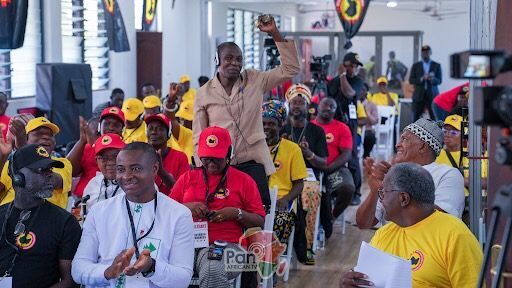
Delegates & observers to the WAPO Second Congress break out into commissions to discuss various themes and topics. Photo: Jnr Johnson Segbefiah / Pan African Television
In response, Noudjenoume framed WAPO’s core mandate: “WAPO aims to raise the consciousness of West African workers and peoples, enabling them to undertake their dual liberation: liberation from imperialist domination and social liberation from the ruthless exploitation of capitalism.”
This aforementioned erosion of democratic processes coincides with escalating state-sponsored repression in countries such as Benin, Guinea-Conakry, Guinea-Bissau, and Côte d’Ivoire. Delegates reported crackdowns, banishment and exile of opposition figures, illegal arrests, and severe restrictions on civil society. Furthermore, socioeconomic challenges including mounting debt, persistent hunger and famine, and widespread unemployment remain prominent issues impacting the region. Incoming WAPO General Secretary Yaw Appiah-Kubi emphasized that organized popular resistance remains the sole effective defense against authoritarianism and imperialist encroachment.

Delegates participate in the plenary discussions of the WAPO Second Congress. Photo: Jnr Johnson Segbefiah / Pan African Television
Reflecting on the necessity of grassroots mobilization, SMG Convenor Kyeretwie Opoku emphasized a core principle of revolutionary solidarity: “Sovereignty that relies solely on government power or state power is not enough. Popular power means organized people – not just state power, and not just a single leader.”
By uniting social movements, trade unions, and anti-imperialist forces under a common program, the Second WAPO Congress reaffirmed that West Africa’s liberation will not come from foreign patrons or neo-colonial elections, but from the organized power of its people.
From BT News via This RSS Feed.