

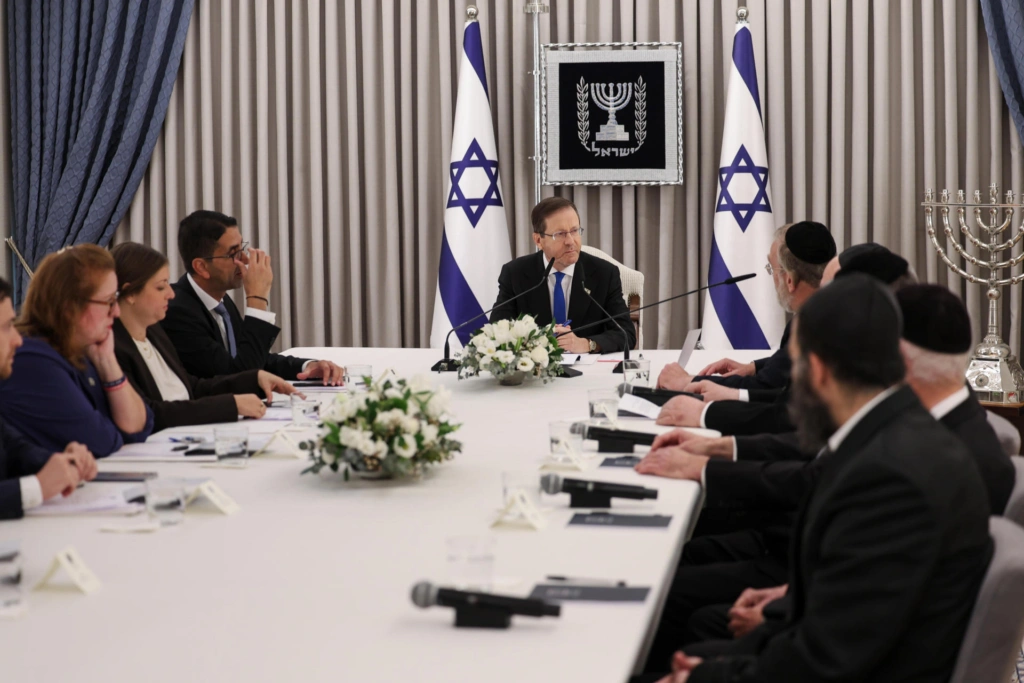
Israeli President Isaac Herzog will announce on Sunday which deputy he will assign to form the next government, after completing rounds of consultation with political factions following parliamentary elections held on October 27.
Under Israeli law, the person tasked by the President has 28 days to assemble a governing coalition, with the option of a 14-day extension. If no agreement emerges, the country must hold new parliamentary elections early next year.
RELATED: Trump to End Annual US$4 Billion Military Aid to Israel
In a video message broadcast by the Israeli news outlet Ynet, Herzog specified that the leader of the Yashar party, Gadi Eisenkot, has the support of 67 members from the 120 seats of the Knesset, exceeding the absolute majority threshold set at 61 seats, while the current Prime Minister and leader of the Likud party, Benjamin Netanyahu, adds support from 46 lawmakers.
Herzog warned that, despite Eisenkot’s numerical advantage, the formation of the government remains uncertain due to mutual vetoes between political blocs in Israel.
President @Isaac_Herzog completed consultations with the Knesset factions at the President’s Residence in Jerusalem this evening.
President Herzog held meetings with the Joint List, Be’Yahad, Yashar!, and Likud Knesset factions and received their recommendations on forming a… pic.twitter.com/bwn5VfGYUi
— Office of the President of Israel (@IsraelPresident) November 5, 2026
The election ended a period in which the 25th Knesset became the first Israeli legislature since 1988 to complete a full four-year term. Five consecutive snap elections between 2018 and 2022 preceded that stability.
Netanyahu’s 37th government weathered mass protests over a judicial overhaul, the October 7, 2023 attacks and the Gaza genocide that followed, and repeated coalition crises over military conscription for ultra-Orthodox men. After the attacks, the opposition joined an emergency national unity government, an arrangement that later fractured.
The crisis that reshaped Israeli politics began long before this vote. In 2023, the government pushed a judicial overhaul that drew some of the largest protests in the country’s history. The Supreme Court struck down a key amendment in January 2024 by an eight to seven vote.
Coalition fractures over drafting ultra-Orthodox men into the military then deepened. Two religious parties resigned from the government in July 2025, and Shas later withdrew its ministers.
Arab parties enter the negotiations with renewed leverage. Their nine-seat gain, combined with the absence of a majority bloc, means no coalition can easily ignore the community that represents one fifth of Israel’s citizens.
Whoever forms the next government will lead a deeply fractured country. The President’s defense of the Arab minority signals the stakes of a campaign in which anti-Arab rhetoric featured prominently.
After meeting party and bloc leaders, Israeli President Herzog says he will announce on Sunday who will be tasked with forming the next government pic.twitter.com/TlRxjM5NN1
— TRT World Now (@TRTWorldNow) November 6, 2026
Racist Rhetoric Condemned
Israeli President Isaac Herzog condemned the racist rhetoric that surfaced during the recent election campaign and reaffirmed respect for the country’s Arab citizens, who make up about one fifth of the population.
The remarks came as the head of State opened consultations to form a new government after the October 27 election for the 26th Knesset. Arab citizens of Israel number close to two million people, roughly 20% of the population, and their political weight grew sharply in this year’s vote.
Arab-led parties gained nine seats, a result driven by unusually high turnout among Arab voters. No party or bloc secured the 61 seats required for a majority in the 120-member parliament, forcing weeks of negotiations.
Herzog placed the country’s largest minority at the center of the political debate. The President, whose office is largely ceremonial, has repeatedly urged social cohesion in a society divided by war and years of political instability.
Israeli President Isaac Herzog:
I have great respect for Arab society in Israel. I recognize its contribution to the state in every sphere of life and its desire to integrate.
I condemn the vulgarity and racist expressions we have heard recently.
There is no place for such… pic.twitter.com/5VIsF6iZVt
— Clash Report (@clashreport) November 4, 2026
Racist discourse has long punctuated Israeli campaigns. This time it drew sharper condemnation from the head of State as party leaders began bargaining over the shape of the next government.
The clock now runs on the 28-day mandate. Failure would return Israelis to the polls early in 2027, a prospect that hangs over every negotiation now underway.
From teleSUR English via This RSS Feed.