

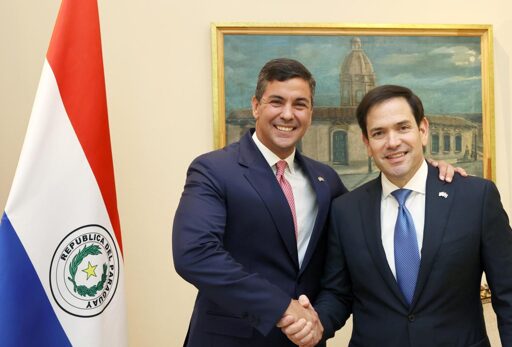
Caracas (OrinocoTribune.com)—Santiago Peña announced his resignation as president of Paraguay on Thursday, November 5, as lawmakers advanced impeachment proceedings over the collapse of Ueno Bank, which left nearly three million customers unable to access their accounts and put hundreds of millions of dollars in public funds at risk.
“I have made the decision to submit my resignation as president of the Republic,” Peña said in a prerecorded video posted on social media. He added that he was acting to preserve “the stability of our country, social peace, and the need to preserve our democratic institutions.” He also apologized to the public, saying he had never intended to betray their trust, but did not accept responsibility for the crisis.
Ueno Bank’s intervention and the political fallout On November 3, the Central Bank of Paraguay began a resolution process for Ueno Bank after finding its solvency ratio had fallen below half the legally required minimum. The regulator cited weaknesses in asset quality, transactions with related companies, and inadequate documentation for some operations. It suspended the bank’s operations and appointed intervenors. A Central Bank’s report describes the findings.
The intervention restricted access to accounts and disrupted transfers, card payments, and the bank’s digital services. Ueno had nearly three million customers in a country of about 6.5 million people. The crisis also put public funds held at the bank in jeopardy, including money belonging to the Social Security Institute (IPS), Paraguay’s state pension and health fund. Telesur reported that the IPS had about $355 million invested in Ueno.
Central Bank President Carlos Carvallo Spalding resigned on Tuesday amid the fallout. Before Peña appointed him to lead the regulator in 2023, Carvallo had headed Financiera Ueno, the institution from which the bank developed. Peña had also held shares in Grupo Vázquez, Ueno’s parent group, until March 2025, while serving as president. The ties became central to the political accusations against him.
Peña’s ruling far-right Colorado Party withdrew its support as lawmakers prepared to consider impeachment. The party said it would not stand “on the side of the plundering of public, private and pensioners’ funds,” according to Telesur’s account of the impeachment proceedings.
Deputies advance impeachment; Senate decision pending The Chamber of Deputies voted 78–0 on Thursday to advance impeachment proceedings against Peña. The accusation sets out five chapters of alleged political and administrative responsibility, including Peña’s business ties to Ueno, Carvallo’s appointment to lead the Central Bank, alleged changes to conflict-of-interest rules, and the IPS’s deposits at the bank. Deputies also selected prosecutors to present the case before the Senate.
The Senate now faces two connected decisions: whether to accept Peña’s resignation and whether to proceed with the impeachment trial. The Constitution assigns Congress the authority to accept or reject a president’s resignation under Article 202, paragraph 16.
Article 189 provides for former democratically elected presidents to become senators for life, except those who have been impeached and found guilty. Critics of accepting Peña’s resignation argue that doing so could give him the protections associated with parlamentary immunity and make efforts to hold him accountable more difficult. The final consequences depend on the Senate’s decisions and their application of the constitutional provisions. The Constitution of Paraguay sets out both provisions.
Retirees demand the return of pension funds The IPS Retirees Alliance called for the return of the pension fund’s resources, sanctions against officials it considers negligent, and an investigation into political responsibility for the crisis. Retirees have also demanded that authorities guarantee future pension payments and replace and sanction current and former Ueno board members over their handling of the fund.
Their demands add to public pressure for the recovery of the funds and accountability across the institutions involved. The bank’s intervention has affected not only depositors but also pensioners, workers, businesses, and public services that relied on Ueno for transactions.
Mainstream media reported that preliminary Central Bank estimates indicate the state Deposit Guarantee Fund’s limit—75 minimum monthly wages per depositor, or about US$38,000—would cover the full balances of roughly 97% of Ueno’s
Ueno Bank Collapse Sparks Chaos, Arrests and Crisis in Paraguay
Vice President next in line Vice President Pedro Alliana is next in the constitutional line of succession and would complete the presidential term, scheduled to end in 2028, if Peña’s resignation is accepted. Alliana is a longtime member of the Colorado Party, which has governed Paraguay for most of the period since the end of Alfredo Stroessner’s dictatorship.
Special for Orinoco Tribune by staff
OT/JRE/XX
From Orinoco Tribune via This RSS Feed.