

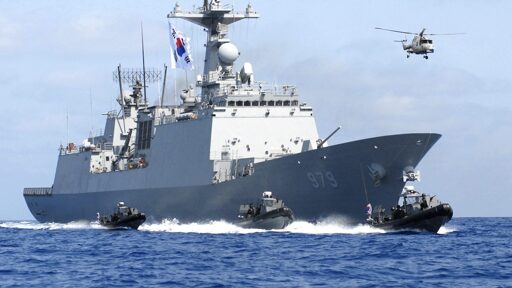

South Korea’s government has begun procedures to potentially join the US-Israeli war of aggression against Iran.
On November 5, a vice-ministerial meeting affirmed a decision to expand the military capacities and operational area of the Cheonghae Unit, a blue-water naval force that has operated in the Gulf of Aden near the Red Sea as part of an “anti-piracy” mission since 2020.
The revised mandate of the Cheonghae Unit would double its deployment area up to the waters of the Arabian Sea south of Duqm, Oman. This would place Republic of Korea (ROK) naval units on the fringes of the Gulf of Oman and the Strait of Hormuz – areas Iran has declared closed to foreign military vessels.
The proposal would further expand the Cheonghae Unit to include P-8A Poseidon maritime patrol aircraft, an Explosive Ordnance Disposal (EOD) team, and unmanned mine-clearing equipment.
An ROK defense ministry official told Yonhap News Agency that the expansion is being undertaken “to protect our citizens and safeguard our economic interests,” adding that the Cheonghae Unit’s new mandate would include support for “efforts to restore freedom of navigation in international shipping routes.” The official added that maritime patrol aircraft would be “prohibited from monitoring Iranian territory, territorial waters, or the interior of the Strait of Hormuz.”
Per ROK law, the decision must now be approved by the Cabinet and President, followed by a vote in the National Assembly, South Korea’s parliament. The decision is expected to be made next week.
War by deception
Word of the ROK’s potential deployment to the Strait of Hormuz leaked in early September, following months of US pressure. Large protests attended by thousands swept the country, with the ROK’s major progressive forces presenting a united front against the war. On September 18, President Lee Jae Myung told media that his government had “ruled out” joining the war – but hinted that expanding the Cheonghae Unit’s deployment could be possible under the auspices of defending freedom of navigation.
While it was widely reported internationally that Lee had ruled out support for the war on Iran, progressive parties and anti-war organizations in the ROK continued to raise the alarm. Many pointed out that expanding the Cheonghae Unit to the Gulf of Oman or the Strait of Hormuz would violate Iran’s prior warnings that foreign military vessels in these areas would be treated as enemy combatants. Given the circumstances, these organizations accused President Lee of misleading the public and attempting to proceed towards war by deceptive means.
These warnings have proven to be prescient. The Lee administration’s claim to expand the Cheonghae Unit to protect freedom of navigation and commercial vessels is at odds with the details of the proposal. The new weaponry slated for addition to the Cheonghae Unit goes well beyond what would be required for a naval escort.
As the Korean Confederation of Trade Unions, a progressive umbrella union organization representing over 1 million workers, put it: “If the true objective were merely to protect vessels, there would be no need for EOD teams, anti-submarine patrol aircraft, or mine-clearing equipment. These are military preparations unrelated to the protection of ships; they clearly reveal an intent to participate in an illegal war led by the United States.”
While the Lee administration is maintaining that it would uphold independent command of its troops, the Cheonghae Unit in fact operates as part of the US Naval Forces Central Command’s Combined Maritime Forces. One way or another, the potential deployment shows every indication of either directly or indirectly supporting US military operations.
The ROK Progressive Party, which holds four seats in the National Assembly, further pointed out that expanding Cheonghae Unit’s operational area amounts to a “deceptive, indirect deployment – a ploy to insert South Korea into the conflict,” adding that the waters from the Strait of Hormuz to the Gulf of Oman are “effectively a single theater of war…there is no buffer zone whatsoever between the two.”
The Party statement also criticized the illegality of the potential decision. The Cheonghae Unit’s legal basis for deployment under international law, United Nations Security Council Resolution 1816, limits its operational mandate to Somalian waters. Furthermore, Article 5, Paragraph 1 of the ROK’s Constitution renounces wars of aggression.
Under Washington’s pressure
For months, South Korea staved off US pressure to join the war.
In August, Trump suddenly announced the partial cancellation of Ulchi Freedom Shield, a major series of joint war drills held annually between the two governments. While citing his “very special relationship” with the Democratic People’s Republic of Korea (DPRK), Trump also delivered invectives against the ROK for its unwillingness to support aggression against Iran.
Read more: ‘Unworthy of comment’: The DPRK rebuffs Trump’s overtures
These demands have piled additional pressure on Seoul, which has also faced economic coercion under Trump’s tariff wars to deliver a massive $350 billion state-backed investment package into US industry. Lee’s domestic economic agenda is also being obstructed by the US military, and his government is in active dialogue with Washington to relocate the US Air Force Gwangju Base to make room for a proposed semiconductor manufacturing complex.
The US and ROK are also negotiating the return of the latter’s operational control (OPCON) over its own military. Recently, US Forces Korea Commander Xavier Brunson declared that the conditions for the transfer had changed, and hinted that a return of OPCON before the end of Lee’s administration in 2030 would be unlikely.
Given this context, it is likely that Lee’s proposed expansion of the Cheonghae Unit is an attempted maneuver to gain leverage in advancing his administration’s other goals vis-a-vis Washington. Lee would not be the first ROK leader to partake in US wars of aggression in the hope of advancing domestic pursuits. The ROK’s participation in the Vietnam War and the Second Gulf War were motivated by similar designs.
However, Iran today is nothing like the Vietnam of the 1960s or the Iraq of the 2000s. Iran has demonstrated formidable military capabilities that have forced the US into a halting campaign which it can neither win militarily nor exit without facing severe loss of prestige. Regarding Seoul’s potential participation, Tehran has been clear: any foreign military operating in the Strait of Hormuz, the Gulf of Oman, or the Persian Gulf will be regarded as an enemy and its units and economic interests will be targeted.
All this has compelled Lee’s government into contortions. Rather than straightforwardly backing the US war, Seoul is now engaged in a rather acrobatic performance that seeks to appease all sides. Technically, the ROK is meeting Washington’s demand, falling short of Tehran’s threshold for retaliation, and packaging it all in such a way that may avoid provoking a renewed wave of domestic outrage. Lee may believe this is the politically prudent thing to do. That illusion will rapidly fade if a single ROK casualty occurs.
From BT News via This RSS Feed.