

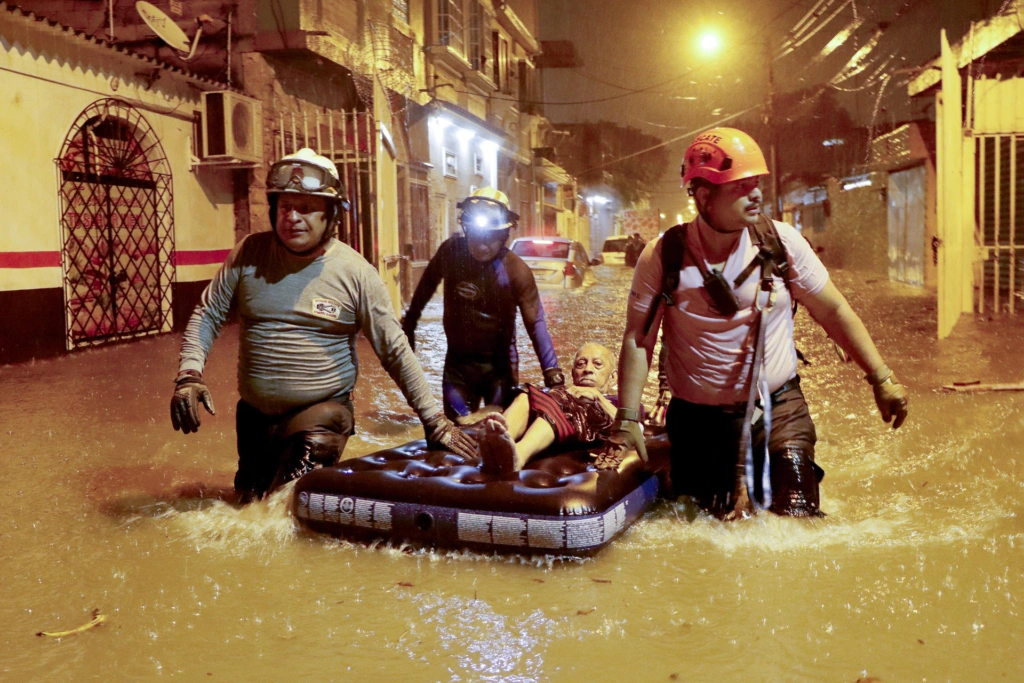
Severe flooding triggered by El Niño has isolated communities, cut water supplies and forced school closures across Ecuador, leaving at least 12 people dead nationwide and more than 56,000 affected.
The increase in rainfall associated with the El Niño climatic phenomenon caused rivers to overflow in the coastal province of Manabí, leaving several communities isolated and affecting the supply of drinking water.
The Ayampe and Buena Vista rivers overflowed in the coastal province of Manabí after rainfall intensified sharply. Residential areas of Puerto López flooded, and several communities found themselves cut off as the swollen channels swallowed roads, homes and basic services.
RELATED: Atacama, World’s Driest Desert Experiences a Historic Bloom Thanks to El Niño
In the canton of Chone, a rupture in the main pipeline stripped 60% of the urban population of drinking water. The break added a public health risk to an emergency that had already paralyzed essential infrastructure across the province.
As conditions worsened, authorities suspended in-person classes in heavily populated cantons including Guayaquil, Samborondón, Durán and Daule. Families in low-lying neighborhoods moved to higher ground while main roads remained under water.
Los estragos de #ElNiño se siente en varias regiones de la costa de #Ecuador
En Cañitas de Charapoto, la calle principal convertida en rio.
En la vía #Canuto – Membrillo 2 personas fueron rescatadas después de que su camioneta cayó a un socavón#DanielNoboa #MANTA pic.twitter.com/ELdSSY20RE
— tendenciapopular.ec (@tendenciap_ec) November 5, 2026
The Ecuador’s National Aquaculture Chamber raised a separate alarm over the economy. Around 110,000 hectares of shrimp ponds stand exposed to severe flooding, a situation that could cause million-dollar losses and obstruct exports from the fishing sector. The flooded ponds would not only destroy harvests but also stall the export flows that sustain the industry.
Official figures give the disaster its full weight. The National Secretariat for Risk Management (SNGR) reported that the emergency has affected 56,323 people and caused 12 deaths nationwide since the Red Alert was declared on August 29.
More than 12,000 homes show structural damage, floodwaters have blocked 25 kilometers of roads, and 5,247 hectares of crops have been destroyed. The toll now spans all 24 provinces.
#MonitoreoSatelitalEc| Jueves 05/11 (06h30): En el perfil costero de #Esmeraldas y #Manabí persisten lluvias dispersas, que se mantuvieron durante la madrugada. Se prevé que disminuyan y se disipen en el transcurso de las próximas horas 🌧️
⚠️ ADVERTENCIA No. 86 VIGENTE pic.twitter.com/2df3pWb1ef— INAMHI Ecuador (@inamhi_ec) November 5, 2026
The Worst Is Ahead
The damage stretches to the Galapagos archipelago. On Santa Cruz Island, 2,000 families lost basic services and watched transport routes collapse, exposing operational failures in contingency plans built for precisely this kind of event.
Local organizations and analysts have questioned the effectiveness of the government’s response. Social groups say heavy machinery took too long to reach blocked highways. The economic repair bonus announced by the national government has also stalled, they add, because no verified registry of beneficiaries exists.
That bureaucratic delay has left the most vulnerable populations waiting. Critics argue that managing the emergency from central offices in Quito falls short of what families on the ground actually need to recover. Emergency crews have struggled to clear blocked roads, and water service remains interrupted in several cantons.
Meteorologists and risk management technicians warn that the current rainfall represents only the opening phase of El Niño. They project the most intense climate months will arrive between January and March 2027. By then, soils will be saturated and river basins will sit at the edge of their capacity. The socioeconomic crisis already unfolding across Ecuador could deepen sharply in the months ahead.
From teleSUR English via This RSS Feed.