


One senator out of the 100 who will fill the upper chamber of the 120th Congress was elected to his seat on a loud campaign promise to end U.S. complicity in Israel’s genocide in Gaza.
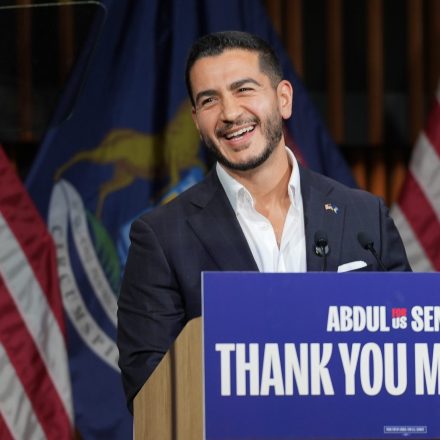
Abdul El-Sayed will walk into a newfound Democratic majority after animating his base with pro-Palestine pledges seldom heard from a U.S. Senate contender. As a first-term senator, he’ll lack seniority on the committees to which he’s assigned. And although his critiques of the U.S. relationship with Israel have proven overwhelmingly popular in public opinion surveys and among voters at the polls, the same can’t be said for most of his soon-to-be colleagues.
“It’s going to be a fight,” said Beth Miller, political advocacy director for Jewish Voice for Peace Action, which supported El-Sayed’s campaign. “The Democratic establishment, when it’s in control, has not taken measures in support of Palestine in the past. And so this is about making sure that now they finally start listening to what the overwhelming majority of their bases say.”
[
Related
Abdul El-Sayed Wins Senate Seat With Pro-Palestine Campaign](https://theintercept.com/2026/11/03/michigan-senate-results-el-sayed-rogers/)
El-Sayed’s run marked the first time the Jewish-led, anti-Zionist group backed a Senate campaign. Pro-Palestine lobbying groups like JVP Action have been pushing for legislation to block weapons transfers to Israel for years, aligning themselves with a small but growing number of left-leaning House members. The group helped author the Block the Bombs Act, introduced by Delia Ramirez, D-Ill., which netted 82 co-sponsors and became a pro-Palestine litmus test in some Democratic primary campaigns.
Building consensus around a single bill in the Senate is harder, but the upper chamber offers stronger levers to pull. Senators can force votes called Joint Resolutions of Disapproval that would block foreign security assistance, such as weapons sales to Israel. Sen. Bernie Sanders, I-Vt., has exercised this option repeatedly throughout the genocide in Gaza to try and block the sale of certain bombs, firearms, and other military equipment to Israel. While his resolutions failed in the Republican-controlled Senate, the most recent ones drew support from wide majorities of Democrats — soon to be the party in power.
Yet with the looming threat that Democrats might actually be able to pass legislation, El-Sayed would find himself under pressure from the likely Senate majority leader, Chuck Schumer, who has long maintained the support of the pro-Israel lobby, to fall in line with party priorities.
“The question is, ‘Who does he want to be?’ Does he want to be someone like Bernie, who is willing to sometimes stand up to leadership?” said Hamid Bendaas, communications director for the Institute for Middle East Understanding Policy Project, which also backed El-Sayed’s run. “It’s hard to do that as a freshman and someone who’s just getting in there.”
Bendaas expressed confidence that the Michigan senator would be a champion of pro-Palestine legislation, but he noted that El-Sayed would have to balance his priorities, especially after running a campaign focused on economic populism and providing universal healthcare through Medicare for All.
Shifting Winds
There is a tension revealed by the dilemma facing Sen.-elect El-Sayed: While a growing share of Americans — and an overwhelming majority of Democrats — disapprove of the U.S. spending billions of dollars on aid to Israel, voters’ clear No. 1 concern in the 2026 election cycle was the cost of living and their own economic precarity.
Some pundits have encouraged pro-Palestine candidates like El-Sayed to put their anti-genocide principles aside, arguing that more moderate Democrats performed better on Tuesday night. They compare El-Sayed’s 7-percentage-point defeat of Mike Rogers to James Talarico’s 12-point win over Ken Paxton in Texas — and some have already asked Talarico to defy his new colleague.
[
Related
Haley Stevens Destroyed Her Political Career for Absolutely Nothing](https://theintercept.com/2026/11/04/el-sayed-michigan-senate-win-democrats/)
But on the campaign trail, El-Sayed often connected the issues of a high cost of living and outsized U.S. spending on aid to Israel. “We ought to be spending our money here, to build schools and provide healthcare and child care here, rather than sending our money abroad to a foreign government that’s done terrible things with our money,” he said in a September interview with Bloomberg TV. El-Sayed’s approach made him the target of nearly $40 million in outside spending from the super PAC for the American Israel Public Affairs Committee, which supported widespread anti-Arab and Islamophobic attacks and accusations of antisemitism in an attempt to keep a vocal critic of Israel out of the Senate.
“None of it mattered,” said Yousef Munayyer, a senior fellow at the Arab Center Washington D.C. who likened the gravity of El-Sayed’s win to that of New York City Mayor Zohran Mamdani. “And this is not the Commie Corridor. This is a swing state. A lot of taboos here have been shattered, and people are going to learn from this and be emboldened now.”
“This is not the Commie Corridor. This is a swing state. A lot of taboos here have been shattered, and people are going to learn from this and be emboldened now.”
In addition to bringing joint resolutions to block future weapons transfers — like the Trump administration’s planned sale of $2.8 billion in 2,000-pound bombs to Israel — El-Sayed could introduce resolutions citing the Foreign Assistance Act; Sen. Chris Van Hollen, D-Md., used one to demand a State Department report on Israeli detention of Palestinian children and Israeli military and settler killings of American citizens in the West Bank. He would also be able to introduce amendments to the Pentagon’s annual spending bill that carves out billions of dollars in joint U.S.–Israel weapons research. (The Senate is currently sitting on this year’s $1.15 trillion National Defense Authorization Act, which would even more deeply enmesh Israeli technology within the Pentagon’s programs and supply chain.)
Munayyer, the former head of the U.S. Campaign for Palestinian Rights, said that despite the uncertainty over whether moderate Democrats will be willing to link arms with progressives next session, El-Sayed’s win creates an environment ripe for accountability over Israel.
[
Related
There Is a Taboo Against Criticizing AIPAC — and Ilhan Omar Just Destroyed It](https://theintercept.com/2019/02/12/there-is-a-taboo-against-criticizing-aipac-and-ilhan-omar-just-destroyed-it/)
“You have a climate now where there’s going to be a lot less intimidation felt by people who had previously been hesitant to speak out on these issues because they thought it was political suicide,” he said.
Even Republicans are beginning to feel the shifting winds. On the morning of Election Day, President Donald Trump made a surprise announcement on Fox News that the U.S. would halt the annual $4 billion in military aid to Israel. The move would only cut off one path for Israel to get weapons from the U.S. — still allowing direct weapons sales to Israel from U.S. companies and weapons development and sharing with the Pentagon — and Trump said it was made in agreement with Israeli Prime Minister Benjamin Netanyahu, who had been previewing it for months. Tactically, Trump said the goal was to take a “talking point” away from Democrats. He cited El-Sayed by name.
While ballots were still being counted on Wednesday, Vice President JD Vance, an expected 2028 presidential contender, posted on X an early post-mortem of the massive GOP losses across the country. He wrote that the party could bring back “voters who had abandoned us” if they “End the war” in Iran and “Change our relationship to Israel.”
Such recognition from the Trump White House is new territory for U.S. politics, Munayyer said.
“We are about to witness, in my view, something we have never seen before in American politics,” Munayyer said. “A robust debate in the presidential primary campaigns in both parties, where the question of the U.S.-Israel relationship is going to come up time and again. That’s never happened before, and it’s gonna be seismic.”
“We are about to witness, in my view, something we have never seen before in American politics.”
The question is whether Democrats will stay on top of the wave. If Schumer, a staunch supporter of Israel, remains in charge of the Senate majority, he’ll have power over appointments to key committees — giving him the opportunity to curb the influence of a figure like El-Sayed.
“I don’t think that Democrats want to have a messy fight about this stuff when the base is largely in agreement on it,” Munayyer said. But while Senate Democrats have evolved on the issue of Israel and Palestine — even Sanders expressed far weaker critiques of the Israeli state a few years ago — it’s one thing to be the dissenting party when you’re in the minority. It’s another to wield serious power.
Constant Pressure
El-Sayed is perhaps the most vocal supporter of Palestinian rights of any U.S. senator elected since James Abourezk of South Dakota, who in the late 1970s became the first Arab American to serve in the Senate. Abourezk frequently advocated for a Palestinian state and was an early critic of the pro-Israel lobby. After his time in Congress, he founded the American-Arab Anti-Discrimination Committee.
El-Sayed, now the first Muslim elected to the U.S. Senate, frequently referred to Israel on the campaign trail as an “ethnostate” and said he opposes any nation that organizes its government by ethnicity and religion. In an appearance on ABC News, El-Sayed argued Israel was not a U.S. ally. Two days before the election, he spent a large portion of his sit-down with “60 Minutes” calling for Palestinians’ right of self-determination and repudiated the question of whether Israel had a right to exist. In his victory speech, he criticized attempts by pro-Israel critics to conflate advocacy for Palestinians rights as “hate.”
[
Related
Mahmoud Khalil: “We Can’t Afford to Stay Silent”](https://theintercept.com/2026/10/02/mahmoud-khalil-ice-palestine/)
Even so, in the lead-up to the general election, El-Sayed started being subjected to pressure from some on the pro-Palestine left. Critics chastised his decision to stump with former Vice President Kamala Harris over her complicity in the Biden administration’s support for the genocide in Gaza. Similar ire was directed at his partnership with former President Barack Obama, who has yet to name or condemn the genocide and governed over U.S. wars in the Middle East that saw the United States kill thousands of civilians.
Advocates for Palestinian rights, however, told The Intercept they recognized the utility in El-Sayed’s campaigning with the highest-profile members of the Democratic Party, and they counted it as a success that he earned their support. But they said they were not pinning all their hopes on a single individual.
On top of all the other calcified interests and long-standing political biases that shape the U.S. Senate, there’s the influence of the sprawling U.S. weapons industry, with manufacturing giants like Lockheed Martin and Boeing lobbying for their interests and showering politicians in campaign cash. That industry wants to keep profiting off the genocide in Gaza, said JVP Action’s Miller, and El-Sayed alone is not enough to stop that.
“This is not gonna be that one man comes into the Senate and changes everything,” she said. “This is that one person has been elected with a mandate that has demonstrated where the masses of people are at on this issue, and now we have to keep fighting harder than ever before.”
The post Abdul El-Sayed Won His Senate Seat With a Mandate on Palestine. Can He Deliver? appeared first on The Intercept.
From The Intercept via This RSS Feed.