

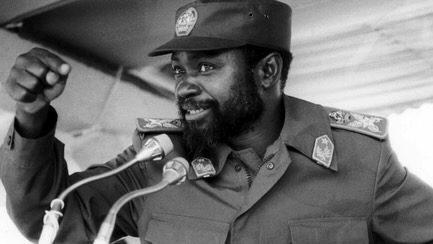

Forty years after the death of Samora Machel, Mozambique’s first president and leader of the country’s liberation movement (FRELIMO), the circumstances surrounding the plane crash that claimed his life remain contested. The tragedy, which occurred on October 19, 1986, in Mbuzini, in what was then South Africa’s eastern Transvaal, continues to raise questions about whether the crash was an accident or an act of sabotage involving the apartheid government.
At the 40th anniversary ceremony on October 19, 2026, Mozambican President Daniel Chapo said the investigations of the past four decades had not dispelled the doubts. Machel’s family joined the call, and a day later the government signaled that the case file may have to be reopened.
His daughter, Josina Machel, expressed the family’s frustration. “If the investigation is open, then we need to know,” she told the gathering, asking investigators what information has been uncovered in 1986, 1996, and 2006, and whether anything new had emerged since. The family has made similar appeals at earlier anniversaries too.
Mozambican president renews calls for clarity
Mozambican President Daniel Chapo used the occasion to renew calls for the truth about the circumstances of Machel’s death, arguing that the investigations conducted over the decades had failed to eliminate the doubts surrounding the incident. He said the families of the victims and the peoples of Mozambique and South Africa had a right to know what happened on that October night in 1986.
Chapo also connected Machel’s legacy to the continuing struggle for economic independence. He called for a Mozambique capable of producing more than it consumes, processing its own resources and creating employment opportunities, particularly for young people and women.
“Samora’s generation won the freedom of the homeland. It is up to our generation to transform that freedom into prosperity for the people,” Chapo said.
The Mbuzini plane crash
On October 19, 1986, Machel was returning from Lusaka, Zambia, where he had attended a summit of African leaders. His presidential aircraft, a Soviet-made Tupolev Tu-134, went down in the Lebombo Mountains near Mbuzini, close to the borders of Mozambique and Swaziland, now Eswatini, in South African territory.
The crash killed Machel and 34 other people, including members of his delegation and aircraft crew. Nine people survived.
The location of the crash immediately raised questions. At the time, Mozambique was facing a devastating civil war, with the apartheid government of South Africa providing support to the RENAMO insurgency seeking to overthrow the FRELIMO government. Machel had also been a vocal supporter of liberation movements fighting white-minority rule across Southern Africa, including the African National Congress (ANC).
The political relationship between Mozambique and Apartheid South Africa was therefore deeply hostile. Mozambique’s support for regional liberation movements had made it a target of South African destabilization efforts. The apartheid government regarded Machel’s government as a threat to its regional interests. Against this, suspicions emerged that the crash might not have been an accident.
Competing investigations and unanswered questions
Following the crash, a Commission of Inquiry headed by South African Judge Cecil Margo was established to investigate the circumstances. Its findings attributed the accident to pilot error, concluding that the flight crew had failed to follow the required procedures during an instrument approach and had continued descending without maintaining the minimum safe altitude.
However, a Soviet investigative team disputed the findings. Its minority report argued that a false or decoy navigation beacon had misdirected the aircraft, causing it to turn away from its intended route and into the mountainous terrain near Mbuzini. The Soviet delegation also denounced that its expertise and experience had been undermined during the inquiry. It maintained that the aircraft’s unexpected 37-degree turn was central to understanding the crash and rejected the conclusion that pilot error alone explained the tragedy. The different findings left important questions unresolved.
The matter was revisited by South Africa’s Truth and Reconciliation Commission (TRC), established in 1996 to investigate human rights violations committed during apartheid. Its special investigation into Machel’s death examined the earlier inquiries, interviewed witnesses and considered evidence concerning the political and security circumstances surrounding the crash.
The TRC did not establish conclusively whether the aircraft had been deliberately brought down. However, its report raised questions about the conclusions of the Margo Commission and highlighted evidence that warranted further investigation.
Among the issues examined was the possibility of a false navigation beacon and the failure of South African authorities to warn the aircraft about the danger posed by its flight path.
The report also considered testimony about a suspicious electronic device reportedly found near the crash site. A television journalist who attended the on-site investigations by the joint Soviet, Mozambican, and South African team told the Commission that an investigator had shown the television crew a device that could have been a frequency scrambler. While members of the Margo inquiry team reportedly told a journalist that the device had been found to be harmless, an expert on mobile beacons told the TRC that such a device could potentially interfere with an aircraft’s signal.
The Commission’s final conclusion was that the investigations had raised questions that remained unanswered. It stated:
“The investigations conducted by the Commission raised a number of questions, including the possibility of a false beacon and the absence of a warning from the South African authorities. The matter requires further investigation by an appropriate structure.”
That recommendation has never been carried through. Nelson Mandela and Thabo Mbeki both promised to reopen the inquiry, and a police investigation, announced in 2012 after new documents surfaced, produced no public findings.
Samora Machel’s revolutionary legacy
Beyond the circumstances of his death, the 40th anniversary also brought renewed attention to Machel’s place in the history of African liberation.
Born in 1933, Machel became involved in the struggle against Portuguese colonial rule and joined the Mozambique Liberation Front, FRELIMO, which was established in 1962. He rose through its military and political ranks, eventually becoming the movement’s leader following the death of Eduardo Mondlane in 1969.
Under his leadership, FRELIMO intensified the armed struggle against Portuguese colonialism, which culminated in Mozambique’s independence on June 25, 1975. Machel became the country’s first president and led the newly independent state through a period of socialist-oriented transformation.
His government pursued nationalization and expanded public provision in areas such as education and healthcare, while seeking to dismantle the economic and social structures inherited from colonial rule. It also supported liberation movements across Southern Africa, providing political and material solidarity to those fighting apartheid and white minority rule.
This position placed Mozambique in direct confrontation with the apartheid government. South Africa supported RENAMO as part of its wider regional strategy to undermine governments and liberation movements opposed to apartheid. The resulting conflict devastated Mozambique, causing widespread displacement, destruction of infrastructure, and loss of life.
Machel’s death therefore occurred within a wider regional struggle in which the survival of independent African governments and the liberation of Southern Africa remained closely connected.
His political legacy continues to resonate across the continent, particularly through the principles of anti-colonialism, African solidarity, and self-determination. His famous revolutionary slogan, A luta continua (The struggle continues), remains associated with the liberation movements and generations of activists who challenged colonialism, apartheid and imperialism.
The history of Africa’s liberation struggles is also marked by the assassination of other revolutionary figures, including Amílcar Cabral, Patrice Lumumba, Titina Silá, and Chris Hani, as well as the killing of Steve Biko under apartheid detention. While the circumstances of these deaths differ, they form part of a broader history in which political violence was used against leaders and movements challenging colonial and minority-rule systems.
Machel’s death continues to be considered within this historical context, although the allegations surrounding the Mbuzini crash have never been conclusively established.
From BT News via This RSS Feed.