

With tech mogul Elon Musk pouring nearly half a billion dollars into the midterm elections and just 20 individuals spending over $2 billion in an effort to elect Republicans who would continue President Donald Trump’s corporate-friendly MAGA agenda, the results—including at least seven US Senate seats, 30 US House seats, and five governorships taken over by Democrats—sent a resounding message to GOP megadonors.
But economic justice advocates on Thursday said the Democratic Party must not stop there, demanding that the party’s new majorities take immediate action after the new Congress is sworn in in January to pass a federal wealth tax—the kind that was central to campaigns including those of Sens.-elect Troy Jackson (D-Maine), James Talarico (D-Texas), and Abdul El-Sayed (D-Mich.).
“This election was a referendum on who has control over our democracy and our economy," said Meghan Schneider, senior spokesperson for Tax the Greedy Billionaires. “The ultrawealthy funneled billions of dollars into state and federal races to manipulate public opinion and buy influence, to further enrich themselves. From Michigan to Texas, voters across the political spectrum rallied against the billionaires and the cronies they bankrolled.”
By electing candidates including El-Sayed, Talarico and Sen.-elect Peggy Flanagan (D-Minn.), said Schneider, voters sent a clear message: “We want leaders who will improve the lives of working people, not billionaires.”
While billionaire opponents of California’s proposed wealth tax, which would have established a one-time 5% tax on the state’s richest residents, succeeded in crushing the proposal after spending more than $379 million against it, experts are expecting Democrats in Congress to consider bills, including one proposed by Sen. Chris Van Hollen (D-Md.).
“From Michigan to Texas, voters across the political spectrum rallied against the billionaires and the cronies they bankrolled.”
The senator has called for a graduated surtax on people earning more than $1 million per year. Those who earn $1 million-$2 million would be taxed 5% and households earning more than $5 million would be taxed 12%, while the capital gains top tax rate would be raised from 23.8% to 35.8%.
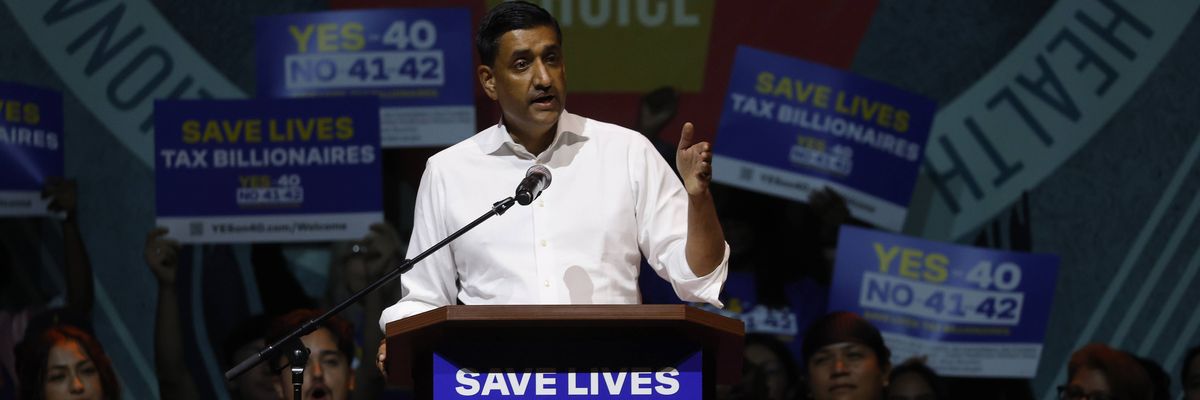
Rep. Ro Khanna (D-Calif.) has also joined Sen. Bernie Sanders (I-Vt.) in proposing the Make Billionaires Pay Their Fair Share Act, which would establish an annual 5% tax on households whose net worth is more than $1 billion.
Senate Minority Leader Chuck Schumer (D-NY) has proposed quadrupling a tax on stock buybacks, while Sen. Ron Wyden (D-Ore.), set to become the chair of the Senate Finance Committee, said in a post-election statement Wednesday that “the committee will redouble its efforts to ensure billionaires pay their fair share and hold tax cheats accountable.”
Van Hollen, who has been floated as a potential 2028 presidential contender or a successor to Schumer—but has said he doesn’t plan to run for the latter—told Politico Thursday that even if President Donald Trump vetoes a potential billionaires’ tax, putting forward the proposal would show the American public whose side the Democrats are on ahead of 2028.
“It is essential that we show the American people where we stand,” said Van Hollen. “If Trump vetoes it, it will just show people that he’s on the side of billionaires.”
Schneider said that with the artificial intelligence boom and looming initial public offerings by wealthy corporations “already accelerating historic wealth inequality and worsening the affordability crisis, the need to act decisively and quickly at the national level is dire.”
“Leaders in the new Congress must deliver on their promises to put working people over billionaires,” she said, "and introduce a national wealth tax within the first 100 days of the new Congress.”
From Common Dreams via This RSS Feed.
Well, if they can spend so much on elections, they might as well pay taxes.
