

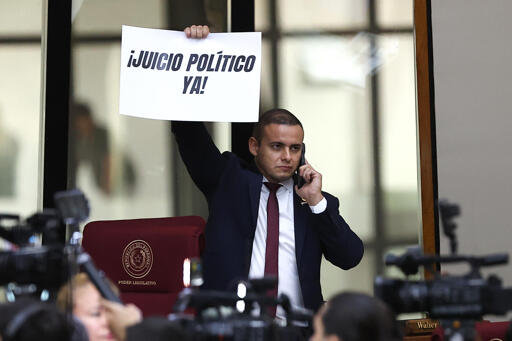
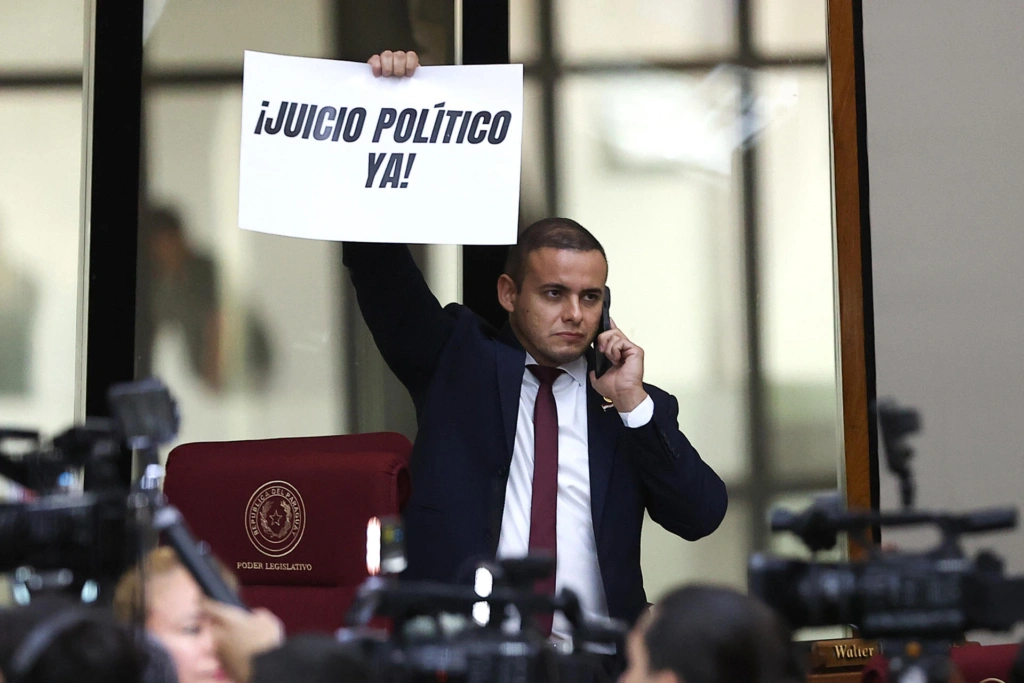
The Chamber of Deputies of Paraguay unanimously approved the political trial against Santiago Peña this Thursday, amid the institutional crisis caused by the closure of Ueno Bank. The decision was announced a few hours after the president announced his resignation, having lost the support of the Colorado Party, his main political supporter.
The accusation brought before lawmakers lays out five chapters of alleged political and administrative responsibility linked to the management of the country’s pension funds.
Among the charges, the document cites a conflict of interest stemming from Santiago Peña’s shareholding in Ueno Holding, the financial group that controls Ueno Bank.
RELATED: Paraguayan President Santiago Peña Resigns Amid Ueno Bank Crisis
The text also questions the appointment of Carlos Carvallo to head Paraguay’s Central Bank. Carvallo previously served as president of Ueno finance company, and the signatories contend that placing him at the monetary authority is incompatible with protecting the public interest.
The accusation goes further, alleging that Peña promoted changes to conflict-of-interest legislation and tolerated the Instituto de Previsión Social, the state social security institute, holding outsized sums in Ueno Bank beyond permitted limits.
Before the legislative session, the Colorado Party, the political force of both Peña and Alliana, pulled its support for Peña. The party said it is not “on the side of the plundering of public, private and pensioners’ funds.” It added that “the Colorado flag represents a history of service to the country and honoring it also means acting with courage when the homeland demands it.”
The rupture between Peña and his own party deepened a crisis that has been building around Ueno Bank, the lender linked to Peña. State funds flowed into the institution in large volumes after he took office in 2023.
Paraguay’s Chamber of Deputies holds an extraordinary session to consider impeachment charges against President Santiago Pena and Vice President Pedro Alliana, filed by 35 lawmakers after the Central Bank dissolved Ueno Bank. Mass protests continue in Asuncion, with depositors,… pic.twitter.com/7S3e0oVqhk
— teleSUR English (@telesurenglish) November 5, 2026
Senate Vote Decisive
The Senate now holds the decisive card, and its ruling will shape both the political and judicial future of Santiago Peña. If the impeachment advances and Peña is removed, he would lose access to the status of senator for life and the legal protections attached to that figure, leaving him exposed to criminal prosecution.
If the upper house instead accepts his resignation and drops the impeachment, Peña would take a Senate seat and gain a shield. Any future lawsuit against him would then require Congress to strip that immunity before he could answer in court.
The arithmetic favors the party. Of the 45 seats in the Senate, 27 belong to the Colorado Party.
The financial trail sits at the center of the case. Since Peña arrived in power in 2023, state deposits in Ueno Bank grew to around 869 million dollars by the end of June, equal to 29% of everything the bank captured. Part of that money belongs to the social security institute, which placed roughly 345 million dollars linked to the pensions of thousands of workers in the institution.
The institute’s exposure shows what is at stake. That money is tied directly to the retirement funds of thousands of Paraguayan workers, and the allegation that deposits exceeded legal limits feeds the broader case against the administration.
Alliana, for his part, is 52 years old and was born in the southern department of Ñeembucú. He has belonged to the Colorado Party for more than two decades and holds a degree in international relations from the Universidad Autónoma San Sebastián. Before politics he worked as a merchant in his hometown, where he ran for mayor. He later won the race for governor of Ñeembucú, served as a deputy for the department and climbed through the party’s internal structure.
Ver esta publicación en Instagram
Una publicación compartida de teleSUR English (@telesurenglish)
From teleSUR English via This RSS Feed.