

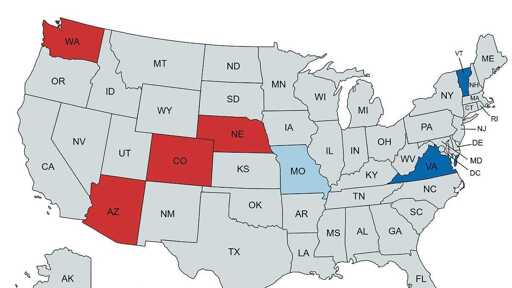
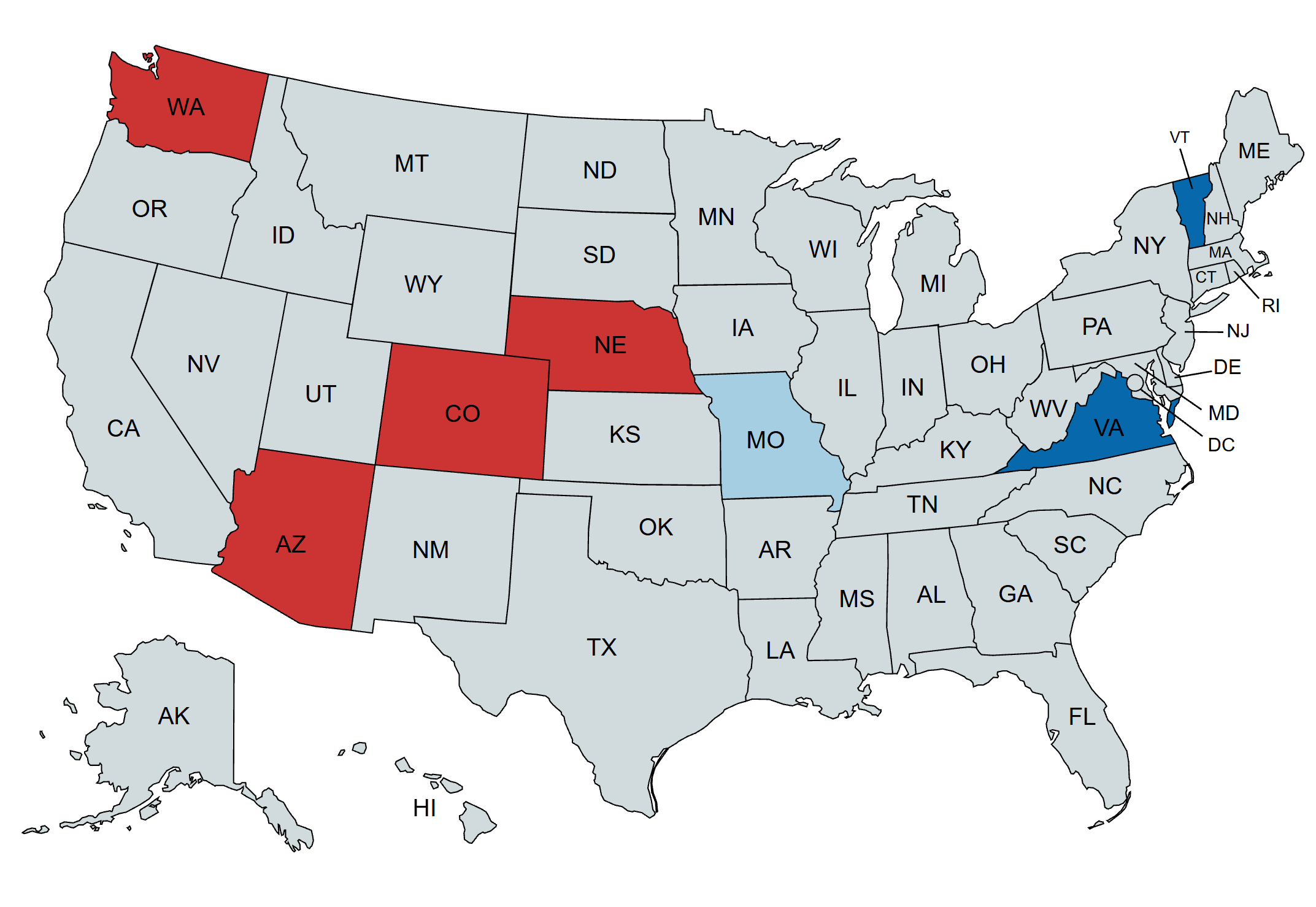
LGBTQ+ Ballot measures // Red = passed, Light Blue = failed, Dark Blue = Good Measure
Erin In The Morning is a reader-supported publication. To receive new posts and support my work, consider becoming a subscriber.
On Tuesday night, as election results poured in, it became immediately clear: anti-transgender ads had failed to earn Republicans a victory in the year they relied on them the most. Despite $183 million spent on ads targeting transgender people and any Democratic politician who had ever expressed support for them, even Democrats who openly supported transgender people won in Republican strongholds. As a trans woman won her race in a conservative Alabama district and fierce defenders like Peggy Flanagan won Minnesota’s U.S. Senate race, there was a lot to be hopeful about. But it was not all good news for transgender people on Tuesday night: results began to trickle in showing that anti-trans ballot measures were likely to pass in a handful of states, including blue states like Colorado and Washington. Though some of those vote totals remain uncertain, there is a significant likelihood that we will have our first anti-trans policies written into law in “safe states,” and there are already plans to ensure they never truly take hold.
In Colorado, a state many transgender people fled to because of its strong protective legislation, a sports ban and a surgery ban for transgender youth were ahead by razor-thin margins of 52-48. Neither has been called. Importantly, both measures are statutes, not constitutional amendments. That means the legislature can rewrite them, and it makes them ripe for challenge under the Colorado Constitution, in a state with strong legal protections for transgender people and a state Supreme Court that has enforced them, meaning the laws may never truly take hold. A state constitutional challenge would also be largely insulated from the U.S. Supreme Court: that case would run through the state court system, and the U.S. Supreme Court lets states interpret their own constitutions to protect more rights than the federal Constitution does.
In the meantime, transgender people can take heart that the measures, if they pass, will do so by very narrow margins. Transgender sports participation is not the “80-20 issue” some have claimed; this looks closer to a 50-50 issue. Voters also had relatively little time to learn what the laws would actually do. It remains to be seen what the impacts will be. Given how narrowly the measures appear to be passing, a strong campaign against them could conceivably defeat similar measures in the future, making state ballot measures far from the slam dunk anti-trans activists had envisioned.
Advocates and state leaders are not waiting for a court challenge, though. There is already talk of other ways to defang the measures. Colorado Governor-elect Phil Weiser said, “We’re going to have to take a look at these anti-trans measures and what adjustments are necessary and appropriate … It’s important that we recognize that sometimes, something is passed and it is incomplete. It is not administrable … it is a natural and, I believe, appropriate role for the legislature to say, ‘What are the adjustments that need to be added?’ ” And on the sports ban specifically, he said, “I don’t believe it would be acceptable to Colorado to have every student athlete to have to go through full-body examinations or other invasions of privacy.” What might this mean in practice? The measure itself never says how sex is supposed to be verified, so it could be defanged by allowing a birth certificate to serve as proof of sex in sports, a document that many states, including Colorado, allow trans people to change, or by allowing self-attestation to serve. And the legislature can and likely will adjust the law, meanwhile Colorado officials could put forward a non-enforcement agreement.
In Washington, similar dynamics are in play, and in fact the news may be a little more hopeful there. Initiative 638, which requires girls who want to play girls’ sports to get a statement from a health care provider verifying their sex, a requirement critics have warned could mean genital inspections, is passing 57-43 with plenty of the vote still out. Meanwhile, Initiative 1, the “parents’ bill of rights” that could have resulted in the forced outing of transgender youth, is trailing and seems likely to fail. Initiative 638’s apparent passage in a state that is otherwise very safe for transgender people has been cause for concern and consternation on an otherwise positive night.
But even here, it appears that organizations are preparing for legal challenges. Sam Fox of Legal Voice sent a statement on Initiative 638 stating, “Legal Voice will take every measure to protect young people from this discriminatory law.” Meanwhile, a press release from No Hate in WA State, one of the main organizations opposing the ballot measure there, stated, “Many have said that I-638 is likely unconstitutional and we understand there are legal groups and organizations considering litigation.” Washington’s state Supreme Court leans quite left and it has struck down voter-passed initiatives before, as recently as 2020.
The situation is somewhat bleaker in Arizona and Nebraska, both of which passed sports bans, with Arizona’s sports ban also being a potential bathroom ban. Nebraska’s sports ban is a constitutional amendment and bans transgender athletes from sports from kindergarten through college. Meanwhile, Arizona’s ban not only bans transgender sports participation but also restricts access to “restrooms, locker rooms, shower rooms or other private spaces that are integral to athletic engagement.” That “integral to athletic engagement” clause will be important in the state, because read narrowly, as the Legislature’s own nonpartisan analysis reads it, the bathroom ban portion applies only to athletic spaces. There is no easy way to overturn this measure, given the current makeup of the Arizona Supreme Court and a state law that restricts the Legislature from repealing voter-approved measures and allows changes only by a three-fourths vote. But over time, it too could fall to court challenges should the court’s makeup shift.
Ballot measures were not all bad news for transgender people, though. In Vermont, Proposal 4 passed, adding gender identity and gender expression to the equal protection rights in the state constitution. It passed with nearly 80% of the vote, and that right reaches everything the state does, from public school sports to education to state health care policy. Policies like this can help roll back or prevent further backsliding on transgender rights in blue states, and this kind of measure will likely be integral to protecting transgender people’s rights in the future. Meanwhile, Virginia repealed its same-sex marriage ban, and Missouri defeated its own anti-trans constitutional amendment, which had been attached to an abortion ban.
Ultimately, Election Day was mostly great for transgender people. Republicans will lose much of the power they have used to target the community, and some of the country’s worst anti-trans officials will soon be out of office. Meanwhile, pro-trans Democrats won even in places Trump carried. The ballot measures, though, will leave a bitter aftertaste for many transgender people on an otherwise good night. But readers should know this: advocates and officials are already working on plans to keep at least some of these measures from ever taking full effect, and there is no reason to lose hope for the future of transgender people in safe states.
Erin In The Morning is a reader-supported publication. To receive new posts and support my work, consider becoming a subscriber.
From Erin In The Morning via This RSS Feed.