

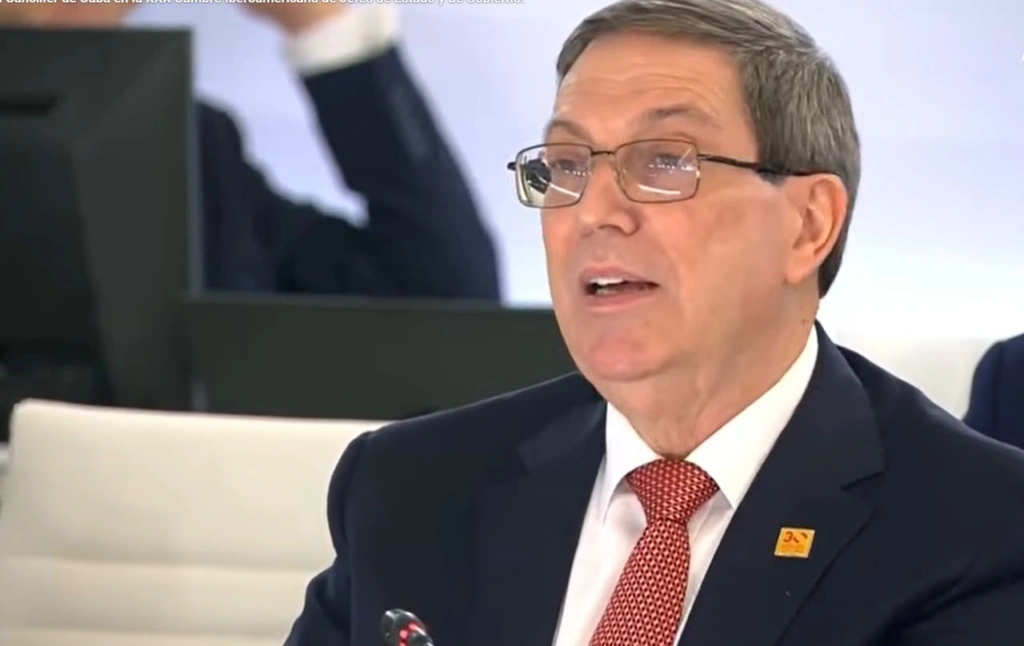
He denounced the strengthening of economic and financial measures in recent months.
On Thursday, Cuban Foreign Minister Bruno Rodriguez denounced a policy of “collective punishment” imposed by the United States against the island during the Ibero-American Summit held in Madrid.
RELATED: Cuba Condemns U.S. Deportations of Migrants to Africa
In his address to representatives of the 22 countries of the Ibero-American Community of Nations, Rodriguez criticized the economic blockade imposed on Cuba and its effects on the Caribbean nation’s economy and population.
The Cuban minister thanked the Ibero-American states that supported the resolution adopted by the United Nations General Assembly on October 28, which rejected the continuation of the U.S. blockade against Cuba.
Rodriguez stated that, faced with what he defined as unilateral actions and an abuse of power, the countries of the region must act in accordance with the founding principles of the Ibero-American Community, upholding cooperation and respect for international law.
La política absurda del gobierno EEUU contra Cuba bloquea todo aquello que sostiene la vida. Hasta sus propios ciudadanos sufren las consecuencias.
¿Por qué el bloqueo contra Cuba impide que 7 millones de estadounidenses reciban los beneficios del medicamento cubano NeuralCIM… pic.twitter.com/OrGyTzMEVK
— Bruno Rodríguez P (@BrunoRguezP) October 29, 2026
The text reads, “The absurd U.S. government policy against Cuba blocks everything that sustains life. Even its own citizens suffer the consequences. Why does the blockade against Cuba prevent 7 million Americans from receiving the benefits of the unique Cuban drug NeuralCIM, which can combat Alzheimer’s and senile dementia?”
He also called for preserving the independence of the Ibero-American Conference, rejecting any form of interference, exclusion, or external pressure on the mechanisms for dialogue and cooperation among member countries.
The Foreign Minister noted that the current international landscape is marked by unilateralism, the proliferation of conflicts, violations of international law, human rights issues, and the growing effects of climate change on societies.
He said the challenges facing the Ibero-American community echo questions posed decades ago by the historic Cuban leader Fidel Castro, especially regarding the defense of sovereignty, independence, and the development of the region.
Cuba is implementing a package of 176 economic and social changes to boost domestic production against the U.S. blockade, adapt to the dynamic global economy through foreign trade and investment, and improve the population’s quality of life with better jobs, wages, and social… pic.twitter.com/JZEgiyZGXT
— teleSUR English (@telesurenglish) October 3, 2026
teleSUR: JP
Source: EFE
From teleSUR English via This RSS Feed.