

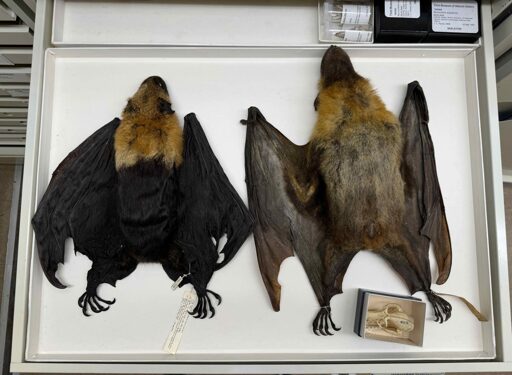
Madagascar’s largest fruit bat is getting smaller, and hunting may be partly to blame, a recent study suggests. The Malagasy flying fox (Pteropus rufus) feeds mainly on fruit and nectar, making it an important pollinator and seed disperser. But the species is also hunted for meat, both for subsistence and commercial sale. Hunting is legal in Madagascar from May to September each year; some hunters use nets to catch bats for food, while others shoot them with shotguns to sell in markets and restaurants. Researchers from the Field Museum of Natural History in Chicago, U.S., first noticed the apparent change while observing the bats in the wild. The animals seemed smaller than specimens held in the museum. “I was thinking about a million different angles to explain why the bats were getting smaller,” Emily Cornelius Ruhs, the study’s lead author a postdoctoral researcher at the Field Museum’s Negaunee Integrative Research Center, said in a statement. “I wondered if it was related to changes in temperature or habitat.” Co-author Steve Goodman, also from the Field Museum, suspected commercial hunting, which had intensified from the 1980s onward, might be a factor. To investigate, Ruhs and Goodman measured the skulls and teeth of 121 Malagasy flying fox specimens collected over the past 150 years. They found the bats’ skulls had become significantly smaller since 1980, while their teeth had not. The researchers suggest this could indicate that hunters are selectively shooting larger bats because they yield more meat. “If you’re the biggest bat…This article was originally published on Mongabay
From Conservation news via This RSS Feed.