

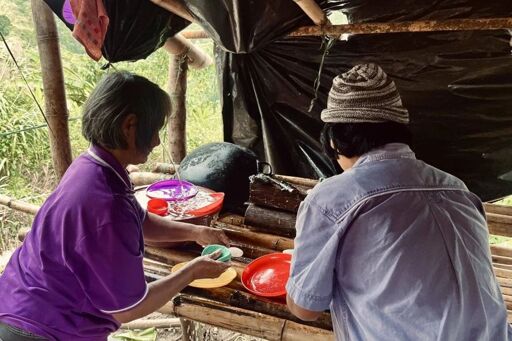
KASIBU, Nueva Vizcaya – In this third class municipality some 300 kilometers north of Luzon, land is life. It feeds families, sustains Indigenous communities, and carries generations of history. Yet under Ferdinand Marcos Jr.’s banner of “development,” mining expansion threatens to dispossess communities of the very land that keeps them alive.
In defense of their land, the people of Kasibu set up the people’s barricade against large-scale mining. Their steadfastness was met with force when on August 28 this year, police arrested 11 locals of Barangay Paquet for blocking the entry of North Luzon Mineral Resources Corporation (NLMRC).
They were later released on bail, but the crackdown has not ended because members of the community continue to face trumped-up criminal charges or what advocates consider as Strategic Lawsuit Against Public Participation (SLAPP).
The NLMRC is the seventh company to attempt exploration in the area. It holds a government-issued exploration permit covering 4,456 hectares across parts of Kasibu, where it seeks to explore for gold, copper, and other minerals.
It is no coincidence that mining companies have their eyes on Kasibu. Beneath its mineral-rich mountains lie the farmlands and watersheds that sustain its people. Known as the Citrus Capital of Luzon, the municipality grows calamansi, other citrus fruits, and vegetables, while the 18,417-hectare Kasibu Watershed forms part of a vital network of watersheds in the Sierra Madre.
For farmers already struggling with high production costs and potential losses of P25,000 ($392.63) to P150,000 ($2,355.75) per cropping cycle, mining threatens to worsen their hardships. They fear contamination of soil and water, as well as landslides, droughts, and floods. The drive to extract mineral wealth destroys the land that feeds communities and sustains generations.
But the people of Kasibu have never surrendered their land. Their resistance dates back to 2007, when the Kasibu Inter-Tribal Response for Ecological Development (KIRED) emerged from the community’s struggle against large-scale mining. Alongside the Alyansa ng Novo Vizcayano para sa Kalikasan (ANVIK), they have helped sustain a network of barricades against successive mining ventures.
There are currently six barricades standing across Kasibu, positioned along routes that mining operations could use to advance into community lands. The main barricade in Barangay Paquet has drawn more than 100 regular members, with more joining when the community calls for reinforcements.
Women play a central role in sustaining this resistance.
At least 300 women are part of the wider community barricades, taking on leadership roles and helping sustain their operations. As mining threatens their livelihoods and ancestral lands, these women are fighting for their families’ right to remain on, live from, and care for the land they call home.
Nanay Linda: Never giving up
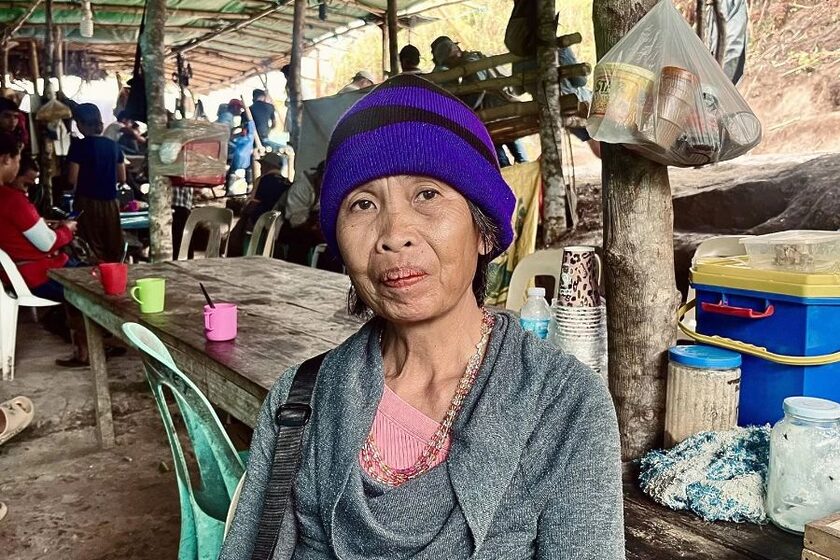
Nanay Linda, 60 years old.
At 60, Linda Kuruko knows the weight of a life spent working the land. Born in Lamot, Ifugao, she grew up in poverty before her family settled in Kasibu in search of a better life. She has spent years as a farmer, making ends meet even when harvest prices fall.
“I’m still strong—if I don’t work, I won’t have anything to eat,” she told Bulatlat in Filipino.
Despite the exhaustion that comes with age, she continues to climb the mountain to join the barricade. She and her son have even built a small hut uphill so they can stay close to the community’s defense line.
Her determination is rooted in what she has witnessed in Didipio, a neighboring village in Kasibu where OceanaGold operates a large-scale gold and copper mine. She has seen how mining can damage the land and leave slopes vulnerable to erosion and landslides during heavy rains. She fears Kasibu’s communities will suffer the same fate if mining operations continue.
But fear has never been reason enough for Nanay Linda to surrender. She knows the hardship of living harvest to harvest, and she knows what losing the land would mean for families who depend on it. Despite the harassment and the strain of waiting at the barricade for possible confrontations, she continues to stand with her fellow defenders.
“Sometimes, I feel hurt by what they do to us, but I try to keep my composure so I don’t become stressed. We are fighting for our children’s rights and for what we will pass on to them,” she said.
She wanted her children to raise their families on their own land and her grandchildren to have the opportunity to study—something poverty denied her generation. She hopes they can build a future in Kasibu without being forced to leave in search of a livelihood elsewhere.
For Kuruko, growing older is no reason to abandon the struggle. Years of hardship have taught her what is at stake, and the damage she has witnessed elsewhere has only strengthened her resolve.
Stella: Taking a mother’s fight beyond the household
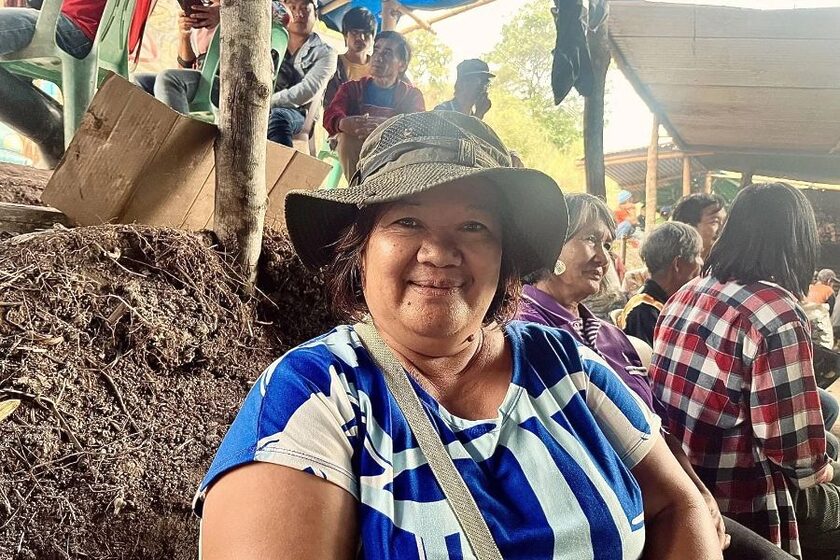
Stella, 50 years old.
For Stella Mari Marquez, 50, being a mother means more than raising her four children. An Ibaloy who has lived in Kasibu all her life, she farms rice, vegetables, and other crops to help sustain her family. But with fertilizer costs rising and crop prices fluctuating, even months of hard work can end in losses. Now, as mining threatens the land and water her family depends on, Stella has taken her fight beyond the household.
“If we lose our land, what will happen to our children and grandchildren?” she said in Filipino.
She recalled that when the community barricade against NLMRC began in June 2026, residents were told the company’s entry was just for road clearing, never expecting the confrontation that followed.
During the August 28 police assault, Marquez and the other women in the barricade were on the frontline, linking arms and preparing to face the advancing police.
“We said the women should be at the front because maybe the police would have a conscience. But it turned out they spared no one,” she told Bulatlat.
Marquez’s husband was among the 11 residents arrested on August 28. Watching a video of him being dragged by police was painful, she said, especially seeing an elderly woman dragged alongside him. After four days in detention, her husband returned home with pain in his hands and back.
At the barricade, Marquez’s role as a mother does not end; it expands into collective care and the defense of their shared future. At the barricade, she has found her place by turning its often-invisible work of care into a collective act of resistance. Women in the barricade prepare meals and coffee, welcome visitors, and look after those keeping watch.
To the mothers standing beside her, she has one message: “Let us continue the struggle until we win.”
Femadel: Inheriting the fight, defending the future
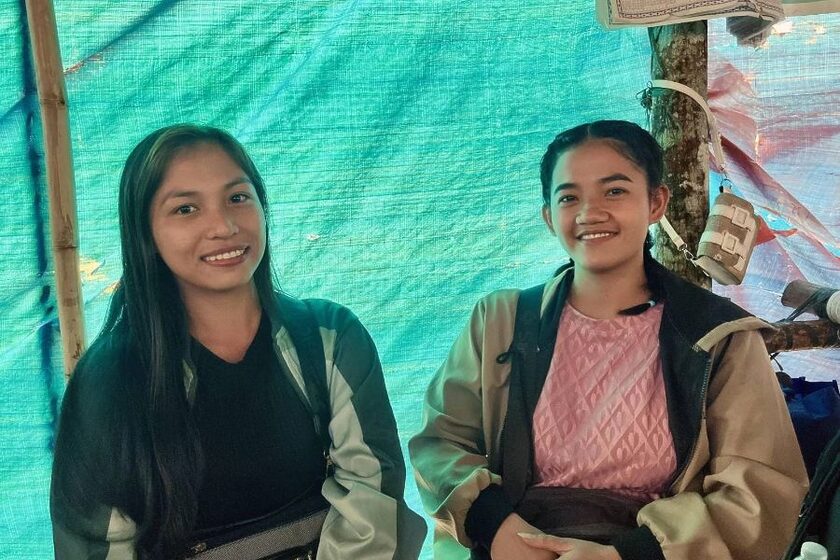
Femadel, 25 years old and her cousin Cherybeth, 23 years old.
At 25, Femadel Pablo put up a small sari-sari store to help support her family. She is the second of five siblings.
Since high school, Pablo has helped her parents in the farm and dreamed of using her education to support their farming.
She visits the barricade twice a week, where her mother, grandparents, and other residents are also present, ready to defend their land.
Pablo grew up hearing stories of her grandparents going to the barricade as early as 2007.
It was her first time joining the barricade in August 2026 and witnessed police handcuffing fellow residents. She and other young people documented the arrests, recording videos that could serve as evidence.
“I was angry, I wanted to cry, but I was also afraid,” she said, adding that seeing those arrested refuse to give up has inspired her. “They didn’t give up, so we shouldn’t either.”
For Pablo, young people have a vital role to play. They document incidents, share information online, and help ensure that abuses do not go unrecorded. But she believes courage must come with knowledge.
Young people need to understand mining and their rights so they can face authorities with confidence and stand their ground. “It’s good to be brave, confident, and knowledgeable, so you don’t feel small,” she said.
Watching the elders defend their land has taught her that the struggle is not theirs alone. It is also about the land and future that her generation will inherit and eventually pass on to their own children.
It moves her to tears to see elderly residents, some already frail, still standing at the barricade. She hopes more young people will join them, bringing their skills and energy to the struggle.
Pablo dreams of a day when Kasibu will be known not for mining threats and arrests, but for the abundance its land provides.
“I hope the news will say, ‘Kasibu, Citrus Capital of Luzon’—I hope that’s the kind of news people hear,” she said. “It’s such a waste, because Kasibu is so rich in agriculture. I hope that’s what goes viral, not another story about mining here.”
For Pablo, defending the land is no longer simply a struggle she grew up hearing about. It is a responsibility she has chosen to carry forward. She hopes that one day, young people in Kasibu can build their lives without having to fight to protect the land that sustains them.
Nanay Linda, Marquez, and Pablo share one conviction: Kasibu’s future must belong to the people who call it home.
As mining is increasingly framed as “necessary for a greener future”, their struggle exposes a deeper contradiction: what kind of progress destroys the land, water, and communities that make life possible?
Their message is clear: there can be no genuine progress when communities must lose their land, livelihood, and future to make way for it. (AMU, RVO)
Disclaimer: This story was produced through a grant from Oxfam Pilipinas’ Patas na Bukas Media Fellowship.
The post Women tending the Kasibu barricades against large-scale mining appeared first on Bulatlat.
From Bulatlat via This RSS Feed.