

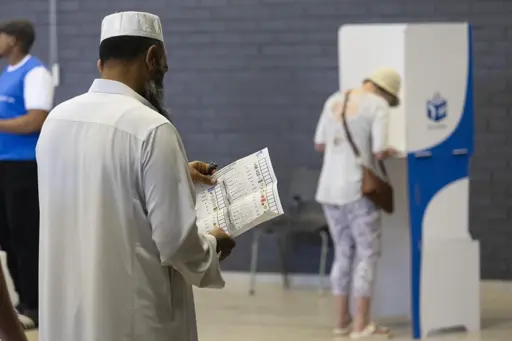
Voting concluded late Wednesday in South Africa’s municipal elections, a nationwide test for the African National Congress as citizens punish failing public services.
Polling stations closed at 9 P.M. local time, with more than 29 million registered voters called to renew municipal councils across the country.
The ballot will define the councillors responsible for choosing mayors and forming local administrations in 8 metropolitan, 44 district and 205 local municipalities. 136,790 candidates, divided between 546 political parties and independent candidates, compete.
RELATED: South Africa Begins Early Voting Ahead of Local Elections
Preliminary figures from the Independent Electoral Commission showed roughly 12 million ballots cast by 5 P.M. local time, though the commission cautioned the tally was incomplete. The vote unfolded against deep popular frustration. Collapsed infrastructure, recurring water cuts and unemployment above 30% shaped the campaign and darkened the mood at the polls.
Counting began immediately after the stations closed. Partial results were expected through the night, with official final figures due Thursday or Friday. The outcome will decide the political direction of the main cities and serve as a national barometer ahead of the 2029 general elections.
Voting Stations Officially Closed! Thank You, Mzansi!
The 2026 LGE have officially come to an end as voting stations across the country close their doors.
📌Reminder, if you’re still in line after closing time, you will still be allowed to vote. #LGE2026 pic.twitter.com/CKHs0CvRN7
— IEC South Africa (@IECSouthAfrica) November 4, 2026
Early voting already signaled trouble for turnout. Of the 2.6 million people authorized to cast advance ballots, only 1.4 million exercised the right, a striking abstention rate that worried election officials.
President Cyril Ramaphosa declared a national holiday to encourage participation and urged citizens to vote peacefully. The appeal came in a tense atmosphere marked by xenophobic clashes, protests and 43 politically motivated killings documented so far this year by the Global Initiative Against Transnational Organized Crime.
The African National Congress (ANC), the historic movement that led the struggle against apartheid, is expected to remain the most voted force nationally. But polls anticipate a further erosion of its support. The party founded by Nelson Mandela fell below 50% in the 2021 municipal elections and declined again in the 2024 general vote, winning just over 40%. That collapse forced it into a unity government with nine other formations.
First Prelimary Results
The Electoral Commission of South Africa (IEC) has released the first results with the Democratic Alliance (DA) holding a commanding early lead in a small voting district in the Eastern Cape.
The initial figures came from Driefontein Farm, in Ward 6 of the Blue Crane Route Municipality. According to the IEC, the DA won 58.82% of the valid votes, well ahead of the African National Congress (ANC), which secured 26.47%. The Economic Freedom Fighters (EFF) took 11.76%, while the Patriotic Alliance trailed with 2.94%.
The result reflects a single voting district and should not be read as a signal of how the wider municipality, the province or the country will vote. Early returns from small districts, often in rural areas, can differ sharply from the final picture once larger and more densely populated areas report their counts.
The Electoral Commission of South Africa (IEC) has released the first results of the 2026 Local Government Elections, with initial results coming from the Eastern Cape.
Reporting: 0.0%
Registered voters: 63
Voter turnout: 27.0%TOP PARTIES
- DA — 58.82% (20 votes)
- ANC —… pic.twitter.com/OcdLY2X0Nk
— SABC News (@SABCNews) November 4, 2026
Coalition Era Looms
This election date serves to gauge the popularity of a African National Congress (ANC) that already suffered a debacle in the 2021 local elections, when it received less than 50% of the vote for the first time since constitutional democracy was established in the country in 1994. The trend was confirmed in the 2024 general election, when ANC also lost for the first time an absolute majority and was forced to form a coalition with the liberal Democratic Alliance (AD) – a party associated with the white minority and main opposition force until 2024 – and eight other smaller formations.
For it part, the opposition is moving to capitalize on the failures of public management. The liberal Democratic Alliance (AD) has concentrated its efforts on wresting Johannesburg from the African National Congress (ANC). In Durban, the coastal epicenter of anti-immigrant tensions, the uMkhonto weSizwe party led by former president Jacob Zuma poses a direct challenge.
With no absolute majorities expected in several key districts, analysts foresee complex coalition negotiations. That model already operates in 74 of the country’s 257 municipalities, a preview of the bargaining that will likely dominate the coming weeks.
The results will reveal whether the ANC can still command national majorities or whether South Africa’s political center has permanently shifted toward fractured, negotiated governance. For Ramaphosa, the numbers arriving through the night will measure how much goodwill his unity government retains after two difficult years in office.
The IEC is expected to release further results as counting progresses at voting districts across the country, with the first full picture of party support emerging only after results from the large metropolitan areas are captured. Final results for each municipality will determine council seat allocations, and where no party secures an outright majority, parties will have to negotiate to form governing coalitions.
From teleSUR English via This RSS Feed.