

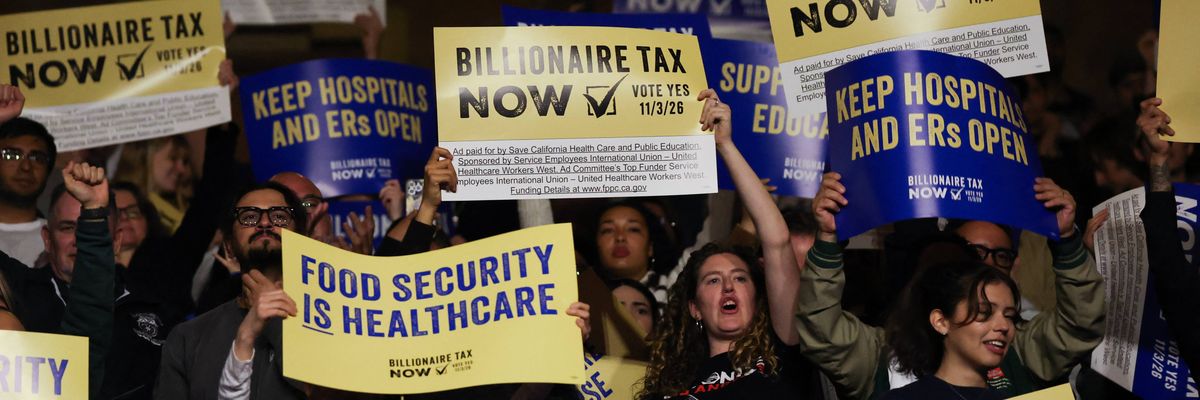
Proposition 40, the California proposal for a one-time 5% tax on the state’s billionaires, appeared headed for defeat Wednesday after a spending blitz exceeding $300 million by some of the state’s wealthiest residents helped turn a potentially landmark effort to make plutocrats pay their fare share into one of the most expensive ballot fights in state history.
With around 60% of expected votes counted, Prop 40—also known as the California Billionaire Tax—was losing by a 56% to 44% margin, according to CalMatters and The Associated Press, which had not yet projected the final outcome due to the significant number of uncounted ballots.
The measure, which is sponsored by Service Employees International Union-United Healthcare Workers West, would impose a one-time 5% tax on the wealth of California residents and trusts worth more than $1 billion. Affecting approximately 200 billionaires, Prop 40 would generate tens of billions of dollars to help fund healthcare, food assistance, and public education programs facing funding pressures, including cuts resulting from President Donald Trump’s attacks on Medicaid, Supplemental Nutrition Assistance Program, and other social safety net lifelines.
Polling showed a majority of California voters—55%—supporting Prop 40 last December, buoyed by the backing of prominent national figures like Sen. Bernie Sanders (I-Vt.), Congressman Ro Khanna (D-Calif.), and former US Labor Secretary Robert Reich.
In early 2026, Google co-founder Sergey Brin and other tech billionaires began pouring money into efforts to oppose the initiative and support competing ballot measures, Propositions 41 and 42, which were specifically designed to undermine or nullify Prop 40.
Democratic California Gov. Gavin Newsom also came out against Prop 40. Critics accused the potential 2028 presidential contender of trying to bamboozle voters with a plan for a national billionaire income tax, knowing that very rich people actually have relatively little income when compared with their investments and other assets that would be subject to taxation under Prop 40.
By June, Prop 40 was polling under 50%. By October, with a deluge of anti-Prop 40 ads flooding the airwaves and internet, support barely topped 40%.
According to CalMatters, billionaires and business interests spent $316.7 million on the campaign against Prop 40, including spending on Props 41 and 42. Most of that money was raised by Building a Better California, a political action committee funded by prominent tech executives, venture capitalists, and business leaders.
As Common Dreams reported Tuesday, opponents of Prop 40 outspent supporters of the measure by a staggering 250: 1 margin.
“We won’t need much analysis to identify what swayed voters,” Yousef Baig wrote for CalMatters. “The playbook for defeating the tax was simple: Stoke economic fears and confuse Californians.”
Baig continued:
Prop 40’s authors may have even doomed their own campaign with an amendment provision that opponents seized on. If a supermajority*—t**wo-thirds* of the Legislature—wanted to retool the tax, they could, so long as “the statute is consistent with and furthers the purposes of the 2026 Billionaire Tax Act.” Opponents created ads proclaiming politicians would use this clause to come after our retirement accounts.
It lit up social media. Some Californians are so cynical that they figured 7 out of 10 state lawmakers would vote to extend a billionaire tax to people with fewer zeros and commas invested. It also made one of Brin’s countermeasures, Proposition 42, an easy sell. It would bar taxes on personal property and its passage would make it almost impossible to enact a similar tax in the future. It was ahead in the count Wednesday morning.
“If there is a glimmer of hope, it is that Brin and other billionaires stepped into the sunshine,” Baig said. “The record spending and attack ads and political gamesmanship was done out in the open. Many Californians took notice, whether they backed Prop 40 or not.”
“The state’s billionaires may have avoided this wealth tax,” he added, “but voters won’t forget how some of the richest people on the planet behaved when fairness was on the ballot.”
From Common Dreams via This RSS Feed.