


During a speech in Manila in August, Under Secretary of Defense for Policy Elbridge Colby (the current architect of U.S. war strategy on China) said, “America is definitely not disengaging from Asia. We are not leaving; in fact, we are digging in.”
Digging in and throwing money at it. The Trump administration has requested an unprecedented $1.5 trillion war budget for the 2027 fiscal year, composed of a $1.15 trillion National Defense Authorization Act (NDAA) and an additional $350 billion through budget reconciliation. Although the NDAA (aka the War Bill) directs significant resources toward U.S. military positioning globally, a significant component of the bill is the expansion of U.S. military power across the Pacific to prepare for war on China.
Under Secretary Colby has repeatedly referred to China as a “pacing threat” that the U.S. must counter through increasing the war spending. He argues an increased budget will put the U.S. military industrial base “back on a wartime footing” and advocates for the U.S. to maintain a massive military presence in the Pacific, positioned to fight China. While this is referred to military strategists as “deterrence by denial,” it is actually, in essence, preparation for war right on China’s doorstep.
The reality is that China has no plans for war. In fact, China has consistently stressed their desire for peace and cooperation with the United States. It is the U.S. that continues to escalate by surrounding China with military bases, troops, and advanced weapons systems. The 2027 War Bill will only do more of the same, and create even more risk for confrontation.
So what exactly does the War Bill include?
According to the Senate version, the War Bill will increase U.S. military presence in Australia and the Philippines by directing INDOPACOM to develop separate master infrastructure plans to support rotational U.S. force presence in both countries.
The War Bill will expand AUKUS (a trilateral security partnership between the U.S., Australia, and the U.K) and will extend the Pentagon’s senior defense responsibility for AUKUS through 2032. It also expands military integration with Australia and modifies submarine transfer authorization to allow three U.S. nuclear submarines to be given to Australia.
The War Bill will strengthen the U.S.-Japan military alliance. The bill directs the Pentagon to report on U.S. support for Japan’s development and deployment of an operational counterstrike capability. It also authorizes $232 million for integrated air and missile defense systems in Guam, which has already been deeply impacted by decades of U.S. military occupation.
The War Bill will review delays in U.S. weapons sales to Japan, Taiwan, South Korea, and the Philippines, specifically examining how those delays affect the Pentagon’s ability to build and sustain what the bill calls a “strong denial defense in the First Island Chain.”
The War Bill will increase minor military construction for the Indo-Pacific Command to $35 million and increase unspecified minor military construction to $15 million.
The War Bill will prohibit reducing U.S. military posture on the Korean Peninsula or changing wartime operational control arrangements. This is significant because South Korean President Lee Jae Myung has recently called for South Korea to regain wartime operational control (OPCON) of its own forces from the United States. OPCON means that the U.S. has control over the South Korean military during wartime and will be able to use South Korea, as U.S. Army General Xavier T. Brunson, commander of U.S. Forces Korea, said, as a “dagger” pointed at China.
The War Bill will also extend military planning and surveillance of China through the China Military Power Report and continued authorization of the Pacific Deterrence Initiative, which was established in 2021 as an initiative designed to prepare for war in the Pacific.
Overall, the War Bill will expand U.S. military presence across nations in the Pacific, surrounding China with more bases, more troops, and more weapons. Interestingly, the House version of the bill has many of the same priorities, but lacks the specificities of the Senate version. The level of detail reveals just how extensively the U.S. is planning to entrench its military presence in the region and prepare for a potential conflict with China. The two chambers are expected to negotiate the final version of the bill during the post-election lame-duck session.
Most significantly, the biggest piece of cake for the China war hawks continues to be Taiwan. The House and Senate versions both seek to expand U.S. military support for Taiwan, but the Senate proposal takes this a step further. While the House authorizes up to $1 billion for Taiwan’s existing Security Cooperation Initiative, the Senate renames it the First Island Chain Security Cooperation Initiative, expands eligibility to the Philippines and authorizes $1.5 billion in shared assistance. It also authorizes a war-reserve weapons stockpile for Taiwan.
U.S. policy leaders have long since established the timeline of 2027 as a potential for war over Taiwan. Earlier this year at the Honolulu Defense Forum, Indo-Pacific Commander Admiral Samuel Paparo spoke openly about the need to prepare for war with China over Taiwan: “But there could be a war of, quote, ‘necessity,’ anytime between now and August 1 of 2027, and there can be a war of choice anytime after August of 2027.”
He also explained that the military is preparing by incorporating “information operations” into “every plan, every investment, every operation.” He added: “We don’t bolt information operations on the end. We integrate and suffuse it from the very start.”
“Information operations” essentially means the war propaganda used to justify military spending and operations, which is a big part of U.S. war preparation. They include psychological operations, strategic communications, cyber activities, and information campaigns. In 2023, Congress provided $400 million for the “Countering PRC Influence Fund” alongside another $1 billion to counter what Congress describes as “Chinese influence”.
Colby, Paparo, and other military and policy leaders worked tirelessly to convince Congress that expanding U.S. military capabilities across the Pacific is necessary. The stated justification is that the United States is protecting regional countries from Chinese influence. However, the truth is that hypermilitarization makes war more likely, not less. According to Jennifer Kavanagh, director of military analysis at Defense Priorities, the militarization of the First Island Chain does not deter war, but actually increases the risk of one. As the United States expands its forward military presence and deploys additional weapons systems near China’s coastline, it fuels a cycle of military buildup, heightening the possibility of confrontation.
In short, U.S. militarization of the Pacific is not about protecting people, but about preserving U.S. hegemony at any cost.
In May 2025, Defense Secretary Pete Hegseth escalated China threat rhetoric at the Shangri-La Dialogue in Singapore, declaring: “The threat China poses is real, and it could be imminent.” He urged regional governments to increase military spending and strengthen their military cooperation with the U.S. This was a significant escalation in the administration’s public language, acknowledging war is increasingly possible.
The administration has also increasingly portrayed China as a threat extending far beyond the military sphere. U.S. lawmakers have made allegations of Chinese government influence in American protests, universities, and political movements. Such allegations have broadened the threat narrative around China, even with zero evidence of truth.
The result is a growing acceptance in political and social spheres of the militarization of the Pacific, and an endless pouring of taxpayer dollars into prepping the region for war. Over the past 13 years, the United States has spent at least $3.4 trillion on the militarized rivalry with China, according to Brown University’s Costs of War Project. That amounts to approximately $260 billion every year since the Obama administration’s 2011 Pivot to Asia. Now, the Trump administration wants to take this buildup to another level with the proposed $1.5 trillion military budget for FY2027.
When military rhetoric and funding align, the American public needs to prime themselves to combat the next future war.
What can you do?
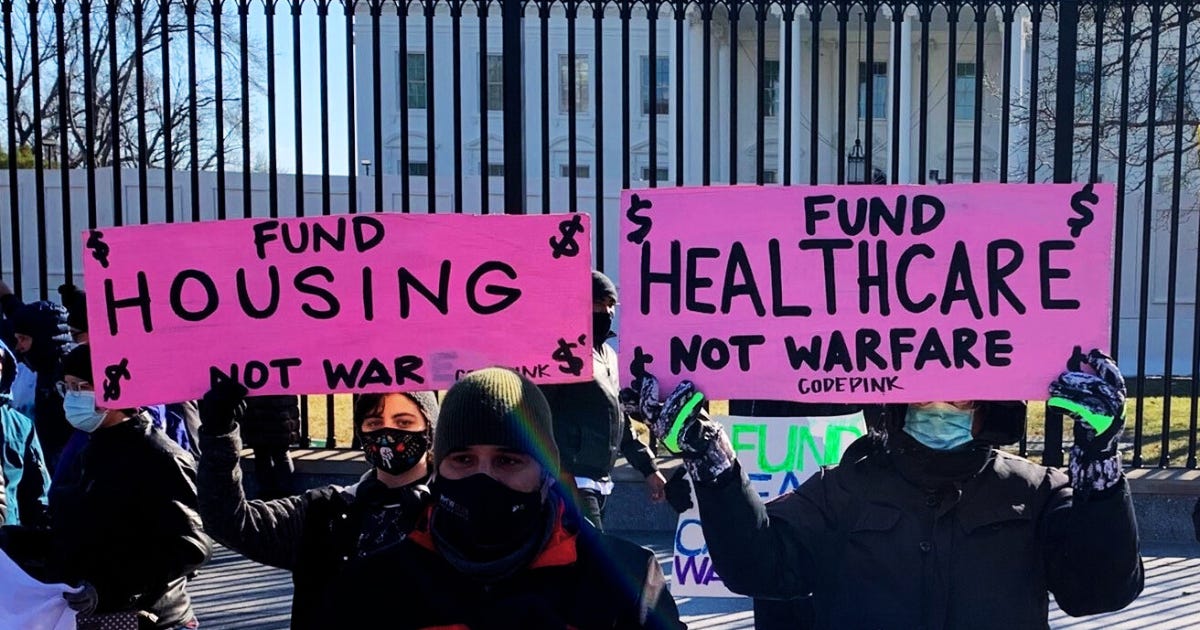
Next week CODEPINK and over 40 supporting organizations are launching the Taxpayer Uprising. Activists from across the country will be converging in D.C. to demand no more money for war. Join us in taking a stand against the endless expansion of the Pentagon budget, the militarization of the Pacific, and the growing threat of war on China!
Megan Russell is CODEPINK’s China is Not Our Enemy Campaign Coordinator. She graduated from the London School of Economics with a Master’s Degree in Conflict Studies. Prior to that, she attended NYU where she studied Conflict, Culture, and International Law. Megan spent one year studying in Shanghai, and over eight years studying Chinese Mandarin. Her research focuses on the intersection between US-China affairs, peace-building, and international development.
CODEPINK Substack is a reader-supported publication. To receive new posts and support our work, consider becoming a free or paid subscriber.
From CODEPINK Substack via This RSS Feed.
Madness
