

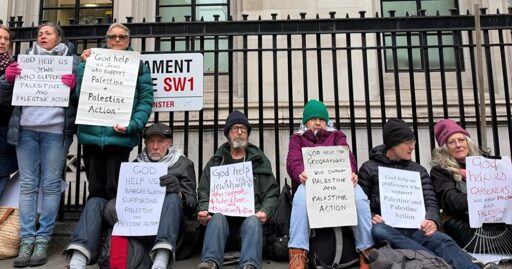
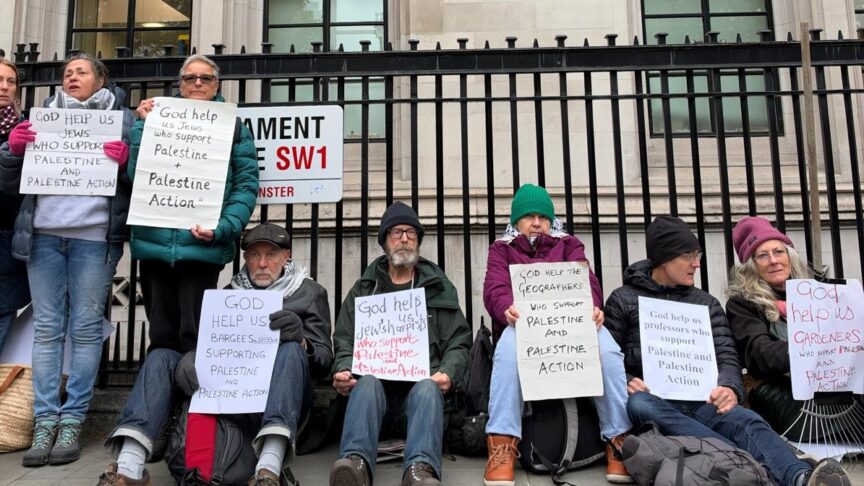
Twenty-five peaceful protesters were arrested under terror legislation outside the supreme court in London on Wednesday, as the controversial ban on Palestine Action undergoes its final legal challenge on British soil.
Retirees, health workers, the children of Holocaust survivors, a CBE and a professor held signs quoting the writer Sarah Helm, who posted on X last month, “God help us authors who support Palestine and Palestine Action” . They swapped the word “authors” for their own descriptor, such as “Jews”, “physiotherapists”, “son of a Holocaust survivor”, “gardeners” or “normal people”.
Everybody who held these signs was arrested on suspicion of supporting a proscribed terrorist organisation under section 13 of the Terrorism Act.
Helm is married to the prime minister’s national security advisor, Jonathan Powell. The Metropolitan police chose not to take action over her post , saying it “did not meet the criminal threshold”.
Many of those outside the court decried this apparent “double standard” in the enforcement of the Palestine Action ban. Officers seemed initially confused about what they should do. Novara Media heard some debating the meaning of the protesters’ placards and whether or not they should make arrests.
The majority of those protesting outside the supreme court were over the age of 50, as has been the case at all demos against the ban organised by Defend Our Juries (DOJ) over the 15 months of the proscription being in force.
Actor Alfie Enoch and Massive Attack frontman Robert Del Naja were outside court in support of the protesters. Enoch, who played Dean Thomas in seven Harry Potter films, told Novara Media that the arrests of peaceful protesters happening around him were “chilling and frightening”. He held a sign reading: “This is democracy, not terrorism.”
Del Naja said he hopes “common sense prevails” at the supreme court, telling Novara Media: “Direct action is not terrorism. These are people acting on conscience to prevent lethal drones destined for the civilian population of Gaza – that to me is a patriotic duty.”
Among those arrested were Jonathon Porritt CBE, a former advisor to the government, and academic Peter Hallward. Professor Hallward organised a letter delivered to the president of the supreme court, which was signed by 150 leading professors – including dozens of UK law professors – and 1,500 members of the public. It read: “We oppose genocide so we support Palestine Action.”
Porritt, a professor with the Centre for Research in Modern European Philosophy, told Novara Media that preventing genocide is an “absolutely moral obligation and legal duty” and compared defying the ban on Palestine Action to the historic actions of the suffragettes and the abolitionists.
Trudi Warner, a 71-year-old retired social worker and DOJ co-founder, told Novara Media, that the ban is a “complete mess” and “we’ve managed to show what a mess it is”. “It’s cost the police and the taxpayer millions of pounds to enforce a law that’s obviously ridiculous – it has to stop.”
Warner was arrested for holding a sign that read, “God help us artists who support Palestine and Palestine Action” as she enjoys art in her retirement.
Tom Southerden, Amnesty International UK’s law and human rights director, called the arrests “appalling” and said that people being arrested for using the same language as Sarah Helm “shows how dangerously vague our terrorism laws are”.
A DOJ spokesperson said: “Now we understand what the Met meant when they said Sarah Helm’s message ‘did not meet the criminal threshold’. If you say you support Palestine Action and you’re married to the national security advisor that doesn’t meet the criminal threshold. But if you’re not married to the national security advisor it does.
“Let’s hope the supreme court takes into account the blatantly discriminatory application of this crazy law.”
A Met spokesperson said: “Officers have arrested a total of 25 people outside the Supreme Court on suspicion of expressing support for a proscribed organisation. The policing operation is ongoing and officers will continue to arrest those who break the law.”
Why is Palestine Action in court?
Palestine Action co-founder Huda Ammori is challenging whether the UK government’s decision to proscribe the direct action group as a terrorist organisation last summer was lawful.
It’s Ammori’s last chance to appeal in the UK, and she was granted permission to do so on one ground: whether the proscription of Palestine Action is compatible with Articles 10 (the right to free expression) and 11 (the right to freedom of peaceful assembly) of the European Convention of Human Rights (ECHR).
Ammori has confirmed that if her appeal to the supreme court is unsuccessful, she will take her case to the European Court of Human Rights.
Justices will hear arguments over two days (4 and 5 November). This includes interventions in support of Ammori’s case from writers’ associations PEN International and English PEN, Amnesty International UK and Liberty, a UK Jewish Bloc, and UN special rapporteur Ben Saul.
The Jewish Bloc, made up of 11 Jewish and Jewish-led groups, seeks to challenge the “fundamental fallacy” that Palestine Action targeted or otherwise posed a threat to the Jewish community, or that it was in any way motivated by antisemitism. It also highlights the particular impact of the proscription of on the Article 10 and Article 11 ECHR rights of the pro-Palestinian Jewish community.
Ammori first took the UK government to court in November 2025, marking the first time a banned group has been able to legally challenge its proscription via judicial review in British history. The high court decided in February this year that the decision to ban Palestine Action was unlawful because it was incompatible with articles 10 and 11 of the ECHR and that then-home secretary Yvette Cooper breached her own policy in the proscription process.
The government appealed the high court’s decision, and the court of appeal – the next court up the chain – sided with the government, ruling the ban on Palestine Action lawful in June.
Since Palestine Action was proscribed, approximately 4,000 people protesting the ban have been arrested under the Terrorism Act 2000, causing a record-breaking spike in terror-related arrests.
From Novara Media via This RSS Feed.