

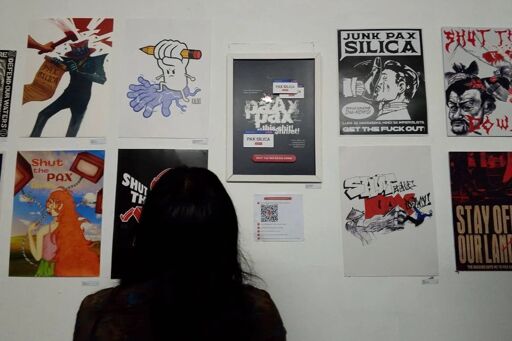
As the Marcos Jr. administration flexes the upcoming visit of U.S. President Donald Trump for the ASEAN summit, Filipino artists decide to use art to take a stand.
Cultural group Sama-samang Artista para sa Kilusang Agraryo (SAKA) and the Artists Unite Against Pax Silica (AUPAX) network launched “ALL CAPS: Art, Land, and Labor” at the Sampaguita Project in Quezon City. The anti-Pax Silica and anti-imperialist exhibit which ran from September 6 to September 11 challenged the U.S.-led initiative that threatens to displace around 20,000 Aeta in Tarlac to clear land for technology and artificial intelligence (AI) infrastructure hubs.
Featuring works from member creators and independent cultural workers, the exhibit exposed the deadly cost of imperialist plunder and expansion disguised as technological progress.
Not passive observers
What began as a localized digital campaign transformed into a broader physical movement. Ivan Pasion of SAKA and convenor for AUPAX said that the exhibit started as an online art protest by the Bulacan Collective and SAKA. “We noticed so many artists joined because AI itself is already a very polarizing topic. But beyond that, it is a much wider issue.”
Pasion said that during SAKA’s general assembly, they realized the massive reach of the protest and how deeply artists were affected. They saw this as an opportunity to build the ALL CAPS exhibit and integrate artists into a broader societal movement.
For Pasion, standing against Pax Silica is inseparable from the struggle against foreign domination. “Historically, artists have always played a huge role in society. We often view art as a mirror reflecting truth, but we cannot remain passive observers of history—we must be active participants.” Pasion said in an interview with Bulatlat.
He connected this to the idea that generative AI is already a uniting issue for artists as resisting Pax Silica is not an isolated issue but an ongoing fight against imperialism. “Even if you claim your art isn’t political, everything down to your subjects and materials is inherently political.”
Artist for Just Peace (AFJP) member Kart Mabato, one of the exhibit artists, brought this critique into physical form through visual symbolism, as expressed in an interview with Bulatlat. His featured piece titled “Bonk” focuses on the grotesque realities of U.S. hegemony disguised as tech expansion.
“In my artwork, I depicted a modernized, suit-wearing Uncle Sam carrying a scroll that lays out the destruction expected in the Philippines—land grabbing, labor exploitation, and environmental degradation. Opposite him, a giant hand holding a sledgehammer strikes Uncle Sam’s head, symbolizing the Filipino workforce resisting Pax Silica,” Mabato said.
When asked about the title of his artwork, Mabato said that it refers to the sound made when hitting metal. “As artists, our works are reflections of our ideology shaped by social conditions. We don’t just draw for the sake of drawing; we draw with a purpose—and at this point, that purpose is fighting back against U.S. land grabbing and imperialism.”
Resisting imperialism
Both artists stressed that individual creation is insufficient when dismantling a rotten system. For them, collective organization remains the primary key to turning art into a force capable of dismantling broken systems.
“Whenever I lead educational discussions on art and society, I challenge the common belief that art is merely a mirror reflecting reality. Art can also be a hammer—an active instrument to reconfigure, reform, and revolutionize societal ills,” Pasion said. “We will only reach a point where we can truly live off our craft if we take action now to critique these ills. Simply voting isn’t enough when the framework itself is broken; art is a vital component in driving cultural revolution.”
Mabato urged unorganized creators to join collective fronts. “To fellow artists who are unorganized or working independently: it is crucial to organize. Being in a collective gives you comrades and creates a far greater impact against these issues.”
“The government claims Pax Silica displaces no one and promotes national progress. But no innovation exists in a nation where people, especially Aeta communities and farmers, are exploited,” Pasion said. (DAA)
The post Art exhibit vs Pax Silica as visualizing resistance appeared first on Bulatlat.
From Bulatlat via This RSS Feed.