

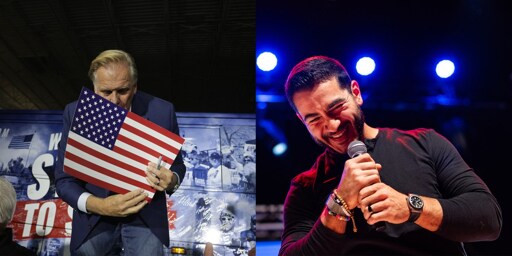
For the left, it’s been the marquee race of the midterm cycle. Either a Republican former U.S. representative known for pushing domestic spying powers or an outspoken progressive who forced a reckoning over U.S.–Israel policy among Democrats will emerge from Election Day as the next senator from Michigan.
Abdul El-Sayed would be the first Muslim U.S. senator if elected Tuesday night, capping off a race that’s been viewed as a referendum on swing-state appeal for the Democratic Party’s left flank. If he defeats Mike Rogers, a loyal Trump ally whose campaign often peddled Islamophobic tropes against the Democratic nominee, the results will all but certainly embolden progressives ahead of the 2028 presidential election.
If El-Sayed loses, it will likely trigger a centrist backlash — and cost the Democrats a critical Senate seat as the party fights to take back the upper chamber.
Polls across Michigan closed by 9 p.m. ET on Tuesday, with anxious voters across the state awaiting the returns.
[
Related
Polls Close in Maine as Democrats Make Final Push to Oust Sen. Susan Collins](https://theintercept.com/2026/11/03/maine-senate-results-jackson-collins/)
In the heavily Arab and Muslim city of Dearborn, voters across party lines said they were outraged at the Islamophobic attacks ads targeting El-Sayed that became a staple of airwaves and social media feeds in the campaign’s final days.
“I am a Muslim. And I’ve seen a lot of ads, and it’s disgusting, because we are good people,” said Gus Tarraf, a Republican running for a state House seat. “I love this country.”
Although Donald Trump carried many precincts in Dearborn two years ago due to voter frustration over the Biden administration’s support of Israel, Tarraf said his community is turning on the Republican Party this year.
“Not a lot of Arab Americans are happy with the Trump administration,” he said. “So it doesn’t matter if they know you, as soon as they know you are on the Republican ticket.”
El-Sayed’s willingness to criticize U.S. policy on Israel animated soap-opera-level drama in the final days of the race, when his former primary opponent, centrist Democratic Rep. Haley Stevens, announced she would switch her endorsement to support Rogers.
After demanding an apology from El-Sayed for an outside PAC’s ad, Stevens said on social media that she came to the decision after feeling “shut out” by El-Sayed’s campaign, adding that she’s heard from “Black voters, Jewish voters, and others about how deeply these messages hurt.” Rogers, she said, gave her “the hope that he can serve in the tradition of John McCain: a senator willing to put country before party and stand up to his own side when conscience requires it.”
Stevens’s late-breaking endorsement of Rogers drew a mix of eye-rolls and outrage from voters at three precincts in Detroit and Dearborn. None of the voters interviewed by The Intercept said it had swayed them to vote for Rogers.
“People have already early voted. People have already absentee voted,” said Noora Iskander. “I don’t think many people change their minds. So I think it’s just hypocritical.”
Stevens’s decision to make the endorsement while inside a Black church in Detroit may also have generated backlash from the Black voters that Rogers was hoping to win over, according to some who spoke to The Intercept. One said the church community has been buzzing — and not positively — about the weekend’s events.
“Unfortunately, she went to a Black church to use it as a backdrop,” said Dearborn voter Dorothea Sharon. “It really was a slap in the face for the Black community that that happened.”
[
Related
Trump Scrambles to Halt Military Aid to Israel to Deprive El-Sayed of a Talking Point](https://theintercept.com/2026/11/03/trump-us-military-aid-israel-el-sayed/)
While El-Sayed has had to face intense scrutiny over accusations of conflating opposition to U.S. aid to Israel with antisemitism, little accounting has been made of the blatant Islamophobia and xenophobia from the Rogers campaign, the Republican Party, and Trump. But in Dearborn, the rhetoric had clearly hurt several voters who spoke to The Intercept.
The father of state Senate candidate Abbas Alawieh, a Democrat who played a prominent role in the 2024 Uncommitted movement, grew visibly upset when asked about the ads targeting Muslims.
“These are weak people who don’t have anything to do — they don’t have any programs for our economy, for our health, for our future,” Zouheir Alawieh said. “That’s why they are attacking us as Muslims and as human beings. It’s never been like this. This is a shame. America is a place where the Black with the white with the yellow, the Muslim with the Christian with the Jews, can live freely. Don’t try to tear up our society.”
Outside Dearborn, El-Sayed has tried to defuse the anti-Muslim smears against him by joking that he is only in favor of “shawarma law.” However, the Islamophobic attacks convinced at least one voter to cast her ballot for Rogers.
“I don’t want to live under Sharia law,” said Joann, a law firm employee who declined to give her last name after she voted in Detroit.
The fear of Islamic rule was the main issue for Joann, she said, although she also worried about El-Sayed’s campaign pledge of Medicare for All.
“I’ve worked my whole life, put all my stuff into the Medicare, but then I’ve got to let other people get it for free? It doesn’t seem fair to me when I’ve worked my whole life for it, and we’re not even sure that it’s going to be there when we really get ready to retire,” she said.
Yet it was that very messaging from El-Sayed’s campaign that excited many other residents in Michigan. Many voters who spoke to The Intercept said they were more focused on pocketbook issues.
“It’s the gas prices, the food. I mean, money is running out your pocket so fast,” Leigh James said after voting at Tabernacle Missionary Baptist Church in Detroit.
James said she had walked to the polling place to avoid using gas. “I’m trying to save,” she said. “So thank God I live in the neighborhood.”
Other voters said they were inspired by El-Sayed’s personality, with one woman describing him as a “fighter.”
Noora Iskander, who voted for El-Sayed in Dearborn, said she approved of his stance in favor of Medicare for All, his affordability platform, and his solidarity with Palestine.
“I think he’s going to make a lot of change. He’s going to scare a lot of people — which I believe is a good thing, because you can’t really change for the better if you don’t scare a few people,” she said.
This is a developing story. Matt Sledge reported from Dearborn and Detroit, Michigan.
The post Michigan Senate Race Closes as a Referendum on Israel Policy appeared first on The Intercept.
From The Intercept via This RSS Feed.