

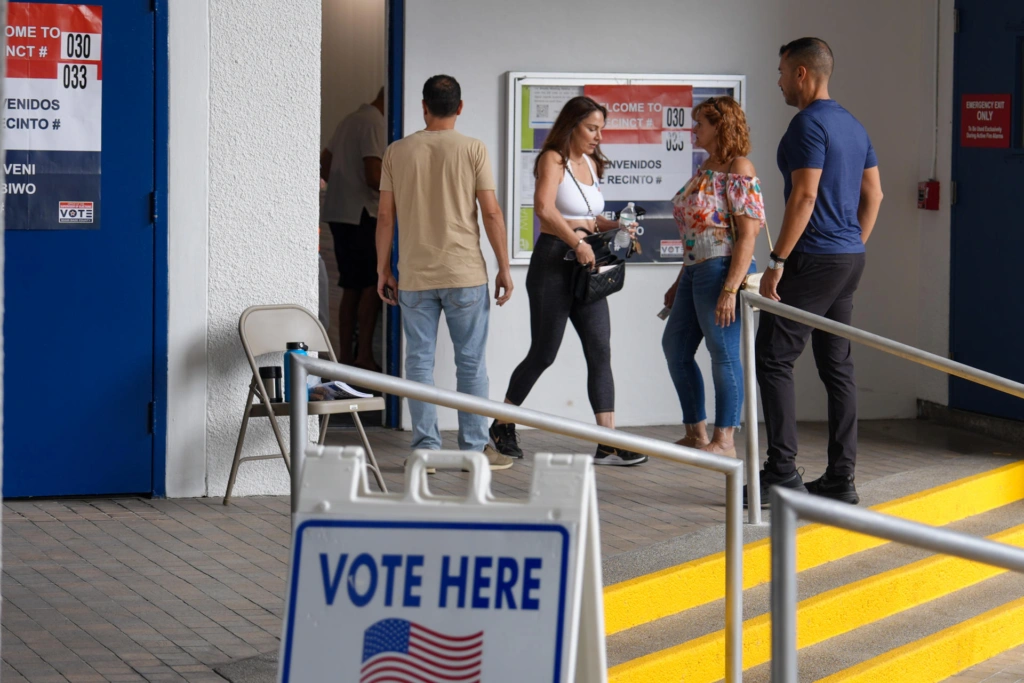
Polling stations had closed in 25 states by early Tuesday night, wrapping up a midterm election day that will renew 435 House seats, 35 Senate seats and 36 governorships while testing the political counterweight to President Donald Trump’s second term.
The first closures brought to an end a campaign that both majority parties treated as a verdict on the President’s agenda. Across the country, voters decided the composition of the next Congress and dozens of state governments, with control of both chambers hanging in the balance.
The ballot puts all 435 seats in the House of Representatives in play, along with 35 of the 100 Senate seats and 36 gubernatorial contests.
RELATED: U.S. Voters Prioritize Household Cost Over Foreign Engagements
Observers describe the vote as the first major assessment of Trump’s administration since his return to the White House. The U.S. President arrives at this test with an approval rating of 30 to 38 percent, according to surveys.
Polls point to a favorable scenario for Democrats. To reclaim the Senate majority, the party must gain four seats without losing any it currently holds, a margin that leaves little room for error. The outcome will shape the second half of the president’s term and determine whether Congress and the states can moderate his agenda.
Ver esta publicación en Instagram
Una publicación compartida de teleSUR English (@telesurenglish)
Results from the East Coast arrived first, but the count will stretch deep into the night and beyond in several states.
Voting centers closed starting at 6 P.M. East Coast time (23:00 GMT) in parts of Indiana and Kentucky, marking the beginning of the vote count. The closures stretched from the East Coast into the Midwest, marking the busiest stretch of a midterm night that will decide control of the House of Representatives, 35 of the 100 Senate seats and a slate of governorships.
The final wave of closures came in Alabama, Connecticut, Delaware, Florida, Illinois, Maine, Maryland, Massachusetts, Mississippi, Missouri, New Hampshire, New Jersey, Oklahoma, Pennsylvania, Rhode Island and Tennessee. Those states joined Georgia, Indiana, Kentucky, South Carolina, Vermont, Virginia, North Carolina, Ohio and West Virginia, where voting had ended earlier in the evening. In Florida, some districts electing House members completed balloting while the rest of the state kept its polls open until 10 P.M.
Alaska, a strategic state for the Senate balance, will not begin counting ballots until 1 A.M. local time.
Ver esta publicación en Instagram
Una publicación compartida de teleSUR English (@telesurenglish)
Record Early Turnout
More than 60 million U.S. citizens cast ballots through early voting, a figure that breaks the previous midterm record of 45.9 million set in 2022. Experts tie the surge to anxiety over the state of the economy, the country’s involvement in wars that lacked broad public approval, and the government’s crackdown on migrants.
That level of participation injects uncertainty into projections. Higher turnout does not automatically benefit one party, but analysts note that midterm electorates historically punish the party holding the White House. The record numbers suggest a mobilized public across the political spectrum.
Despite warnings about possible intrusions by federal agents at polling places, the day passed without major incidents. The main disruptions came from weather and technical failures. Severe flooding in Florida and areas of the Southwest forced officials to relocate voting sites. In Westchester County, the scanners used to read ballots reported technical problems.
Ver esta publicación en Instagram
Una publicación compartida de teleSUR English (@telesurenglish)
Vote counting now dominates the night. More results will keep arriving through the evening, though some contests may not produce a winner until Wednesday or later as additional states finish voting and officials publish their tallies. The balance of power in Washington rests on those numbers.
From teleSUR English via This RSS Feed.
This won’t change anything really. US are NOT a Democracy, its an Oligarchy. It likely has always been as information and elections can be ‘arranged’. Both ‘sides’ of their one-party system believes almost the same things, are sponsored and controlled by the same rich people, and 1. scientific papers have shown that ordinary people have no influence (something like 0.2% afair) over policies, and 2. we can see that US foreign policies throughout the last 25-50 years follow the same Oligarch strategy from think tank papers, no matter which ‘sides’ administration is in the puppet house. In short, everything in US and their sphere of influence is run by money and pressure from rich c*nts. Watch/read someone like Brian Berletic for which think tanks US policies/behaviour comes from, and hence who is really in charge in US.
Expect some drama and public bantering, huffing and puffing, about crimes and promises of change - cheaper eggs/fuel, more ‘freedom’, more ‘transparency’, harder smack-down on crime (not Oligarch crimes oc) and such banale local stuff - but none of the promises will be fundamental or be fulfilled, as usual, so no serious change on any front unless the Oligarchy want to faint a change for marketing purposes.
The US policies and behaviour are locked in to the current trajectory for many many years to come, just as it have followed that trajectory for the mentioned 25-50 years, via Trump, Biden, Obama, Bush, Hillary or whatever Oligarch puppet is placed in the white house.
Only real change must come from public sustained political revolution, or more direct revolution.