

Bullets:
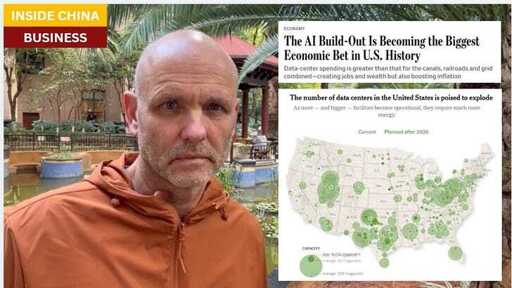
AI Data Center infrastructure investments in the United States are far larger than canals, railroads, the highway system, electrification, and the internet.
But the nature of AI itself argues that most of the global compute will be performed in low-cost data centers, now under construction in China and Southeast Asia.
Asia is also where the users are: the massive population centers, the industrial capacity, mines, logistics and ports, and advanced manufacturing and pharmaceuticals.
AI tasks that demand low latency and superfast reaction times will require data centers to be as close as possible to the end user. So North American facilities are still needed for apps such as self-driving cars, smart grids, and real-time translation tools.
But Asia will require the same, for its most time-sensitive applications.
For batch processing and the highest value-added activities, however, the lowest-cost centers will take business from other markets as soon as they come online.
Inside China / Business is a reader-supported publication. To receive new posts and support my work, consider becoming a free or paid subscriber.
Report:
Good morning.
Artificial Intelligence is a critical industry, and our thesis is that almost all the applications for AI will happen here, in Asia. And that most of the massive investments in data centers in North America and Europe are misdirected, and most of those investors will lose money.
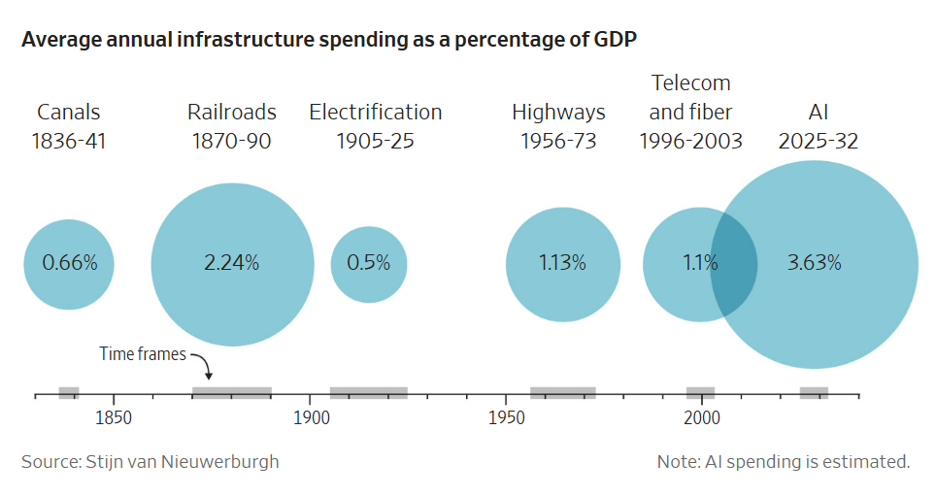
In the United States, data center construction and the related capex already makes for the “biggest economic bet” in history. Spending for AI in the past eight years, on a percentage of GDP, is bigger than railroads. More than three times larger than the construction of the Interstate Highway System.
All that previous spending did give the United States canals, railroads, electricity, highways, and the internet. But many of those investors did lose everything, went bankrupt, because they were early—they built out capacity for customers who would come later.
AI is probably very different though. Railroads do need to be where people are, same with highways, and cities sprang up alongside them. That’s not true of AI—some of the most critical artificial intelligence operations can be done anywhere in the world, by users anywhere else in the world. And that’s the problem.
The entire economy is dependent on the success of those data centers paying off. High levels of debt are required to build them, along with capital raises from sales of equity.
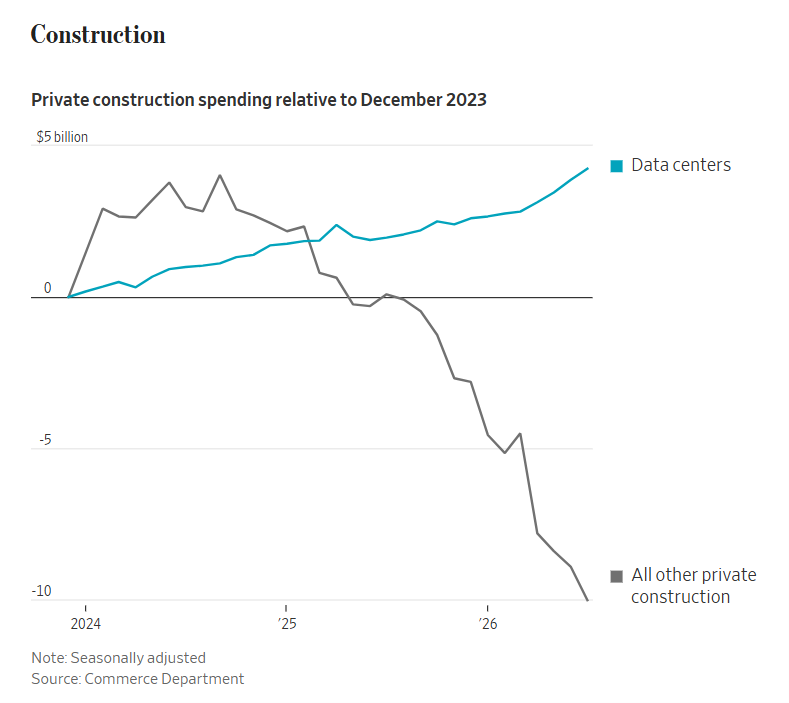
They also present an opportunity cost problem: Data center construction is crowding out homebuilding, for example. We’re desperately short of affordable housing, but hyperscalers are snapping up construction workers to build data centers instead of apartment buildings. Land prices are going up, and that’s bad news for companies who want to expand industrial production.
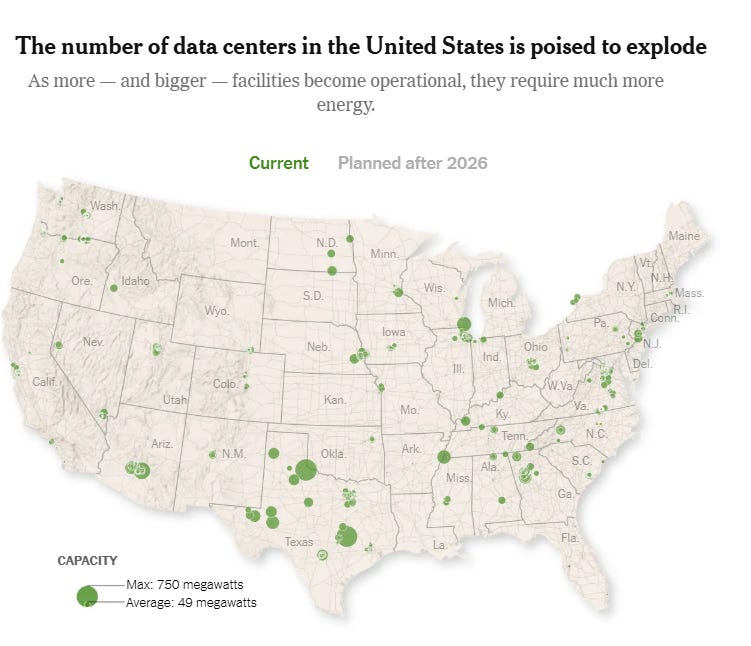
This is a map of where the data centers are in operation, right now. Bigger dots are bigger centers, in terms of compute and power demand.
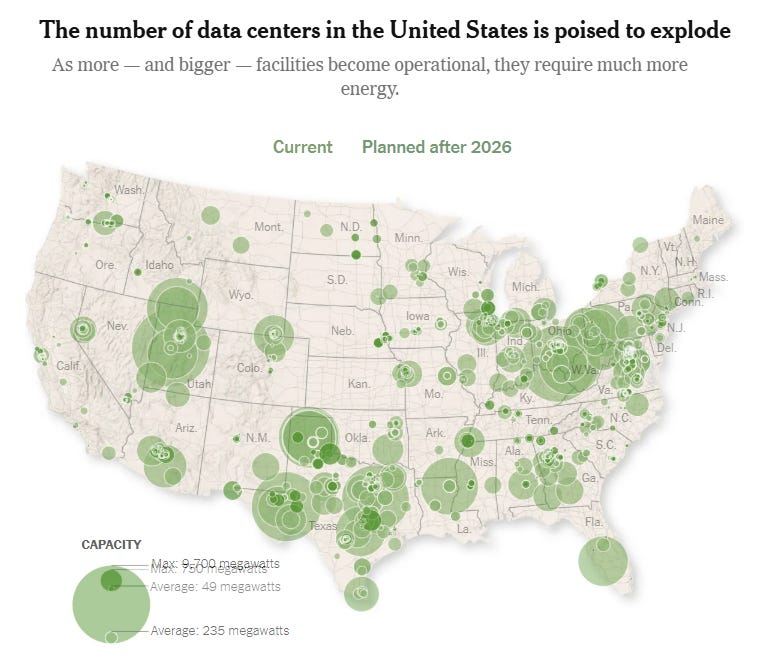
But the above map is for planned projects, and the dots are a lot bigger, pulling a lot more power at a time the grid is already under strain.
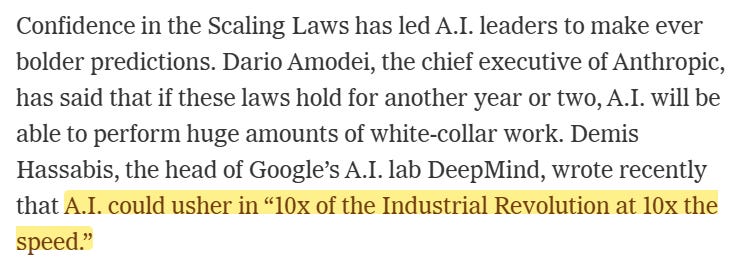
Silicon Valley and Wall Street are selling that promise, right there. Silicon Valley and Wall Street are telling policymakers that AI will bring in a new Industrial Revolution, 10 times bigger and faster. Scientists point out how all this new computing power will lead to new drugs and advances in robots and other technologies.
But that already doesn’t make a lot of sense. The robotics industry is here, in Asia. It’s China, and South Korea, and Japan, who build robots. The supply chains for robots run through China.
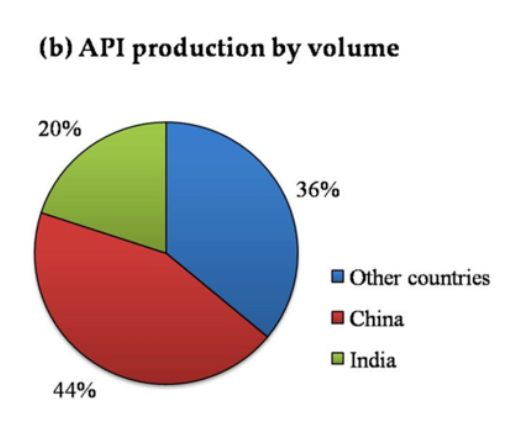
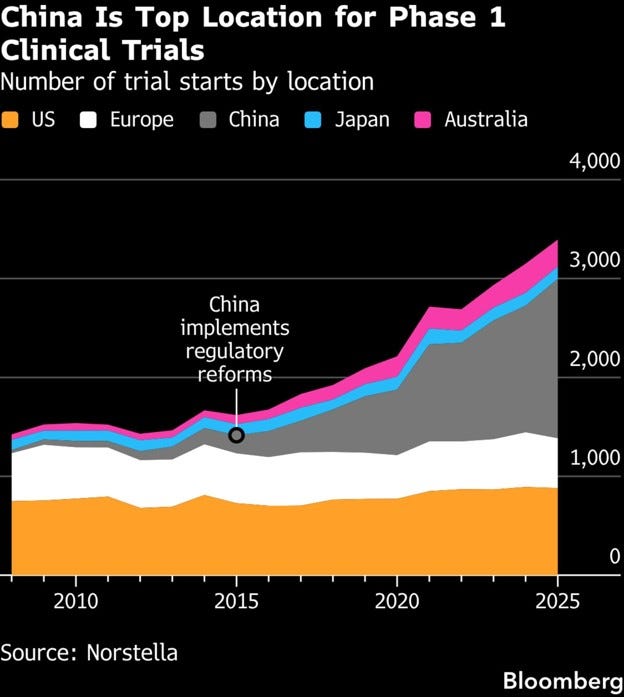
China and India account for most of the world’s production of API’s—the active pharmaceutical ingredients that make the drugs work. We’re saying here that the advances in robotics will benefit the people who build robots, and the factories that use robots. New drug development will happen in the places where labs can build new compounds and test them on patients:
And when we see the statistics, for example, on the relative computing power of the United States compared to China, we’re measuring the wrong thing. Chinese companies are catching up on the chips, and have already passed Western firms for most of the AI stack.
More important, though, is that it is here, in China and elsewhere in Asia, that the actual use cases for AI are today, and will be for the rest of the century.
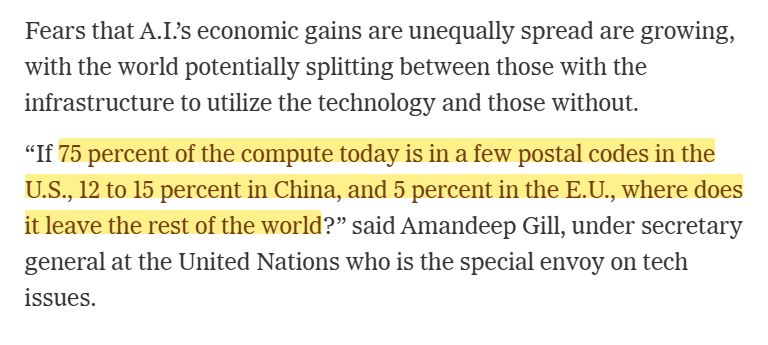
That’s a good question: if it’s true that three-fourths of the world’s compute is coming right now out of the US, and China is about a fifth of that, where does that leave everyone else?
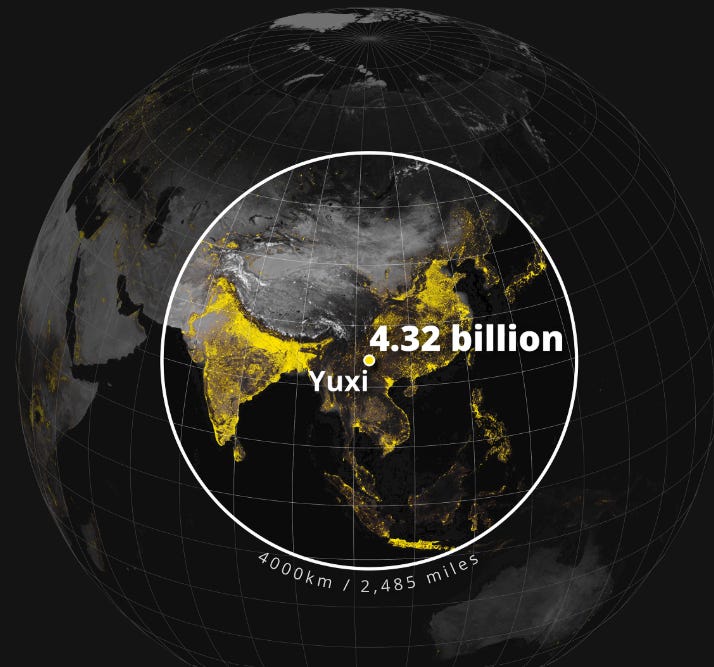
This is one of our favorite maps, that helps us make sense of the world. Where I’m standing right now is 50 miles from Yuxi, I’m within a four-hours plane ride of half the population of the world. Kunming to KL is due south, four hours away, and Malaysia is home to one of the largest AI data center buildouts on Earth, powered by the world’s most powerful chips, and plugged in to cables between China and the rest of the world.
Malaysia is BRICS partner country, and so is very friendly with China, and Chinese firms are making big investments there. Malaysia also has a good relationship with the United States and so can buy chips from Nvidia, and attract investment by the hyperscalers. Equipment that serves US and Chinese companies sit next to each other.
There are obvious cost advantages to build and operate a data center in Southeast Asia. The mid-range cost of construction per megawatt, in Malaysia, is $9.6 million. The median construction cost for an AI data center in the United States is almost three times that, at over $25 million.
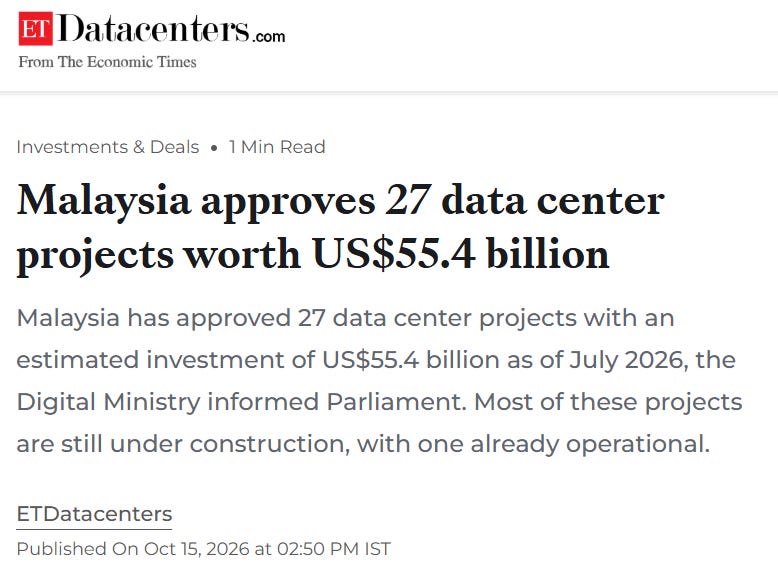
That puts this headline into better perspective: Malaysia approved 27 data centers as of July, and only one of them is online right now. So 26 AI data centers are still coming, worth over $50 billion, but that translates to around $150 billion in comparable compute, were they built in the US. Said another way, AI data centers in Malaysia cost far less to build, and investors can get their money back far faster.
Those lower costs are immediately going to take market share from data centers in the United States and Europe.
There are many tasks in AI that need to be performed by data centers, who are as close to the end user as possible. Any operations that require low latency, all that business will go to the data centers that offer that fastest response time. This report lays out the latency problem for anything like real-time language translation, smart mines or port facilities, or smart cities with self-driving cars. It takes too long for signals to go across the ocean and back.
The key metric for that is “Time-to-first-token”, and it’s the metric that users experience themselves.
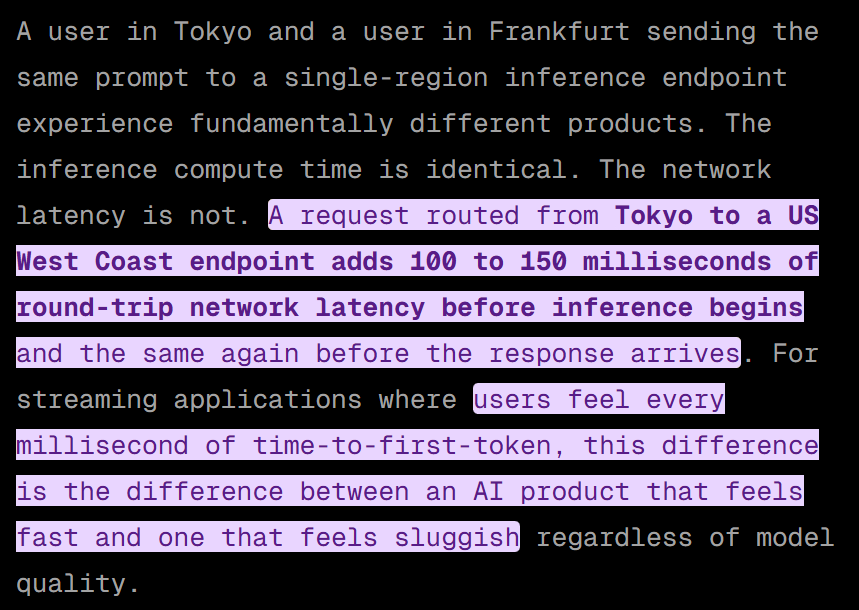
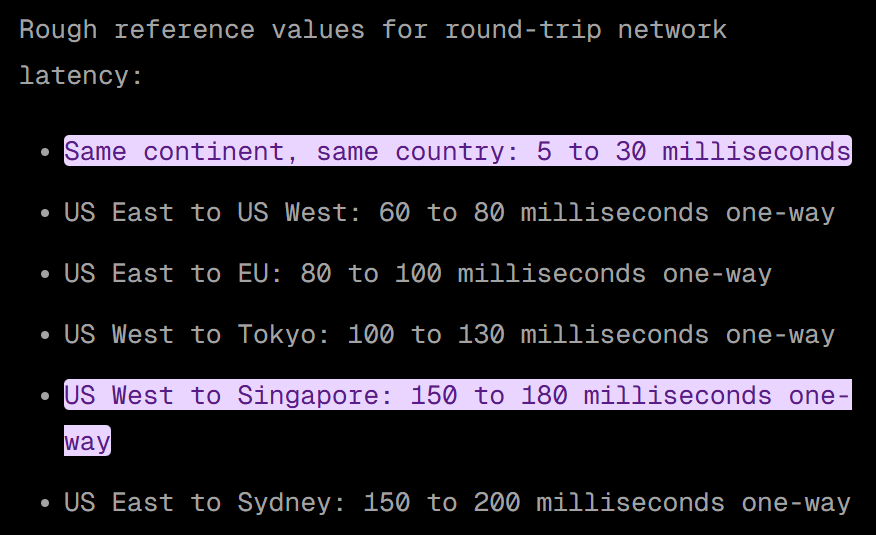
On the same continent or in the same country, TTFT is 5 to 30 milliseconds. But a query or task running from the US to Singapore—or the other way around—takes much longer—it’s six to thirty times slower, so those data centers in North America will keep all that business, for the applications that demand low latency, in North America.
But the data centers in China and Southeast Asia will retain all that business here, too, for the same reason. They need to be close to where the users are, and in Asia there are just a LOT more users. That 200-millisecond fiber-optic round trip will cause a self-driving system to crash. A smart grid might fail. Because the vast majority of the world’s heavy manufacturing, automated logistics–and population–sits inside the Yuxi circle, all latency-sensitive AI infrastructure must be built directly alongside it. Western data centers are geographically locked out.
So a developer in Vietnam, for example, is far better off using China’s token outbound system, using Huawei chips in a Mainland China data center, compared to the newest and fastest chips from Nvidia, if they’re in a facility way over in Ohio or Texas. It’s faster.
There’s another major issue, which is that lots of functions for artificial intelligence are NOT time-sensitive.
For example, “Batch Inference” is collecting thousands of requests, and waiting for the lowest-cost times to process them. A score of examples. Online catalogs and product and pricing updates. Video and media generation and processing. Backtesting trading models. Weather prediction software. Indexing software code, written years ago, but still running systems. The data crunching of massive volumes of medical journals, engineering reports, science papers, into usable databases that can be then turned into real products, and medicines, and industrial processes.
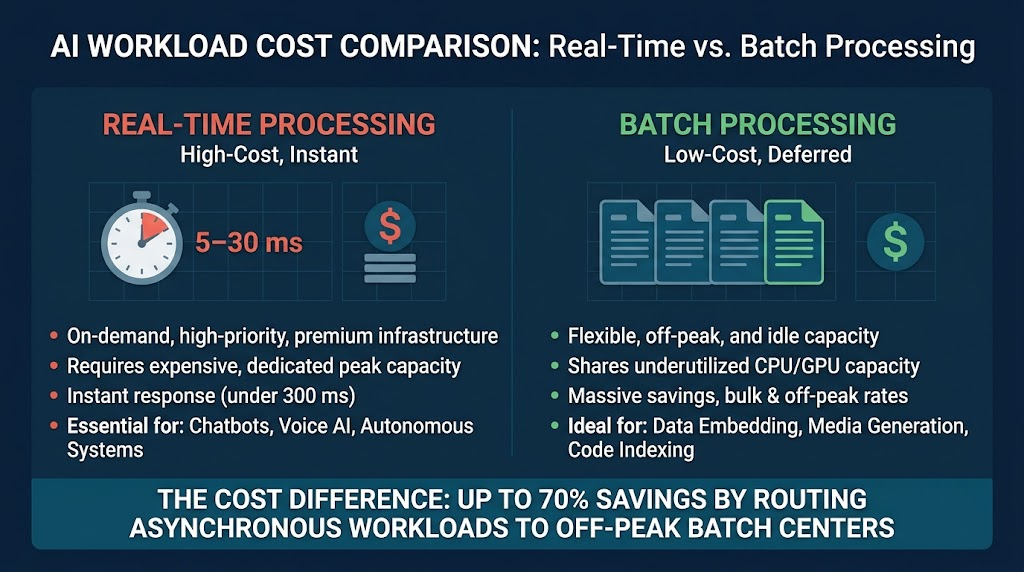
All of that business will migrate eventually to the lowest-cost compute, and to the data centers that can do all that data crunching at lower prices. These are issues that Wall Street investors are missing: the fastest chips don’t matter nearly as much as the fastest turnaround time.
The developers for many of the very high value-added functions in AI don’t need the fastest chips anyway; they want the lowest costs, and that price advantage is what Malaysian data centers will likely always enjoy over AI facilities anywhere else.
So it’s hard to see who, exactly, those data centers in the United States are being built for, and how the investors building them can possibly get their money back.
Be Good.
Resources and links:
The AI Build-Out Is Becoming the Biggest Economic Bet in U.S. History
https://www.wsj.com/economy/the-ai-build-out-is-becoming-the-biggest-economic-bet-in-u-s-history-c60716dd
The Impending, Inescapable Deluge of A.I.
https://www.nytimes.com/interactive/2026/07/29/technology/ai-chips-data-center-boom.html
How One Country Became the Unlikely Crossroads of the Global A.I. Boom
https://www.nytimes.com/2026/10/30/business/malaysia-data-center-china.html
Malaysia’s data centre construction costs hit US$12 mil per MW amid AI infrastructure boom, says real estate firm
https://theedgemalaysia.com/node/798258
Malaysia approves 27 data center projects worth US$55.4 billion
https://datacenters.economictimes.indiatimes.com/news/investments-deals/malaysia-approves-27-data-center-projects-worth-us55-4-billion/134967164
The Yuxi Circle: The World’s Most Densely Populated Area
https://www.visualcapitalist.com/cp/the-yuxi-circle-the-worlds-most-densely-populated-area/
Multi-Region LLM Inference: How to Optimize Latency for Global AI Applications
https://www.gmicloud.ai/en/blog/multi-region-llm-inference-how-to-optimize-latency-for-global-ai-applications
How to Build an AI Data Center in 2026 (and What It Actually Costs)
https://millionminer.com/news/how-to-build-an-ai-data-center
The AI industry in the US is doomed. Now China owns it all.
API production by volume
https://www.researchgate.net/figure/Global-production-of-Active-Pharmaceutical-Ingredients-API-The-graph-represents-the/_fig1/_351478239
China Upends Global Drug Development With Cheap and Rapid Human Trials
https://www.bloomberg.com/news/features/2026-10-29/china-s-speed-in-clinical-trials-draws-drugmakers-roche-astrazeneca-novartis
Mapped: The World’s Data Centers by Country (2026)
https://www.visualcapitalist.com/mapped-countries-with-most-data-centers/
China explores new AI ‘Silk Road’ with token outbound
https://interestingengineering.com/inside-china/china-explores-new-ai-silk-road-with-token-outbound
We were wrong about DeepSeek. Now Chinese AI companies export trillions of AI tokens.
Inside China / Business is a reader-supported publication. To receive new posts and support my work, consider becoming a free or paid subscriber.
From Inside China / Business via This RSS Feed.