

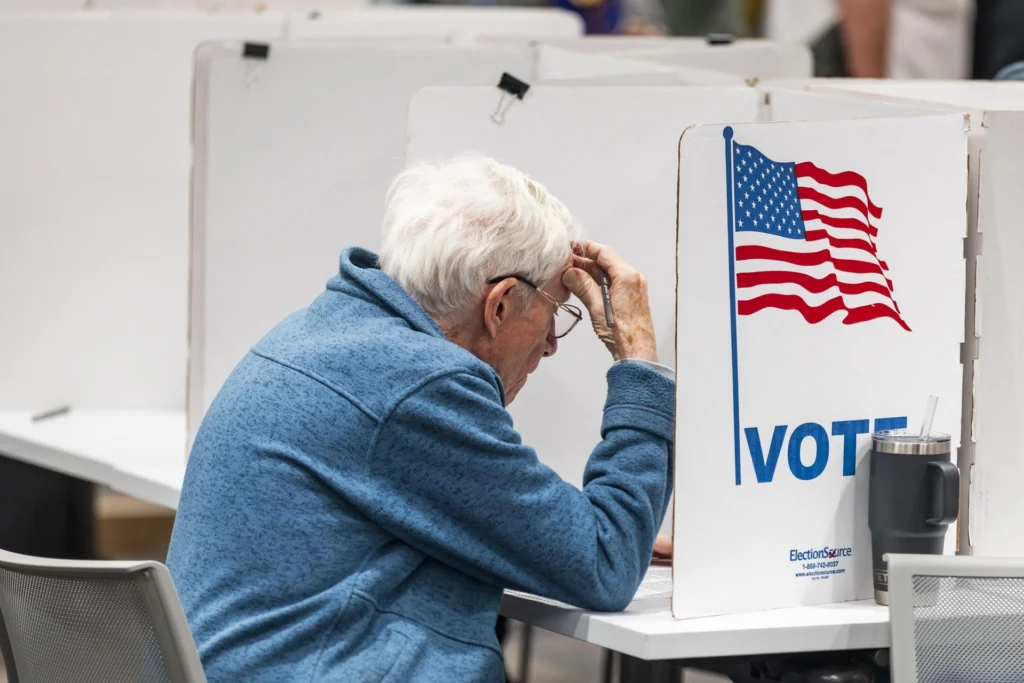
Polling shows affordability is the dominant concern, even as voters increasingly connect trade policy and U.S. military engagements to rising household costs.
The midterm elections in United States are taking place this Tuesday, November 3, and the political environment reflects voter concern about economic conditions and the Trump administration’s policies.
Two years into Donald Trump’s presidency, these legislative elections directly measure public reaction to current economic measures, domestic legislation, and international policy choices.
RELATED: Record 55 Million Early Ballots Cast Ahead of U.S. Midterms
Some data from polling show that key factors shaping voter behavior include elevated consumer costs, housing expenses, and shifts in real income.
While executive communications emphasize national indicators such as gross domestic product growth, public polling indicates that voters remain primarily focused on personal budget constraints and purchasing power.
The midterm elections will determine the legislative agenda and oversight capacity of the U.S. Congress over the final two years of the presidential term.
Ver esta publicación en Instagram
Una publicación compartida de teleSUR English (@telesurenglish)
Campaign Dynamics and Voter Reception
The national campaign was a hard-fought party competition, with high rates of voter engagement and distinct regional differences in voter turnout.
A published survey conducted in late October 2026 showed Democrat congressional candidates leading Republican candidates by 52% to 44% among likely voters nationally. Independent voters in the same study supported Democrat candidates over Republican candidates by 52% to 39%.
Public Donald Trump addressed in swing states and competitive congressional districts have produced varied public responses. While campaign rallies in core base areas retain steady attendance, events held in suburban districts present a more complex environment.
Media reports document active counter-demonstrations and local organized pushback during executive visits to suburbs in states across the Industrial Midwest and the Sun Belt, like Michigan, Ohio, Indiana, and Wisconsin.
Speeches addressed by President Trump prioritize traditional base mobilization messaging, with remarks highlighting strict border enforcement policies, energy sector deregulation, protectionist tariff enforcement, and criticisms of traditional media outlets.
However, polling data from the Marist survey indicates that 44% of likely voters view their vote for Congress as primarily a vote against Donald Trump, while 21% report voting mainly in support of the president, and 35% state that the president does not directly determine their choice.
Additionally, the Marist Poll reports that 76% of independent voters state they are excited to cast their ballots, representing a major influence in suburban electoral districts.
🇺🇸 ATLAS POLL | US MIDTERMS 2026
US SENATE
Democratic candidates lead in all 10 U.S. Senate races surveyed by AtlasIntel, with margins ranging from 2.4pp in Minnesota to 14.9pp in North Carolina.
🔵 North Carolina: Cooper +14.9pp
🔵 Maine: Jackson +9.1pp
🔵 New Hampshire:… pic.twitter.com/inA3wp167C— AtlasIntel (@atlas_intel) November 3, 2026
Trump’s Approval and Partisan Postouring
Trump’s job performance numbers heading into the 2026 midterms reflect an administrative approval deficit across major public polling surveys. Data from some polls in late October 2026 place Donald Trump’s national approval rating among likely voters at 40%, with 59% expressing disapproval.
Further breakdown of the data indicates that 53% of likely voters report strong disapproval of executive performance, compared to 24% reporting strong approval. Among registered voters, job approval rests at 38%, accompanied by a 61% disapproval rate.
The opposition Democrat leadership and the ruling Republican majority maintain distinct narrative frameworks ahead of the voting period:
Congressional Democrats center campaign messaging on personal economic security and institutional governance. Party spokespersons highlight rising consumer expenses, elevated borrowing costs, and real wage dynamics to argue that administrative measures have increased household burdens.
Data show that annual growth during Trump’s second term is hovering around 3.2%, with an inflation rate of approximately 3.7%. It has also recently emerged that the price of a gallon of gasoline stands at $4.48, and that the maximum additional cost resulting from tariffs on new cars is $8,900, among other significant figures.
Opposition platform statements frame the legislative elections as a key mechanism for establishing congressional oversight and altering federal fiscal priorities.
Republican candidates and party committees present campaign arguments focused on macroeconomic output indicators, long-term regulatory reductions, and national security directives.
White House press releases point to overall gross domestic product performance, domestic oil and gas development, and industrial project announcements as evidence of economic structural health.
Citizens Renouncing U.S. Status
Federal records document a notable continuation in the number of individuals choosing to formally relinquish their U.S. citizenship.
Reports published in the Federal Register by the Department of the Treasury show that 4,574 individuals were listed in the Quarterly Publication of Individuals Who Have Chosen to Expatriate during the first three quarters of 2026.
This total reflects a 16.2% increase compared to the 3,935 names published during the corresponding three quarters of 2025. Legal and financial specialists attribute the steady volume of renunciations to a combination of statutory tax compliance rules, administrative processing changes, and shifting social considerations:
The financial requirements established under the Foreign Account Tax Compliance Act obligate foreign financial institutions to report on financial assets held by U.S. taxpayers abroad, creating long-term reporting obligations for overseas residents.
Additionally, the Department of State reduced the consular processing fee for processing a Certificate of Loss of Nationality from $2,350 to $450 in April 2026, lowering financial barriers for long-term expatriates seeking to complete administrative paperwork.
While overseas voters represent a distinct population segment with limited overall participation relative to total domestic turnout, the trend of formal citizenship renunciation serves as a public indicator of broader dissatisfaction with civic, tax, and governance frameworks.
Only twice in the past 20 US midterms has the president’s party gained House seats. Polls suggest 2026 won’t be the third https://t.co/KpdoJonsH6 pic.twitter.com/d0oB2j554c
— Al Jazeera English (@AJEnglish) November 2, 2026
Public Opinion, Inflation and Purchasing Power
Public sentiment ahead of the 2026 midterm elections remains closely tied to personal financial conditions and the real costs of everyday living.
Economic tracking data show that the Trump administration trade platform -comprising expansive protectionist tariffs covering over 50 percent of U.S. goods imports- has significantly influenced domestic consumer prices.
Economic analysis from the Federal Reserve Bank of New York indicates that these tariff implementations contributed up to 2.9 percentage points directly to goods price inflation during their initial pass-through phase.
The practical impact of these policies on household purchasing power has become a central focus of electorate concern. Non-partisan budget assessments, including data from the Congressional Joint Economic Committee and independent tax policy groups, estimate that tariff measures and trade restrictions have increased annual household expenditure by an average of $820 to over $1,700 per family.
While total wage metrics show nominal growth, real wage adjustments have failed to offset elevated costs for basic necessities, including grocery items, imported retail goods, and household hardware.
Concurrently, domestic energy demands from expanding industrial operations and infrastructure projects have sustained upward pressure on regional utility rates.
Geopolitical directives and foreign policy commitments have further affected public opinion regarding administration priorities. Surveys show that while base voters express support for national security measures and military readiness, broader electorate segments register concern over the economic allocation of federal resources toward overseas commitments and international trade disputes.
The combination of elevated consumer prices, lingering inflation, and international resource commitments has produced a public mood wherein a majority of independent and undecided voters rate personal financial security as their primary voting consideration.
Ver esta publicación en Instagram
Una publicación compartida de teleSUR English (@telesurenglish)
A Referendum on Economic Reality
The 2026 midterm elections represent a critical point of evaluation for the U.S. political process and executive governance of Donald Trump.
The campaign trail has demonstrated that political arguments centered on macroeconomic growth indicators face challenge when weighed against the immediate realities of consumer inflation, flat real wages, and household budget pressures.
Donald Trump’s public appearances and approval metrics highlight the strategic difficulties facing the governing party in competitive suburban and independent voter corridors.
Meanwhile, indicators such as elevated citizenship renunciations underscore broader patterns of institutional and civic friction among specific voter demographics.
The results will ultimately shape domestic policy implementation and congressional authority for the remainder of the presidential term.
Ver esta publicación en Instagram
Una publicación compartida de teleSUR English (@telesurenglish)
Sources: TeleSUR – Al Jazeera – BBC – Democracy Now – Peoples Dispatch – Los Angeles Times – BBC – DW – EFE – El País
From teleSUR English via This RSS Feed.