

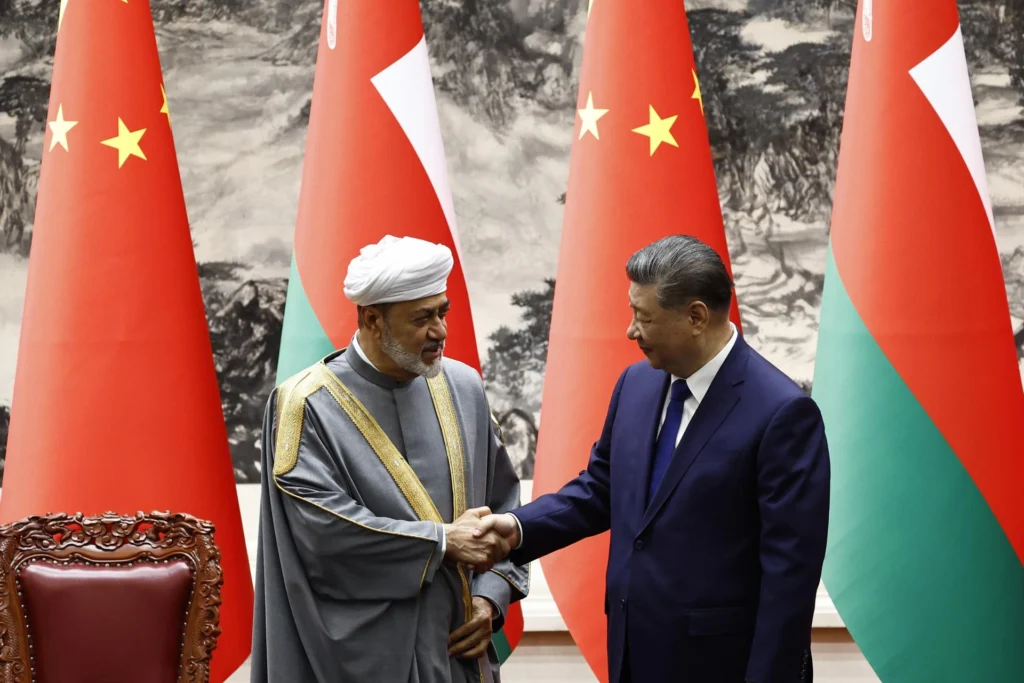
China and Oman agreed to deepen their strategic partnership during a landmark summit in Beijing, where President Xi Jinping and Sultan Haitham bin Tariq Al Said signed cooperation agreements spanning supply chains, digital finance and green energy.
The meeting marks the first state visit by an Omani monarch to the Asian giant since the two nations established diplomatic relations 48 years ago. That half-century gap gives the encounter the weight of a genuine milestone in the consolidation of a political and economic alliance.
RELATED: Global South Media Center: 4 Outlets Launch Bold New Platform in China
During the protocol talks, both leaders witnessed the signing of multiple cooperation instruments. The agreements target the development of supply chains, digital finance and green energy, three sectors where Beijing and Muscat see room to move from trade into deeper integration.
Xi called for reinforced mutual trust and broader exchanges in high technology, artificial intelligence and industrial investment. The aim, he said, is to energize commerce between the two sides and lift the relationship beyond its traditional energy focus.
🔴 مشاهد من مراسم الاستقبال الرسمي لجلالة السلطان المعظم /حفظه الله ورعاه/ بمناسبة الزيارة الرسمية التي يقوم بها جلالته إلى جمهورية #الصين الشعبية، وذلك بقاعة الشعب الكبرى في العاصمة الصينية #بكين. pic.twitter.com/JTT2EDuU0D
— Royal Oman Family (@RoyalOmanFamily) November 2, 2026
China and Oman agreed to align the Belt and Road Initiative with Oman Vision 2040 and sealed the pact with a local currency swap plus 14 agreements, deepening cooperation across energy, technology and regional security after a historic summit in Beijing.
The financial architecture behind the partnership shifted as well. The Central Bank of Oman and the People’s Bank of China signed a local currency swap agreement, a mechanism that allows the two economies to settle trade directly without routing every transaction through a third currency.
Alongside the swap came 14 memorandums of understanding and a health protocol that includes the export of Omani dates to China. The volume of signed instruments underscores how far the relationship has moved beyond its energy roots.
Economic Cooperation Expands
Technology sits at the center of the new agenda. Both nations pledged to push forward the development of artificial intelligence, digital infrastructure and AI risk governance. The accord also covers space cooperation and support for technology startups.
The BeiDou Satellite Navigation System appears in the joint framework as a concrete area of application. Beijing has promoted the system as an alternative to foreign navigation networks, and its inclusion signals Oman’s willingness to adopt Chinese technical standards in key infrastructure.
The renewable energy component extends to storage, a field where the two sides see room for joint industrial investment. Solar and wind generation, coupled with storage capacity, would help Oman diversify an economy long dependent on hydrocarbons.
The economic thrust of the declaration matches Muscat’s stated priorities. Oman Vision 2040 aims to reduce reliance on oil revenue, and the Belt and Road alignment offers capital, technology and connectivity to accelerate that transition.
The Omani delegation also stressed the opportunities for joint investment in infrastructure, tourism, education and comprehensive health.
Regional Peace Pledged
The visit also carried a clear geopolitical message. Xi Jinping stated that the Persian Gulf and the Middle East should not become stages for confrontation between major global powers. The warning carries weight at a moment when regional rivalries have drawn outside actors deeper into the Gulf.
Sultan Haitham praised Beijing’s leadership in the peaceful resolution of international disputes. He ratified his government’s readiness to consolidate commercial and cultural ties with the Asian country, signaling that Muscat intends to keep China as a central partner.
The encounter closed with a joint declaration reaffirming mutual support on sovereignty, independence and national stability. Both governments called for a peaceful resolution and a comprehensive ceasefire between United States and Iran, urging a return to dialogue and negotiations on the nuclear issue, underscoring the need to settle regional conflicts through diplomatic channels. Following this, they demanded the restoration of safe and normal navigation through the Strait of Hormuz. The waterway carries a substantial share of global crude shipments, and its security is a matter of direct interest to both Muscat and Beijing.
Both sides committed to working in coordination within the Gulf Cooperation Council to preserve the truce in the zone. That pledge ties the bilateral partnership to a broader regional framework, anchoring it in the stability of the Gulf as a whole.
President Xi Jinping held talks with Sultan Haitham of Oman.
President Xi noted that China and Oman share a longstanding friendship, which has a deep root, solid foundation, and bright prospect. In recent years, the two countries enjoy ever stronger political mutual trust.… pic.twitter.com/kZfIdDQUD2
— Mao Ning 毛宁 (@SpoxCHN_MaoNing) November 2, 2026
Both governments agreed that stronger economic ties will contribute to the stability of international commerce. They also pointed to the creation of new multilateral financing mechanisms, a nod to the infrastructure and connectivity projects that Beijing has promoted across Asia and the Gulf.
For Oman, the agreements offer a route toward economic diversification and deeper integration with Asian markets. For China, the sultanate provides a stable foothold on a waterway essential to world energy supply. The declaration signed this week gives both sides a roadmap that extends well beyond trade.
The summit consolidates a relationship built on decades of quiet cooperation and now elevated to a declared strategic level. Energy, technology and regional security now sit together on a single agenda. What began as a first visit has produced a roadmap for a much broader engagement. The agreements signed in Beijing will shape trade, investment and diplomacy between the two nations for years to come.
From teleSUR English via This RSS Feed.