

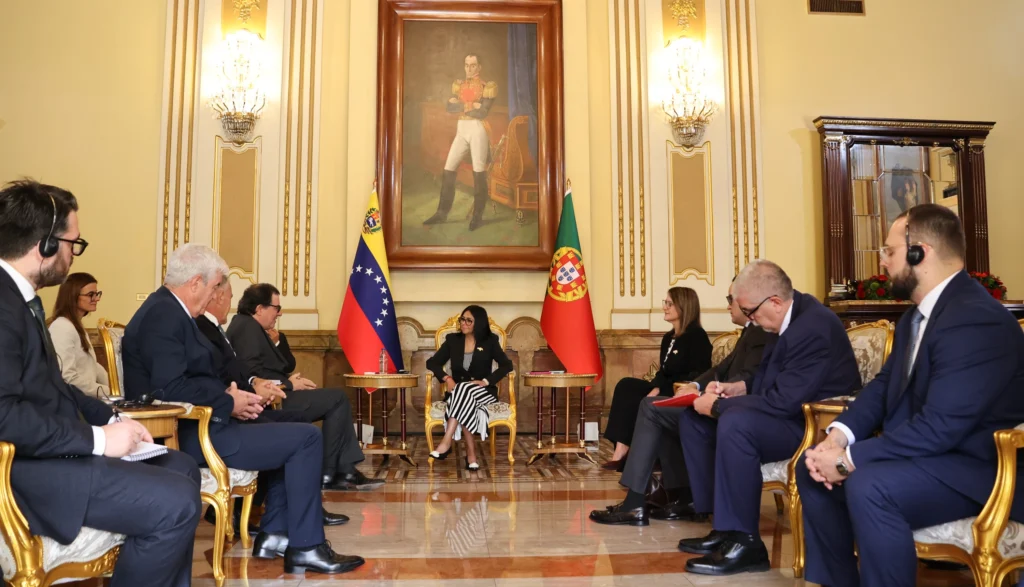
Venezuela’s Acting President Delcy Rodriguez received Portugal’s Minister of Economy and Territorial Cohesion, Manuel Castro Almeida, at Miraflores Palace on Monday to advance bilateral trade and financial cooperation between Caracas and Lisbon.
The meeting unfolded within what Caracas describes as a sovereign offensive to diversify and strengthen its strategic alliances on the international stage.
Portugal’s Minister of Economy and Territorial Cohesion, Manuel Castro Almeida, traveled at the head of a delegation whose stated purpose is to deepen commercial and cooperation links between the two countries.
RELATED: Venezuela’s Sovereignty Is Not Up for Negotiation: Acting President Rodriguez
Both authorities reviewed concrete mechanisms to expand commercial and financial exchange for the benefit of their peoples. The talks built on a relationship that both governments describe as spanning decades, although effective trade between Caracas and Lisbon has remained far below its potential.
The external financial restrictions imposed on Venezuela have constrained the country’s ability to complete transactions with European partners. Almeida’s presence in Caracas signals a shared intent to work around those constraints and restore the flow of commerce between the two economies.
The encounter also advances a wider agenda of trade and productive complementarity. Venezuela has moved steadily to restore political and diplomatic relations with governments around the world, and Portugal now figures among the European partners engaging directly with Caracas.
The visit seals a new chapter in that complementarity agenda. For Caracas, it marks another step in the reconstruction of its international standing and its commercial networks.
Ver esta publicación en Instagram
Una publicación compartida de Ministério da Economia e da Coesão Territorial (@economia_coesao_pt)
Earlier, the Venezuelan Minister of People’s Power for Foreign Affairs and International Trade, Oliver Blanco, held a working meeting with Almeida aimed at strengthening the strategic cooperation of both nations and promoting mutual economic development.
The day featured the formal participation of 37 European companies interested in expanding business alliances in key sectors such as energy, construction and technology, in a productive exchange framework that promotes technology transfer and sustainable industrial growth.
Defying Unilateral Sanction
The reception of a senior European official at Miraflores carries clear political weight. The meeting proceeded despite the unilateral coercive measures promoted by Washington and its allies, and it exposes the limits of the isolation strategy those measures were designed to enforce.
Venezuela’s foreign policy rests on multipolarity, a principle the government has defended as the foundation of its international relations. The country has worked to consolidate bridges of understanding with nations in Europe and Latin America alike, building an alternative to the unipolar order that has sought to isolate it. In this sense, the Portuguese visit advances that objective in a concrete and visible way.
Bilateral ties between Caracas and Lisbon trace back decades. What has held back commercial exchange is the financial siege restricting Venezuela’s transaction capacity, a reality that both sides now appear determined to address through closer coordination.
The encounter forms part of the deepening of political and diplomatic ties that Venezuela has sustained with foreign governments. It demonstrates that the attempts at isolation promoted from Western power centers have failed to prevent Venezuela from rebuilding its alliances.
The visit points toward deeper trade and closer political coordination between Caracas and Lisbon. The encounter leaves the door open for concrete agreements on investment and commercial exchange as the next step in a relationship both governments describe as spanning decades.
From teleSUR English via This RSS Feed.