

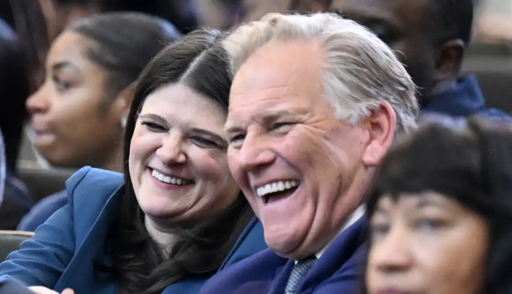
In a not-so-shocking move, Haley Stevens publicly endorsed Republican Senatorial candidate Mike Rogers. Many Democrats — including Democratic Party establishment leaders like Chuck Schumer and Nancy Pelosi — have condemned Stevens action as a betrayal of the party, especially since it hurts the chances of the Democratic Party taking control of the Senate. However, Stevens’s endorsement of Mike Rogers is part of a small but significant group of Democratic Party members who are backing Rogers because of their objection to Abdul El-Sayed’s “radicalism” and so-called “support of terrorism.” To be sure, this argument against El-Sayed was one that Haley, AIPAC, and the Democratic Party establishment utilized in the divisive primary earlier this year. While Haley committed herself to supporting El-Sayed and unifying the party after her defeat, her strong support of U.S. imperialism’s policy in the Middle East and unconditional support for Israel always placed this commitment on shaky ground.
After all, Haley Stevens, who proudly proclaims herself a Zionist Democrat, won her race against Democratic Party Andy Levin in 2022 with the support of AIPAC because of her solid commitment to the state of Israel. She was also part of President Obama’s automotive industry team and helped oversee the government bailout of that industry which demanded major concessions from the United Auto Workers union (UAW) and implemented the dreadful two-tier system that took away pensions from autoworkers hired by the Big Three after 2007. In other words, Haley Stevens’s political career has been built on securing the interests of the capitalist class. This commitment was expressed by Stevens herself yesterday, who said that her support for Rogers is a “vote for country” — not in alignment with the majorities in Michigan and the United States that denounce the genocide in Palestine and the war on Iran, but in favor of an imperialist system that relies on its relationship with Israel to maintain its economic, military, and political dominance.
Embracing Racism and Islamophobia with Open Arms
Stevens’s decision to endorse Mike Rogers weaponizes racism and xenophobia to undermine support for a candidate who is critical of the U.S.’s relationship to Israel and denounces the establishment of both parties. Rogers and Stevens both agree on the need to put “America first.” This type of chauvinism has always been a breeding ground for xenophobia and racism. Rogers has run an extremely racist and Islamophobic campaign that has sought to question El-Sayed’s allegiance to the U.S. government. He has accused El-Sayed of having ties to the Muslim Brotherhood simply because his parents are Egyptian. He has called him a supporter of terrorism because of his association with Hasan Piker and opposition to Zionism and its genocidal war on Gaza. Rogers has even tried to make an issue out of El-Sayed studying abroad — failing to mention that he went to Oxford University as a Rhodes Scholar!
Mike Rogers’s Islamophobic campaign has given space to far-right activist Jake Lang, who held a small rally in Detroit. Lang and his supporters held up “Mike Rogers for U.S. Senate” signs as they marched, spewing racist and reactionary statements and slogans outside of Cass Technical High School where people were lining up to hear Obama speak in support of El-Sayed.
Stevens has not only failed to denounce these racist and Islamophobic attacks against El-Sayed, but helped make space for them in the Democratic primary. While her campaign against El-Sayed wasn’t as overt as Rogers, she also labeled El-Sayed as “too radical” and questioned his ability to represent U.S. interests. More than anything, Stevens is worried about the Democratic Party being seen as too radical and pushing away Zionist and centrist voters. In an interview she did with CNN’s Anderson Cooper, Haley says that El-Sayed was “getting angrier and angrier” and running a campaign that was telling these voters “this is not a party you belong in.” She even compared El-Sayed to former Maine Senate candidate Graham Platner and said she “felt the same way about Platner and his Nazi tattoo.” The insinuation of course is that El-Sayed’s campaign represents extremism, which is Rogers’ argument against El-Sayed. Her reference to a pro-Palestine ad from the Rebellion PAC — which El-Sayed was quick to distance himself from — must be understood as a red herring to justify backing an openly reactionary campaign against a campaign that expresses deep discontent from below and a desire to fight back against exploitation and oppression.
No Lasting Unity Between the Center and the Left
It would be a mistake to view Stevens’ concerns as just her own. They are the real concerns of the Democratic Party establishment, which has made it clear that it will fight to sideline the Left inside the party and uphold the class character of the Democratic Party as a party of capital. While the Democratic Party establishment condemned Stevens for her endorsement of Rogers and even removed her from an El-Sayed election rally for her public criticisms of him, it should not be assumed that the party’s establishment and the Left have “unified.” The establishment Democrats are embracing El-Sayed in ways they are not embracing Florida Dem Senate candidate Angie Nixon because Michigan is a swing state and El-Sayed has shown his willingness to work with the establishment and embrace more centrist politics. The most prominent examples of this are his meeting with Kamala Harris, his public support for capitalism, and his rejection of defunding the police.
Stevens’s defection shows that sectors of the Democratic Party will side with the Right rather than cede space to campaigns that challenge to some degree a status quo in which capitalists are free to profit while working people can’t make ends meet, billions of dollars are sent to support genocide and imperialist war, and immigrants are targeted for deportation and detention using the most violent xenophobic rhetoric. The Democratic Party exists to keep capitalist profits flowing and U.S. imperialism dominant while mediating discontent from below. Whether El-Sayed wins or not on Tuesday, he and other other progressive populist candidates face this opposition from within their own party. This spells trouble for their ability to push their agenda through Congress, and for a strategy that relies on an imperialist party to make gains for the working class and oppressed.
The most troubling thing about Stevens’s endorsement of Mike Rogers is that it potentially strengthens the Trump administration’s offensive against the working class and oppressed. This open crisis and rift within the Democratic Party could allow him to recuperate lost momentum and go on the offensive against the “extremism” of the Left and the movement that has opposed his reactionary and authoritarian agenda. This is why it is crucial that — regardless of what happens on Election Day — the Left make it our top priority to build institutions of self-organization based on our schools, our workplaces, and our communities to organize a bottom up movement against Trump and the Right. We also need to be serious about building a party for the working class and oppressed that helps organize class struggle and fights uncompromisingly for our demands.
The post Haley Stevens’ Endorsement of Republican Mike Rogers Signals Deep Divide within the Democratic Party appeared first on Left Voice.
From Left Voice via This RSS Feed.