

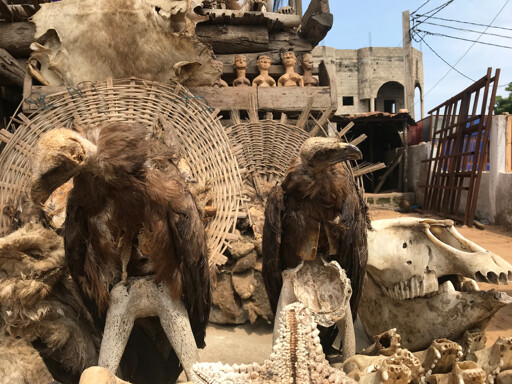
One of West Africa’s largest markets selling wildlife for belief-based uses has expanded rapidly over the past decade, according to a recent study. Researchers surveyed the Akodessewa Fetish Market in Lomé, Togo, between 2022 and 2024 and found a booming trade in both live and dead birds and their parts. They registered more than twice the number of stands selling wildlife and more than four times the number of bird species compared to surveys conducted in 2016. In total, 82 bird species from 36 families were on offer. “When you look at the amount of wildlife available in West Africa, the market should have gotten smaller,” Nico Arcilla, co-author on the paper and president of the International Bird Conservation Partnership, told Mongabay. “But instead, it’s the opposite. It’s more than doubled in size.” Hornbills were the most traded bird group, while barn owls (Tyto alba), northern white-faced owls (Ptilopsis leucotis), double-spurred spurfowl (Pternistis bicalcaratus) and black kites (Milvus migrans) had the most individuals on sale. The study found that the larger the bird, the more likely it was to be sold. Species whose sale is listed by CITES, the global wildlife trade treaty, as either restricted or regulated also appeared more frequently. This is a troubling sign that restrictions are not disrupting trade, said Arcilla. All traders at the market were from Benin and from the Fon ethnic group. Threatened species, including birds presumed to be extinct in Togo, were also found to be on offer. This included the Yellow-casqued…This article was originally published on Mongabay
From Conservation news via This RSS Feed.