

By Guy Feugap, World BEYOND War’s Africa Organizer, November 1, 2026
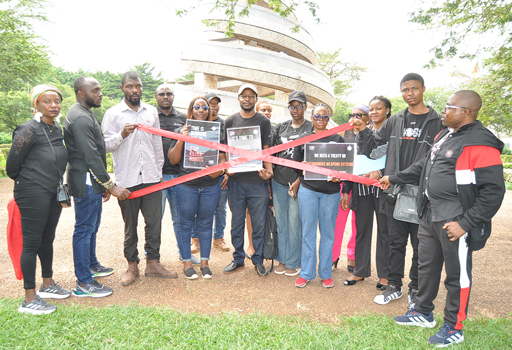
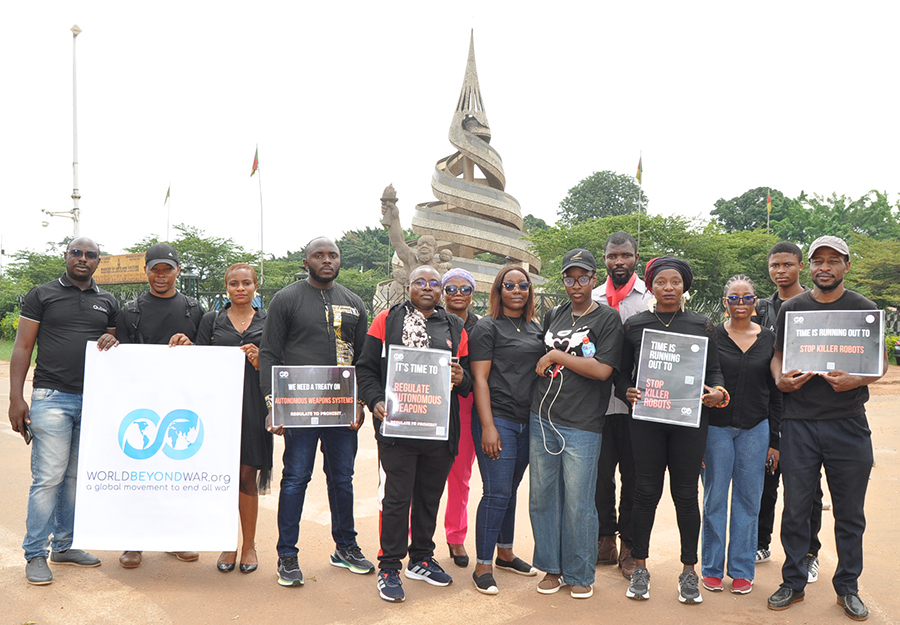
As part of the Stop Killer Robots campaign’s Global Week of Action from October 25 to 31, 2026, the Cameroon chapter of World BEYOND War organized a photo action at the Reunification Monument in Yaoundé. This event, held at this symbolic site representing Cameroonians’ aspirations for peace, aimed to draw public attention to the dangers of autonomous weapons and the need to encourage the country to maintain its position and call on other states to permanently ban autonomous weapons. This event is part of a global campaign leading up to the Seventh Review Conference of the Convention on Certain Conventional Weapons (CCW), scheduled for November 16–20, 2026, in Geneva.
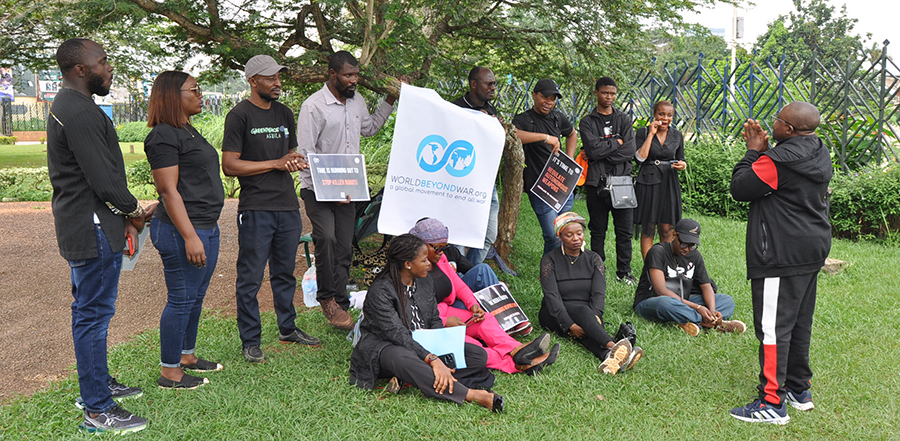
Through this symbolic action, World BEYOND War members in Cameroon are drawing attention to an issue that has now moved beyond the realm of science fiction: the development of weapons systems capable of autonomously selecting and attacking targets. For the members, it is essential to ensure that technological advances do not compromise human life or the fundamental principles of international law; no technology, even when controlled by a human being, is acceptable if its purpose is to kill human beings. Using campaign posters, the participants helped bring to light a major threat to peace, security, and the protection of human life. Beyond the photography, this event was an opportunity to educate chapter members and raise awareness among passersby about the ethical, legal, and humanitarian issues surrounding autonomous weapons, while emphasizing the importance of civic engagement including through signing the Stop Killer Robots campaign petition.

The urgency of this mobilization is underscored by reports of testing and use of autonomous weapons systems in armed conflicts, particularly in Ukraine. The Stop Killer Robots campaign highlights systems capable of autonomously detecting and killing people. It also highlights the use of military tools based on artificial intelligence to propose targets with minimal human validation, like in the contexts of Gaza. Not all of these tools are necessarily autonomous weapons, but they illustrate the risks associated with the increasing automation of military decision-making. When automated systems are deployed in this way in conflicts, it becomes essential to determine how to ensure that no new weapons are produced and put into circulation. The time for debating the technical possibilities of artificial intelligence in the military sphere is over. It is time to establish legally binding international rules to prevent harm and protect humanity from the consequences of autonomy in weapons systems.
The Seventh Review Conference of the Convention on Certain Conventional Weapons, to be held November 16–20, 2026, in Geneva, presents an opportunity for States to turn several years of diplomatic discussions into concrete negotiations. The Group of Governmental Experts on Lethal Autonomous Weapons Systems, having completed its latest mandate to develop the elements of an international instrument, has seen more than 70 states, as well as the United Nations Secretary-General and the President of the International Committee of the Red Cross, acknowledge that the work accomplished provides a sufficient basis to begin negotiations. Furthermore, 130 countries have expressed their support for a legally binding instrument on autonomous weapons systems. In this context, Stop Killer Robots calls on States Parties to adopt, at the Review Conference, a mandate to negotiate a new protocol to the Convention in 2027, with the goal of concluding negotiations within one year. If no agreement is reached in Geneva to launch negotiations, the campaign urges states in favor of legally binding regulations to consider other diplomatic avenues to ensure the process is not stalled.
Cameroon already supports a legally binding instrument
Cameroon’s position is of particular importance in this effort. As a State Party to the Convention on Certain Conventional Weapons and a member of the African Group and the Non-Aligned Movement, Cameroon supports the negotiation of a legally binding instrument on autonomous weapons systems. During the March 2026 session of the Group of Governmental Experts, Cameroon noted that the work carried out had led to significant progress and that the evolving text constituted an excellent basis for negotiations toward the adoption of a legally binding instrument. Furthermore, in December 2025, Cameroon voted in favor of United Nations General Assembly Resolution 80/57 on lethal autonomous weapons systems. This resolution underscores the urgency of addressing the humanitarian, legal, security, technological, and ethical concerns raised by these systems. These positions serve as an important foundation for strengthening Cameroon’s diplomatic engagement in Geneva.
As the Review Conference approaches, World BEYOND War Cameroon joins civil society in calling on the Cameroonian government to maintain and strengthen its support for the launch of negotiations on a legally binding instrument. The chapter also encourages other States Parties to the Convention to support a negotiating mandate and to ensure that the instrument to be negotiated simply bans autonomous weapons. The action taken at the Reunification Monument served as a reminder that the issue of autonomous weapons calls upon our responsibility to protect human life and maintain peace. World BEYOND War Cameroon’s message is that states must abolish autonomous weapons systems, because human control does not guarantee that human lives will be saved.
The post It’s Time to Ban Autonomous Weapons appeared first on World BEYOND War.
From World BEYOND War via This RSS Feed.