

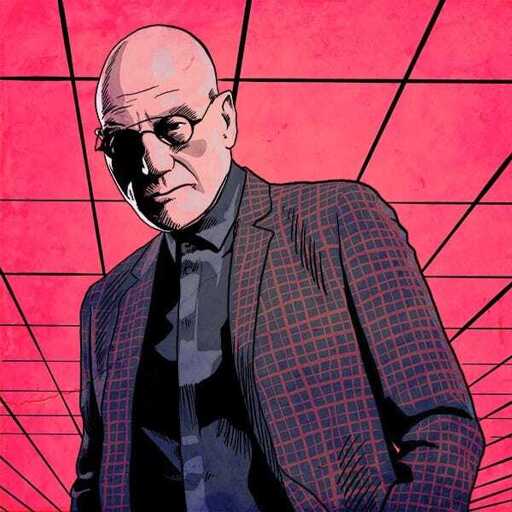
J. Andrew World is the ridiculously talented artist who makes all of the images for this Substack, and for my podcast Give Them An Argument. I’ve spent a huge portion of the last few days watching the stream of Patrick Stewart clips people have been posting, and I have very little to add to Andy’s reflections here, except to say that (i) he’s not wrong about my mixed feelings about the “War Pigs” detail and (ii) I heartily approving of head-butting Charles III.
There isn’t a time in my life when Star Trek wasn’t a part of it. My earliest memories are of watching classic Star Trek before church. While others might have gotten some value from Sunday School, I got more out of the lessons of Captain Kirk and his crew.
Kirk captured my imagination. I wanted Spock to be my friend. And I was invested in all the other characters. Except for Bones. I didn’t appreciate him until I was an adult.
When I was 10, Star Trek: The Next Generation began. While I wanted to be Captain Kirk, Captain Picard was something different. He wasn’t something I wanted to be, but the type of leader I could look up to. The ideas of respecting humanity and finding solutions while avoiding conflict were a better ideal than the Wild West of the original series. Talking about Starfleet policy on the bus to High School certainly didn’t make me popular, but it was where I was beginning to see what was wrong with American foreign policy.
Imagine living in rural Texas when the Gulf War began. Despite all the propaganda, something bothered me about the war that I couldn’t articulate when I was 13. I locked myself in my bed room and listened to War Pigs over and over. (And to Ben’s disappointment, it was the Faith No More cover. It was also on cassette, so I had to constantly rewind the tape.)
If I could not be any more nerdy, in the 8th grade I found a dollar, and with that dollar, I bought an issue of Uncanny X-Men. I was instantly hooked. The series taught me the values of acceptance and respecting other people’s identities.
While reading comics and watching Star Trek, I knew I was never going to be cool, but X-Men also gave me a sense that I belonged somewhere. That my people were out there, and when family fails you, a found family can sometimes be even better. In the alienation of adolescence, this idea helped me find that space and my people.
I was an adult when Patrick Stewart took on the role of Professor X in the movies, and while the films didn’t always contain everything that made the comics great, they had just enough.
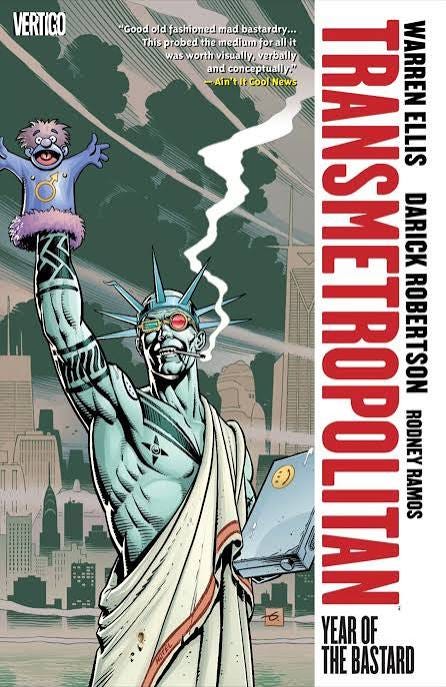
Transmetropolitain is a book that shaped my early 20s. If you never read the comic, it was set in a cyberpunk, transhumanist world about a brash, renegade, gonzo journalist named Spider Jerusalem, who helped what he thought was the lesser of two evils win an election, and the person who appeared to be the lesser evil turned out to be the greater evil, and he used journalism to take him down.
Patrick Stewart was a huge fan of the book and told this story: when he was knighted, he asked himself, “What would Spider Jerusalem do?” and then he thought, “head-butt the Queen.” While that is the appropriate answer, he thought that would be a bad idea.
While head-butting the Queen is probably not something Ben Burgis would approve of, mostly because it would involve desecration of a grave, and that’s probably not something he supports, Transmetropolitan, in extension, Patrick Stewart, taught me not to keep my mouth shut when it matters. (I should ask what Ben might think if I head-butted the King.)
Art isn’t a replacement for theory. However, reading it and making it can be a way to understand and wrestle with the ideas of theory. My wanting to understand foreign policy led me to eventually find Michael Brooks. The empathy I learned from the pages of the X-Men led me to work on the graphic novel APB: Artists against Police Brutality and fight for trans rights.
While Patrick Stewart didn’t write lines like, “The first time any man’s freedom is trodden on, we’re all damaged,” his delivery of that line made it real to me in a way any great actor can. Part of what has always made Star Trek great is how they take ideas and moral dilemmas from philosophy, and use that to tell a story. Those ideas are, in part, what has drawn me to Ben Burgis’s project.
In a round about way, I wouldn’t be drawing my illustrations or working with Ben Burgis if it was for the projects that Patrick Stewart, worked on.
I’m not a socialist because of his performance as Lenin in 1974’s Fall of Eagles, but because of the values that Star Trek and the X-Men made me think about. Patrick Stewart will forever be a part of that legacy.
Philosophy for the People w/Ben Burgis is a reader-supported publication. To receive new posts and support my work, consider becoming a free or paid subscriber.
From Philosophy for the People w/Ben Burgis via This RSS Feed.