

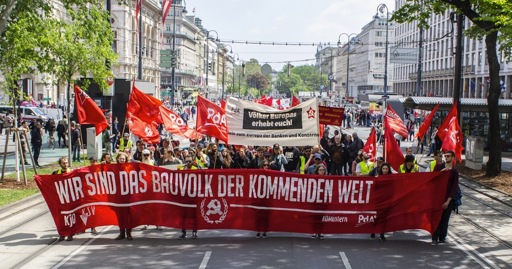

Commentary published in Zeitung der Arbeit, Organ of the Party of Labour of Austria (PdA), on 1 November 2026 under the title “Raus aus der EU!”:
By Lukas Haslwanter*
Even a quarter of a century after the last World Savings Day of the schilling era, nostalgia for Austria’s former currency remains widespread, as sociologist Klaus Kraemer explained to Austria’s public broadcaster ORF on Saturday.
But this sentiment reflects more than nostalgic memories: it also expresses legitimate concerns about the economic future. And hardly without reason. The capitalist crisis, high inflation, rising rents, relentless attacks on the welfare state and years of declining wages have left their mark on people’s lives.
On the contrary, what they once regarded as secure is being systematically dismantled, piece by piece, in the interests of capital. Neither a return to the schilling nor simply withdrawing from the European Union can resolve these problems. What is needed is the organized economic and political struggle of the working class against the dictatorship of the banks and corporations.
On 31 October, World Savings Day was observed once again. For generations, children in Austria have been taught that saving money is the key to prosperity and security. Particularly during the competition between capitalism and socialism, this promise also served to portray capitalism as a system capable of guaranteeing prosperity for everyone.
The latest wave of price increases has exposed just how little remains of that promise. While inflation at times reached double digits, interest rates on savings remained far below that level. Even government-subsidized home savings schemes failed to compensate for the loss of purchasing power. Those who saved money actually saw the real value of their savings decline.
Nevertheless, World Savings Day remains a tradition that many people remember from the days when Austrians still paid in schillings and groschen. Twenty-five years ago, the last World Savings Day was held before the euro was introduced as Austria’s currency on 1 January 2002.
Yet although schilling banknotes have long since disappeared from circulation, the desire to return to the old currency has by no means vanished. According to a representative survey conducted by the Institute of Sociology at the University of Graz, 42% of respondents would like Austria to have its own national currency again.
Speaking on ORF Styria’s Saturday Conversation programme, sociologist Klaus Kraemer explained that this attitude reflects much more than simple nostalgia. For many people, the schilling remains a symbol of economic stability, security and, above all, stable prices. Memories of the former currency therefore also express a profound sense of uncertainty about economic developments and the future of the eurozone.
These concerns are anything but unfounded. Working people have every reason to fear for their living standards in the face of rising living costs, high rents, stagnant real wages and an increasingly uncertain economic future. The real question, however, is where the causes of these developments lie and what conclusions should be drawn from them.
The schilling was not a working-class currency
The notion that restoring the schilling would also restore economic security and social prosperity does not withstand closer examination. After all, capitalism prevailed in Austria during the schilling era as well. Factories, banks and major retail corporations did not belong to those whose labour created society’s wealth, but to the capitalists. Workers were exploited then, too, and unemployment, poverty and social inequality were equally present.
Nevertheless, the economic and social conditions of the postwar decades differed considerably from those of today. At that time, capitalism faced direct competition from the socialist states of Europe. The existence of these states altered the balance of forces between capital and labour even within capitalist countries.
A powerful workers’ movement placed the ruling classes of Western Europe under pressure. They were forced to make concessions while simultaneously attempting to create the impression that capitalism could guarantee prosperity and social security for all.
Yet the social and political achievements of those decades were not the product of some harmonious community of interests or of class collaboration. They were the result of class struggles fought under fundamentally different historical conditions.
As the socialist states entered an increasingly severe crisis from the 1980s onwards, Austria also began gradually dismantling social achievements. The first changes to the pension system were introduced as early as 1985, followed by further cuts in 1988. Social benefits and allowances were restricted, while the privatization of nationalized industries was accelerated, setting in motion a process accompanied by rising unemployment and the relocation of production abroad. Unemployment also increased significantly.
The attacks on the social rights of the working class therefore began well before Austria joined the EU in 1995, and long before the introduction of the euro.
This trend continued throughout the 1990s. Further pension reforms, cuts to family benefits and continuing privatizations characterized government policy. From 2000 onwards, the conservative–far-right coalition government of Wolfgang Schüssel and Jörg Haider intensified this course considerably.
The dismantling of social protections was therefore not an invention of the European Union. It was actively pursued by Austrian governments and domestic capital themselves.
When many people today associate the schilling with economic security and social prosperity, they are primarily thinking of the decades between 1945 and the late 1980s. What is often forgotten is that the dismantling of those conditions had already begun while the schilling was still in circulation.
Many of the cuts took effect only gradually, while their social consequences are now felt far more acutely by young people, industrial and service-sector workers, salaried employees, pensioners and many others.
The economic concerns of working people cannot, therefore, be reduced to the introduction of the euro. Food, energy and housing are not becoming increasingly unaffordable because people pay for them in euros, but because, under capitalism, essential goods and services are commodities from which profits are extracted.
Whether retail corporations calculate their profits in euros or schillings is ultimately of secondary importance to their poorly paid employees. What matters is that social production remains subordinated to the pursuit of profit by a small minority.
Returning to the schilling would change nothing fundamental about this situation. It would neither break the power of the banks and corporations nor put an end to the exploitation of wage labour. Even an independent Austrian monetary policy would remain subject to the contradictions and crises of the capitalist economy as long as capitalist relations prevailed.
The EU is not a mistake, but an alliance of capital
The fact that returning to the schilling offers no solution does not mean, however, that the European Union should be defended. Quite the opposite: the Party of Labour of Austria explicitly demands Austria’s withdrawal from the EU.
Our criticism, however, is not directed merely at the euro, individual regulations or the bureaucracy in Brussels. It concerns the fundamental character of the European Union as an imperialist alliance of capitalist states serving the interests of European monopolies, banks and corporations.
The EU is not an originally progressive project for peace and social welfare that has somehow strayed from its intended path because of misguided political decisions. European economic integration was driven primarily by the interests of big capital.
The single market, the free movement of capital, European economic and monetary policy, and the various mechanisms used to enforce budgetary discipline are all integral components of this capitalist integration.
While working people are repeatedly told that there is no money for higher wages, better pensions, public healthcare or affordable housing, billions are being mobilized for rearmament. European corporations benefit from a common economic area, while the working class is subjected to competitive pressures across national borders.
It would be wrong, however, to shift responsibility for the present situation exclusively onto Brussels. The Austrian bourgeoisie is no innocent victim of foreign powers.
Austria’s banks, industrial corporations and retail groups are themselves beneficiaries of European capitalist integration, as demonstrated by their activities in EU countries and the Balkans. Austrian governments have supported the relevant decisions and represented the interests of domestic capital within the EU.
Out of the EU — but not back to the schilling!
For the Party of Labour of Austria, the demand for the country’s withdrawal from the EU is therefore inseparably linked to the struggle against the rule of capital.
In its statement on the 2024 European Parliament elections, the PdA declared:
“Illusions that the EU can be reformed in a social, democratic and pacifist direction are unfounded. Its anti-worker and anti-people character is firmly entrenched, and its institutions are structured in an undemocratic and antisocial manner. The EU must be dismantled as an entire apparatus. The Party of Labour therefore stands for Austria’s withdrawal from the EU, in order to regain democratic sovereign rights and intensify the class struggle against our principal enemy — Austrian capital.”
This is the decisive difference between our position and all those approaches that regard withdrawal from the EU as a sufficient solution in itself.
Breaking away from the EU does not automatically abolish capitalist exploitation. Nor does it, by itself, create social justice or economic security. As long as economic power remains in the hands of the capitalists, their profit interests will continue to take precedence over the needs of working people.
The only way out of this predicament is the struggle for people’s power and socialism, for the abolition of capitalist exploitation and the organization of the economy according to the needs of working people.
In a socialist Austria, the decisive means of production, banks and major enterprises would no longer serve the private enrichment of a small minority. Instead, social production would be organized on the basis of collective ownership and central planning, with the aim of meeting the needs of the population.
The decisive question would no longer be what financial return an investment could generate, but what social purpose it would serve.
Housing would be built because people need a roof over their heads, not because property corporations expect substantial profits. Food would be produced and distributed to ensure that the population is adequately supplied, not to maximize the profit margins of retail monopolies.
Economic development would no longer be determined by the interests of capital owners, but by the needs of working people.
Such a society, however, cannot be brought into existence simply by changing currencies or passing a resolution to withdraw from the EU. It requires organized class struggle and the overthrow of the political power of the bourgeoisie.
It is not the currency that must change, but the ruling class!
The results of the Graz survey demonstrate that the desire for economic stability and security is widespread in Austria. This desire is both understandable and legitimate.
People have every reason to demand a society in which they do not have to live in constant fear for their livelihoods, jobs, homes or futures.
Yet the security that so many people long for cannot be restored by bringing back an old currency. Nor can it be guaranteed through supposedly more socially responsible management of capitalism.
Economic crises, exploitation and social insecurity are not merely unfortunate deviations or policy failures. They arise from the fundamental contradictions of the capitalist mode of production.
The decisive question, therefore, is not whether banknotes bear the word euro or schilling. It is who owns the banks, factories, retail chains and means of production — and which class holds political power.
The Party of Labour of Austria fights for an Austria outside the European Union, but not for a return to the Austria of past decades.
Its goal is not a more independent Austrian capitalism, but a socialist Austria in which the working class itself determines the country’s economic and social development.
* Deputy Chairman of the Party of Labour of Austria (PdA)
From In Defense of Communism via This RSS Feed.
Socialist Australia could change the world.